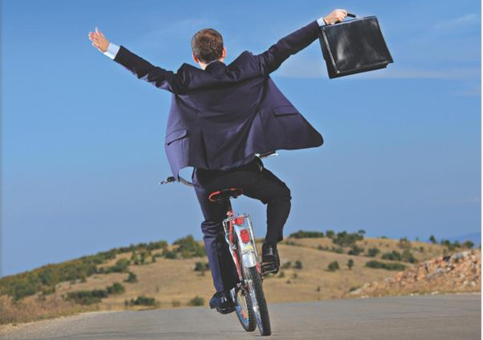
Calamity Jane

What would you do if you were visiting in another city, fell and broke your front teeth? And what if it happened in the evening and on a weekend? Well of course you would try and find a dentist. Unfortunately though, it’s not that easy.

A friend of ours related the story of her friend who encountered this very calamity. She was carrying a platter of meat at dinner time from the common outdoor grill in the condo where she was staying, tripped on a step and did a face plant. In the process she broke her top teeth and actually pushed one of them back at a 45-degree angle. Needless to say, she was in a lot of pain. A dentist lived in the condo building but wasn’t home, so she began calling dental offices in the city. She made contact with approximately 30 practices – presumably it was answering service in each case. Only one dentist called her back.

He was a young man and told her to meet him at his office at 8:30 that evening. When she arrived he opened the office and proceeded to make the necessary dental repairs. She thanked him profusely and his reply was the clincher. “I only hope that if my wife was ever in another city and had this happen, that someone would help her.” I have no idea whether the other 29 dentists even were notified by their answering services so I’m hesitant to make any judgments here. Suffice it to say that she only needed one dentist to respond, and one did.

This dentist clearly displayed an attitude of service. While it may seem like a rather obvious thing, our perception of medical service providers as compassionate and caring isn’t always accurate. Actually, this can be said about most professions and industries. Too often in too many fields, practitioners are focused less on their customers and more on other objectives. Does this person have insurance? Will this person become a repeat customer? I’m busy. Someone else will handle this. I just finished a 12-hour day and I’m too tired. Get the picture?

At what point do we put the needs of the customer ahead of our own? Do we do this only when it is immediately profitable to do so? A lot of businesses apparently have adopted this philosophy. Or, do we believe in serving every customer, client, patient, etc. as we would want to be served? This is a very uncomplicated subject. We either serve or we don’t. It’s totally our choice. But there is a natural law at work here. For when we do good for others, good comes back to us in greater and greater abundance.

As entrepreneurs, the rewards are enormous for putting the needs of others ahead of our own. When service comes first the profits will be bigger than we ever could expect.

This blog is being written in tandem with my book, “An Entrepreneur’s Words to Live By,” available on Amazon.com in paperback and Kindle (My Book), as well as being available in all of the other major eBook formats.
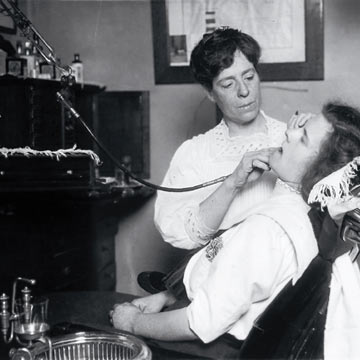
Dentist

Disruption

What do World Book Encyclopedias, the Sony Walkman, public pay phones, cassette tapes, flopping disks, Palm Pilots and manual typewriters have in common? OK, I realize it’s an easy question – they are all obsolete products. But the real question is why they became obsolete in the first place. You may be thinking, “Other more advanced products came along and replaced them.” True again. But why didn’t the makers of these products create newer and more advanced versions? And therein lays the dilemma. I’m going to make a sweeping generalization here to prove my point – and the individual situations may have been more complex than I am purporting. The bottom line – there was a failure to embrace change and a desire to embrace the status quo.

For many people change is scary. It’s filled with uncertainty and risk. Think of all the businesses you know about that have adopted the philosophy, “If it ain’t broke, don’t fix it.” Yet, maintaining the status quo is actually falling behind. Why? Because we’re in a highly competitive age where information flows more quickly and more substantively than at any time in history. Someone is always looking for a better way to do everything all the time. What steps should we take to avoid becoming the next World Book?

Step One. Constantly stay in touch with the customer. We need to mine every customer interaction for the data that can be produced. And we need to create customer interactions outside the regular purchasing process through surveys, focus groups, etc. What do our customers like about our product or service? What don’t they like? What do they like and dislike about our competitor’s product or service?

Step Two. From our ongoing customer feedback process we can continuously fine tune our product or service offering with incremental improvements. This enables us to keep from falling behind in the competitive race.

Step Three. In addition to staying in touch with the customer we should also be totally immersed in what is happening within our industry. Trade publications, conferences, blogs and ongoing relationships help keep us on top of trends, opportunities and threats.

Step Four. This one is the biggie. We can make a choice as to whether or not to be a disruptor or be the disrupted. A disruptor is an innovator who turns an industry on its head with a radical idea. Those who choose to stick with what they are already doing are vulnerable to becoming a victim of this marketplace disruption. Some industries rock along for years with little or no disruptive innovation. In others (technology, for example), disruption occurs daily. Even if we don’t create a huge and splashy disruption of some sort, the fact that we continue to try and do so will often be enough to keep us on the cutting edge.

One of the most prominent disruptors of our time is Sir Richard Branson of the Virgin Group. He has a mindset of looking at various industries and seeing an opportunity to innovate. Then he does it. Often it works – sometimes it doesn’t, but few can argue the success he has had with more than 400 companies.

Resting on the laurels of success is a dangerous game. I imagine at one point in time Walkman sales were off the charts and the folks at Sony were feeling pretty good. And then, BOOM, the ride is over. It’s important to keep our foot on the metaphorical gas pedal. Keep marketing no matter what. Build a backlog. Take the utmost advantage of good times. But . . . always remember and practice Steps One through Four. It’s the best vaccination for obsolescence.

This blog is being written in tandem with my book, “An Entrepreneur’s Words to Live By,” available on Amazon.com in paperback and Kindle (My Book), as well as being available in all of the other major eBook formats.

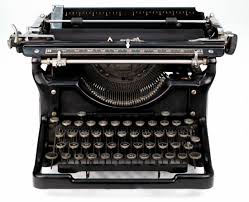
manual typewriter