
The Bus Driving Entrepreneur

Here is a scenario. Sales are flat. The product development team is feuding with the marketing folks. Production is lagging and customer complaints are trending in the wrong direction. Sounds like a nightmare situation – right? It’s at a time like this that makes us wonder why we became entrepreneurs in the first place! As we try to sort out this mess, something becomes quickly apparent. We have the wrong people on the bus.

The whole problem would not even exist if we had selected the right people in the first place. But for most of us, we are where we are and must deal with an unwise hire here and a hopeful hire there. Rarely do we make the right hiring decisions from the get-go and find smooth sailing forevermore. Something I have grappled with for decades is when to change out the people on the bus – and sometimes the bus driver to boot! The mistake I have made over and over has been to give people too many chances and believe that if I just find the “right slot” for someone, that I can “save” him or her. In recent times I’ve come to realize that we’re not in the business of doing social work and it does no favor to someone who is miscast to continue to try and salvage them.

Most of us have a level of empathy that prevents us from being Donald Trump in his old Apprentice days . . . that is to simply say, “You’re fired!” But there is undoubtedly a middle ground. We do not have to have a hair trigger and instantly terminate someone who is beginning to struggle. And we also do not need to continue to enable someone for months or even years who cannot get the job done.

As with much about entrepreneurship, there is a process that can make the decision to invite someone off the bus both humane and timely. We start with clear written roles and accountabilities. It’s imperative that our team members truly understand what is expected of them. Roles and accountabilities should be quite comprehensive, and they must be measurable. We also must make sure that our team members understand how to perform their roles and accountabilities and that they have the proper resources to succeed. If I tell a non-pilot that he is responsible for flying a passenger jet from New York to LA I can be very clear about this. But if he is not trained to fly the plane, then it will either fail to get off the ground or if it does, well, what happens might not be pretty. I realize that this is a bit of an exaggeration, but it illustrates the point.

Hand in hand come key performance indicators. These are the metrics by which we determine if the roles and accountabilities are being sufficiently executed. Ongoing performance reviews are also an important element of ensuring that the right people are on the bus. Some companies do an annual performance review. This may be fine in a formal sense, but team members need a continual feedback loop. Then there will be no surprises when the annual review is performed. It is also helpful (and often judicious) to offer a written assessment as part of the continual feedback process. It’s not so much to build the file as it is to make sure that everyone is on the same page regarding where improvement is needed.

Often when things are going poorly, it’s the result of a lack of roles and accountabilities; or a lack of training; or a lack of proper resources to get the job done; or a lack of measuring results; or a lack of team member feedback, or all the above. When this happens and we must make a change in personnel, we dread having to act. Why? Because we know deep inside that we probably did not do everything necessary to be completely fair with our team members.

Ensuring that we have the right people on the bus is a strong step toward building a successful culture and producing the results we desire. And following a well-designed process to invite people off the bus who are not the right fit will allow us to act objectively and at the right pace.

This blog is being written in tandem with my book, “An Entrepreneur’s Words to Live By,” available on Amazon.com in paperback and Kindle (My Book), as well as being available in all of the other major eBook formats.


The Tale of Two Entrepreneurs

This is a true story about two entrepreneurs – one who is doing it right, and the other who is not. Allow me to set the stage. One of our business units is in the venture capital space. We invest in early-stage companies that operate in agriculture, animal health, and human health verticals. Some might call us seed-stage or angel investors. Often, we are making investments in companies that are pre-revenue or are just starting to generate revenue from their product or service. So, evaluating such opportunities has a lot to do with our assessment of the founder(s) and whether they are competent and have a strong moral compass.

Two companies in our portfolio offer a terrific contrast in competency and integrity. The first company – we’ll call it Company A – is doing all the right things. The founders have a novel idea in the agriculture space that they turned into a real company that is achieving real traction. It is on track to breakeven within the next 12 to 18 months and should become quite profitable as it continues to scale. The team is focused on keeping operating expenses in line and has lowered the cost of producing the product it sells. One thing we are especially pleased with is the level of transparency that the founders exhibit. They communicate regularly with the investors and what they report is substantive and meaningful. If they have experienced a hiccup, they say so. If they achieve a milestone, they celebrate. They are receptive to our suggestions and practice good corporate governance operating with a real board of directors.

Unfortunately, Company B is at the other end of the spectrum. The founder talked a good game when we did our due diligence – and we believed this person. But things unfolded much differently than we anticipated. Shortly after we made our investment, the founder pivoted away from the initial thesis which had attracted us in the first place. The enterprise approach that convinced us to invest was abandoned and the team began focusing on a different one-off kind of model that produced a fraction of the revenue. We have board observer rights, which means that we are entitled to attend all board of directors’ meetings so that we can see firsthand the decisions that are being made. Much to our surprise some decisions that should have been made in a formal board meeting were handled by a board teleconference that we didn’t even know about. And the board of directors, in our opinion, wasn’t a “real” board with independent directors that were performing their fiduciary duties.

Company B’s founder increased his/her salary to a level that is outrageous for a company at this stage. In fact, the Annual Recurring Revenue (ARR) for this company at the time I write this is equal to one month of its cash burn! Most founders at this early stage would be reducing their salary rather than increasing it. Meanwhile, we get weekly e-mails from the founder bragging about how many new customers they added or onboarded during the past week. But this communication is all fluff and B.S. because each customer hardly moves the needle in terms of revenue.

Company B’s founder somehow continues to find ways to convince new investors to throw more money into the pot to keep the company alive. We do not understand what these investors see in this company’s business (or its founder) that shows a clear path to success. At some point the music will stop and Company B will cease to exist, but its founder will have profited handsomely with an exorbitant salary.   

Here are the lessons learned for entrepreneurs. Smooth talk may work for a while (Company B), but eventually solid performance and strong results (Company A) must prevail. Communication is a virtue but only if it provides full transparency sans fluff and B.S. Investors value good ideas and great entrepreneurs. A great entrepreneur has the integrity to always do the right thing even in the face of adversity.

We hope that the founders in Company A eventually have a successful exit where they and their investors (including us!) make a lot of money. And then we hope these founders will start another company. We’ll stand in line to invest in them again.

This blog is being written in tandem with my book, “An Entrepreneur’s Words to Live By,” available on Amazon.com in paperback and Kindle (My Book), as well as being available in all of the other major eBook formats.
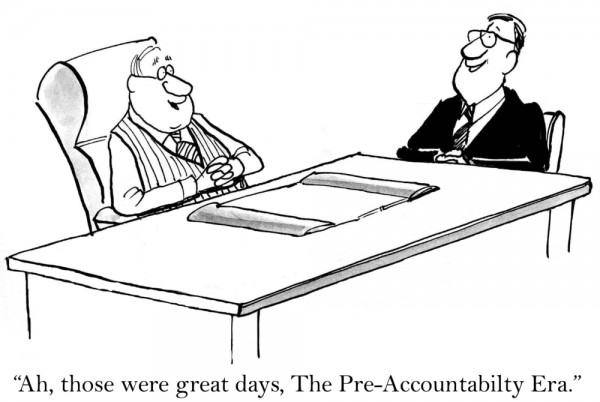
The Accountable Entrepreneur

Here’s a term you’ll hear a lot in the entrepreneurial world – accountability. In our organization every team member has written Roles and Accountabilities. There is a lot of talk in the business world about holding people accountable. So, exactly what does all this mean?

There are some leaders who are confused and think that accountability is a binary choice. They boil it down to believing that either someone keeps their job, or they don’t. In other words, if someone doesn’t perform in satisfactory fashion the only option is to fire him/her. Otherwise, there’s no way to hold that person accountable. Fortunately, this is a misconception – there are many different aspects to accountability.

In some cases, performance issues may be the result of a team member not fully understanding what is expected of him or her. The solution is simple. That person obviously needs further clarification of his/her role. This can be accomplished by making certain that the position description is comprehensive enough followed by a meeting to clarify the expectations and gain an acknowledgement by the team member as to his/her understanding.

Perhaps a team member is struggling to perform in a satisfactory manner because he or she isn’t adequately trained or properly equipped. The leader must make this determination fairly and then prescribe the antidote. In this situation it’s important to understand exactly which elements of the position the team member need re-training. After the re-training takes place, it might be wise for the team member to take a test of some sort to make certain that the training has been effective. Part of the analysis needs to be ensuring that the team member has the proper tools and/or resources to do the job. It’s unfair to hold someone accountable if the company hasn’t done its part in this regard.

I remember in my earlier days as a property manager, encountering difficulties getting a certain maintenance person to perform. He should have been able to close out many more job tickets than he was. I made sure that he understood his role, was properly trained and had the right equipment. After doing so, I began to suspect that he didn’t have good organizational skills. Rather than hand him multiple job tickets, I began doling them out one at a time. When he finished one, he would come back to me for another. This worked quite well, and I was gradually able to help him learn how to prioritize. This type of accountability was a combination of additional training and closer supervision.

We’ve all experienced situations where a particular team member continues to miss the mark in terms of meeting expectations. Role clarification, re-training and closer supervision didn’t do the trick. Naturally this can be incredibly frustrating, and our initial instinct may be to terminate this team member. But there are other steps in the accountability process to consider. One is more frequent performance reviews. The team member meets with his/her supervisor at the end of each week and is apprised of the progress (or lack thereof) made for the week. The conversations may become sterner over the course of time if there’s no evidence that the team member is trying to improve.

Suppose this team member isn’t making progress and doesn’t appear to care. Eventually more severe consequences must be taken. This could include a demerit type of action involving a write-up for the team member’s file. A second write-up might result in a probationary status for the team member. At the end of the probationary period – two weeks, 30-days, etc. – the team member could be terminated if the issue hasn’t been resolved.

Other techniques for holding team members accountable might include re-assignment, suspension, demotion, or a reduction in compensation. In the case where a person just isn’t cutting it, a re-assignment to a different role might be a relief and save a valuable member of the team. I’ve seen cases where the individual is really trying but just isn’t meant for the job. A re-assignment needs to be mutually agreeable – if not, a termination would be a better avenue.

We had a situation where a senior member of our firm was abusive to the administrative staff. She was repeatedly counseled and advised that this behavior was unacceptable. We then threatened to suspend her for two weeks for the next infraction. After another incident of abuse, we followed through on the suspension. I was sure she would quit but she didn’t. When she returned there was never another instance of her abusing the staff.

Accountability takes many forms. The most important thing for an organization is to identify the different methods for accountability and have a process for their use.   

This blog is being written in tandem with my book, “An Entrepreneur’s Words to Live By,” available on Amazon.com in paperback and Kindle (My Book), as well as being available in all the other major eBook formats.

Little Steps to Sweet Success

A friend of mine has a company he started several years ago and he’s on an unbelievable roll. If he’s not there already it won’t be long before his top line revenues exceed nine figures. When I first met him his business was grossing nearly $10 million. Not only has he seen a gigantic increase in his sales, but his profitability is off the charts. I fully expect to read about him in Forbes one of these days. How has he done it?

My friend is not a particularly flashy guy. He didn’t design fancy strategies or engage in crazy risks. Instead, he concentrated on taking little steps. You or I might see them individually as pretty mundane. But when viewed collectively these small steps have become giant leaps, propelling his organization to dizzying heights. What have I learned over the years about how my friend has built such a successful company?

In the early days my friend was the classic bootstrapper. He literally did everything. He and one key associate were the “executive” level management. They paid attention to the little details and obsessed over their customers. I remember urging my friend to spend more time working “on” his business than “in” it. Over time he took this to heart and began to be more strategic. But initially he was the chief cook and bottle washer as well as the CEO.

Also in the beginning, this man was allergic to debt. He re-invested his profits and made sacrifices to get through the leaner times. I suggested that he procure a line of credit to which he responded, “Why? I don’t need it.” I explained that at some point in the future he would need a lending relationship with a bank and that he should establish it sooner rather than later. He could borrow against it and then pay it right back if that would make him feel better. Ultimately he did obtain a line of credit and it was eventually quite helpful in accelerating his growth.

My friend was very particular about the business he would take. There were opportunities abound, but he showed great discipline in staying in his lane. He did not set out to be the biggest company in his industry, nor did he care if he developed a national footprint. By only taking assignments that he knew he could handle, he avoided the pitfalls that many entrepreneurs have made (including yours truly) by gobbling up every piece of business they could. At first I thought he might have an affliction of limited thinking. But I was wrong. Though it wasn’t articulated, it was obvious that he had a winning formula that was taking shape as a result of his intuition.

Over time, my friend learned how to scale his company. He gradually created the infrastructure necessary to meet the needs of more and more customers. Today he hires more than 50,000 people a year to staff the industrial operations of his customers. He attributes his continued growth to his ability to identify and value talent. The “value” part is especially intriguing. He genuinely cares about the team he has assembled. It would be easy to view 50,000 workers as a commodity. But he doesn’t. My friend goes to great lengths to make certain that everyone is treated fairly and with respect.

Above all, he’s played it straight as long as I’ve known him. He makes certain that he only hires team members who are legal and I’ve never seen him cut corners. Over many breakfast meetings and other encounters, I’ve observed this man to be grounded in principle and integrity. We’ve all heard about high-flying businesses that came crashing down when it was revealed that they had been involved in some form of cheating. My friend is Mr. Straight Arrow and has marched to that tune from Day One.

Overall, I think I can ascribe his level of success to his ability to execute. Some leaders are born to perform – my friend seems to do so effortlessly. I’m sure he’s stubbed his toe along the way. But I’m not aware that he’s made any major mistakes that would have jeopardized his future. I can’t say that he was studious about creating strategic plans and organizational charts or subscribed to the Harvard Business Review. Maybe he did. My guess is that he simply exercised a great deal of common sense and had an amazingly deep understanding of his industry.

My friend is a living example of how taking little steps can lead to sweet success. What he has done can be instructive for the rest of us as we grow and flourish as entrepreneurs.

You can also listen to a weekly audio podcast of my blog. What you hear will be different than what you read in this blog. Subscribe on iTunes or wherever you get your podcasts. You can also click on this link – Click here to listen to Audio Episode 79 – The Disneyland Story.

This blog is being written in tandem with my book, “An Entrepreneur’s Words to Live By,” available on Amazon.com in paperback and Kindle (My Book), as well as being available in all of the other major eBook formats.