
Shooting Star

Imagine a warm summer night, a meadow away from the city lights and a cloudless, moonless sky. A blanket is spread on the ground and you stretch out on your back and gaze at the heavens above. Trillions of pin dots twinkle back at you. Suddenly, as luck would have it, a streak of light crosses right in front of your eyes – a brief moment of intense action in an otherwise passive setting. Yes, a meteor is truly a sight to behold and provides a metaphorical warning to us as entrepreneurs.

The romanticism of a shooting star quickly gives way to the realization that we have just witnessed a piece of interplanetary debris burning up in the earth’s atmosphere. The operative words here are “burning up.” In entrepreneurial parlance, we’re talking about “burning out.” We all know what burnout is, so I don’t need to describe its symptoms. In fact, we’ve all probably experienced burnout in some form over the course of our careers. More important are two central questions. How do we prevent burnout in the first place? And how do we get out of burnout if it already holds us captive?

Preventing burnout in the first place is actually easier than figuring out how to get out of it once we’re in it. Consider this example. Jeff is focused on his software training business in laser-like fashion. He eats, sleeps and breathes software training and hasn’t had a vacation in six years. The business is growing in a very profitable fashion, but Jeff worries every day that if he takes his eye off the ball, his competition could easily overtake him and he’d begin losing money. He justifies his herculean efforts as the right way to provide for his family (but he’s missed eight of his son’s last ten soccer games). By contrast, Amy has a competing software training business. She is passionate about her company which is growing like Jeff’s and is also profitable. Amy has learned through time management techniques and following a carefully thought plan, how to be incredibly productive while she’s at work. She serves on a non-profit board, exercises and meditates every day, volunteers at a local homeless shelter, plays tennis and takes a ten-day vacation every six months. It’s pretty obvious which entrepreneur is a prime candidate for burnout. Because she has embraced a life balance, Amy is more creative and innovative. When Jeff finally hits the wall Amy will blow on by him because she has learned how to build a strong team to which she can delegate.

Extracting ourselves from the clutches of burnout is a real challenge. The first step is to go back to the basics and determine if our vision and mission are the same now as they were when we were filled with passion at the outset of our endeavor. Do they need to be tweaked? What made us passionate about what we started doing in the first place? Are our core values intact? Reconnecting with our passion is critical and can only happen when we become grounded in our vision, mission and values. Without this re-set we cannot know for certain if the passion is truly alive.

Next, we need to make the choice to move toward a more balanced approach to life. Nothing prevents us from adopting Amy’s M.O. Experts say that it takes three weeks to form a habit. Every day we must become intentional about identifying and implementing the different elements that will compose our newly balanced life. Getting out of ourselves and doing good things for others is one of the best ways to break out of the burnout cycle.

Finding a balance in life is the best preventive medicine for warding off burnout . . . and for getting out of it. While shooting stars are spectacular to watch there’s no need to be one.

Shooting stars

On It or In It?

I have the good fortune to regularly mentor several amazing entrepreneurs. One question I frequently ask is, “how much time do you spend working on your business versus in your business?” A similar question is, “how much time do you spend working on strategy vs. tactics?” Usually the answer to both questions is, “not much.” The problem is easy to identify. Entrepreneurs find themselves sucked into the daily grind of firefighting and there’s no time left to do much else.

So how do we focus on strategy and vision when the bullets are flying and we’re hunkered down in our foxholes? For starters, we need to examine exactly what it is that we are doing. As part of my mentoring process I inquire on specifically what an entrepreneur is spending his or her time. It’s interesting to listen to the responses which often reflect the fact that  entrepreneurs are handling things that really shouldn’t be their responsibility. Mostly this includes performing tasks for which others should be held accountable. And it’s not just about the failure to delegate. Some entrepreneurs take the position that “if I want it done right, I need to do it myself.” Or, “I really don’t have the time to show someone else how to do it – it’s more efficient for me to bang it out.”

To solve this we need to understand what prevents us from delegating that which should be handled by others. Do we have the right people on the bus? Do we have enough people? Are the right people properly trained? Are we too high control? When I have experienced problems with delegation in the past it’s usually been the result of not having the right people to whom I can delegate. Getting to the root cause of our inability to delegate is crucial. If we don’t have the right people, what is more important than solving this problem? One of the nice things about having the right people on the team is the fact that they may not need as much training – bright, right people figure out a lot of things on their own.

How is an entrepreneur who has a very small team able to delegate effectively? In other words, he or she is a player/coach and is on the field for every single play. This is where blocking out specific amounts of time to plan and strategize can be invaluable. Perhaps this occurs every morning from 8:00 to 9:00 without fail. During that timeframe, the entrepreneur takes no phone calls or any other interruptions and refines the strategy for the enterprise, reviews key performance indicators and determines if the business is on track with respect to vision and mission. Then the entrepreneur suits up and runs out on the field with the rest of the team to face another day. I cannot emphasize enough how absolutely nothing can be allowed to disrupt this daily routine.

We can ill afford to procrastinate when it comes to working on our business because we are too busy working in our business. The more this happens the more likely it is that we’ll get caught on the hamster wheel. Around and around we go as fast as our legs will churn – but we’re not making any headway. Why exert so much energy (and money) to end up right back where we started?

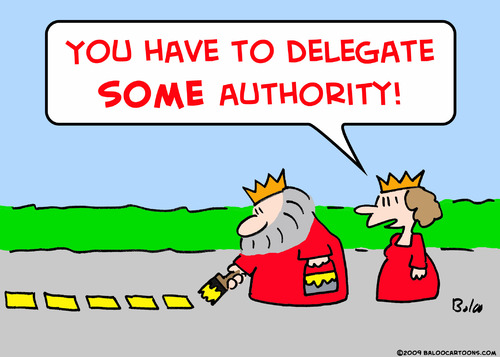
Learning how to delegate and hold others accountable will allow us to strategize and envision the future for our enterprise. And sequestering ourselves for a specified period of time every single day will enable that planning and visioning to happen.

This blog is being written in tandem with my book, “An Entrepreneur’s Words to Live By,” available on Amazon.com in paperback and Kindle (My Book), as well as being available in all of the other major eBook formats.

delegate_authority_king_621555

Intentional Grounding

Question: I personally have a problem with pursuing the future. When I do, I don’t live in the “now.” How can a person remain in the moment but also remain mindful of his future vision?

Answer: It does seem like we must have a bit of a split-personality to do both, doesn’t it? And there’s no doubt that it can be quite confusing at times. On the one hand we’re advised to live in the moment. I certainly subscribe to the philosophy of “live today like you’re going to die tomorrow.” If we spend too much time planning for the future we miss what’s happening today. But on the other hand, if we give no thought to the future, we may not achieve our ultimate goals and objectives.

I’m by nature a planner. I totally enjoy the “vision thing” and plotting a course of action to get there (the mission). A song from 1974 really put it in perspective for me though, and could easily be the national anthem for entrepreneurs . . . The Cat’s in the Cradle by Harry Chapin. To refresh your memory, the song refers to a father and son who are like ship’s passing in the night – always paying lip service to each other but never making the choice to spend quality time together. That song has served as a perpetual reminder to feel the full experience of what I’m doing every moment.

Living in the present and holding a future vision are not mutually exclusive. We entrepreneurs are so driven by our vision that we never have to worry about losing sight of it. It’s our natural disposition to gravitate to holding and nurturing our vision. What we generally have to work harder to accomplish is being in the now. I believe that the key to succeeding in both realms is to be intentional. This means that for whatever we’re doing we need to focus and really see what we’re looking at. If it’s a daughter’s soccer game or a son’s piano recital we need to intentionally focus our attention on this event. Enjoy it, embrace it, and celebrate it. Likewise, when we are contemplating our future vision, we do the same. Be there intentionally without any other distractions and enjoy, embrace and celebrate it. To steal a football term, I like to call this “intentional grounding.”

In the end it’s important to remember what we value. As entrepreneurs we value the passion we have for our friends and families as much as our passion for our chosen profession. The only way we can adequately tend to both passions is to be totally present for each. Succeeding in this regard takes a great deal of practice – it won’t happen overnight. But intentionality will make it so.

This blog is being written in tandem with my book, “An Entrepreneur’s Words to Live By,” available on Amazon.com in paperback and Kindle (My Book), as well as being available in all of the other major eBook formats.

spyglass

No Crystal Ball Needed

Question: I’m not sure what the future holds. How do I deal with the uncertainty?

Answer: No crystal ball is needed. Write your own obituary.

Now I know you’re wondering what this has to do with peering into the future. Stay with me and I’ll show you how. The future is only uncertain to the extent that we allow it to be. In reality we can shape the future if we have vision. I define “vision” as “what it looks like when we get there.” In other words, to what exactly do we aspire? How many years from now will it be before we accomplish our goals?

To be a successful entrepreneur and to succeed in life, we must have vision. Floating along the river of life may work for some people, but for most entrepreneurs we need more clarity. Developing a vision can provide definition and lucidity. Which brings us to the obituary. I know suggesting that you write your own obituary may feel more than just a bit awkward and maybe even a touch morbid. But if you do it correctly it will be a very eye-opening exercise. What you are doing is looking back at the life you will have lived and envision how you want it to have been.

Avoid the shallow objectives such as, “he was the best father he could be,” or “she lived life to the fullest.” While there is nothing wrong with these statements, don’t we want our lives to be deeper and more meaningful than that? Ultimately you will write a strong and powerful statement about the life you want to have lived. From your future “obituary” you will begin to see the vision of what you want your life to become.

Once we create our vision we can develop strategies that will deliver that vision. And then we are able to shape our future, eliminate the uncertainty and move forward with confidence to purposefully pursue our passions.

This blog is being written in tandem with my book, “An Entrepreneur’s Words to Live By,” available on Amazon.com in paperback and Kindle (My Book), as well as being available in all of the other major eBook formats.

CrystalBallLarge