
Cucumber Cool

Question: Some people never seem to get flustered when situations become chaotic. How do they do that?

Answer: We all would like to stay cool, calm and collected when the pressure rises. Sometimes it’s not easy to do. My dad was one such individual. He was trained as a scientist and was absolutely steady as a rock. When my mother would become excited about something, he was unflappable. I studied his quiet manner for many years and often wondered if what I saw on the outside was really happening the same way on the inside. As an adult I was finally able to answer this question the more mature I became.

Dad really was cool as a cucumber inside and out. His scientific background helped him analyze everything and find the facts rather than getting caught up in the emotion. Dad also never took himself too seriously. I can’t remember a single display of egotistical behavior in all of the years he was alive. These attributes are instructive for all of us.

When things start to spin out of control, we can look for the facts. Analytical thinking tends to be a calming process and may be a steadying influence. Imagine a circumstance where we are feeling “fight or flight.” Suppose a large customer has just indicated that it is no longer going to purchase from us. The revenue loss from this customer will mean employee layoffs and potential losses for the company. The staff is upset and panicked over the news. What is needed is someone who hasn’t lost his or her cool. This can happen if we focus on obtaining the facts about the situation. Our words and demeanor are soothing and our pursuit of a logical conclusion is comforting to those around us. Panic and discouragement give way to our team figuring out how to turn lemons into lemonade.

In addition to calmly tackling the situation in a clinical fashion we also avoid letting our egos get in the way. We show concern for others and help them manage through their feelings. We stay positive and upbeat. The people around us see that we’re unruffled and in a problem-solving mode and they respond in kind. Our approach to an unsettling situation helps to defuse the anxiety and channel it productively.

Staying cool, calm and collected is not an act but a mindset. Generally an emotional response to a negative situation does little to produce a resolution. When we shift into analyzing the facts and subordinate our egos to others, they are reassured and able to function in a fruitful manner.

This blog is being written in tandem with my book, “An Entrepreneur’s Words to Live By,” available on Amazon.com in paperback and Kindle (My Book), as well as being available in all of the other major eBook formats.

Cucumber on White

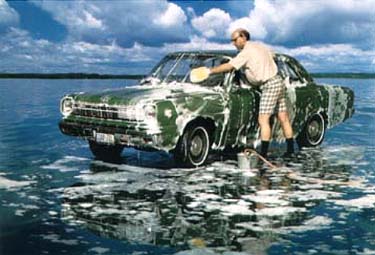
No One Washes a Rental Car

Question: I understand that to succeed in life and as an entrepreneur, I cannot play the victim. But it seems like there should be more to this premise. What is it?

Answer: You are right on with the philosophy that you cannot buy into a mindset of victimization. When we let ourselves think this way we are giving someone else the power over us. Avoiding a victimization mindset is an important step for us to take but as you sensed, there is more to it.

Why do you suppose it is that no one washes a rental car? Think about it. I will confess that in all my years of travel, I’ve never once even thought about driving a rental car through a car wash – no matter how filthy it might have been. There is a very good reason for this. We know that the rental car company automatically washes every rental car when it’s returned. And we know we don’t own the rental car. Our success and happiness is based upon the same concept. Others may help us in our quest for success and happiness but that’s all they do . . . help.

It’s up to each of us to take ownership of our own life. Earlier in my career I relied on a lot of people – and I still do today, but in a different way. There were times in the past when I might have thought, “I’ll do my part but someone else will ‘carry the ball across the goal line.’” As I think back I remember many disappointments along the way where having this mindset resulted in failure. Most likely this is because others were thinking the same way. Not a single one of us truly “owned” a particular project in such a way as to see that we did whatever it took to achieve a successful result. Taking ownership in a work environment doesn’t mean doing everything ourselves. But it does mean that someone (maybe it’s us) must be responsible for seeing that all of the plays are called and executed, and that the team eventually scores. Any time a goal or an objective is set, always remember to ask, “who is going to own this?”

In our personal lives it should be easier. When we ask the question, “who is going to own this,” the answer is pretty obvious. And we need to create some sort of accountability for ourselves to make sure that we follow through and truly “own” it. This accountability might be in the form of a journal, a checklist, working with a buddy or mentor – whatever is necessary for us to take our ownership seriously. If we want to exercise more; lose weight; be more aware of current events; become deeper spiritually; find a significant other; be a better parent, or be more prosperous, the road to success begins with our taking ownership of our situation and committing to see it through to a successful end.

Taking ownership is a liberating experience. In so doing, we cease to worry about whether or not we will succeed. Instead, we live in the knowledge that through our ownership we will achieve whatever it is that we have set forth to do.

This blog is being written in tandem with my book, “An Entrepreneur’s Words to Live By,” available on Amazon.com in paperback and Kindle (My Book), as well as being available in all of the other major eBook formats.

car_wash(2)

Soaring

Question: I’d like to become more imaginative and creative. What suggestions do you have?

Answer: I’ve heard theories that imagination and creativity are innate – you either have it or you don’t. I’ve also heard some people state, “I’m just not a creative person.” In my opinion, everyone is born with imagination and creativity. With some people it’s “closer to the surface” than with others, but it’s still present within every one of us. The key is what we do to bring it into reality.

As entrepreneurs, we tend to spend a lot of time in a left brain mode. We’re analyzing, planning, verbalizing, logical and detail-oriented. But imagination and creativity emanate from the right brain. And if we don’t spend much (if any) time in a right brain mode, how then can we develop our ability to imagine and create the good that we seek? There certainly are things we can do that are outside our comfort zone. What might they be?

I used to read business books and magazines all the time. Nothing else was in my library. Growing up I loved to read, but as I began my career it was all about learning everything I could about business methods, theories and case studies. I participated in education sessions and seminars to obtain a professional designation – all related to my industry. I wrote articles for trade publications. Again, they were all focused on the business of my business. After a few years it became clear to me that my one-dimensional approach to reading, learning and writing wasn’t doing anything to make me more creative or innovative. There is no doubt that I was becoming an expert in my field, but so what? Who wants to be a boring expert? And I noticed that solving problems wasn’t as easy or as fun as it was when I first started my journey.

A course correction was in order for me. I began reading a wide variety of publications. I actually began reading fiction books! Rather than allowing my whole life to revolve around business and more particularly, my business, I decided it was time to be much more curious about a whole lot of things. As a kid, I remember rainy Saturday mornings spent with World Book encyclopedias. I would pore through them in fascination. Somehow I had moved away from exercising my right brain. Living a more varied life was a gradual thing. But I found that the more I got out of my comfort zone and did things unrelated to my business, the more creative and imaginative I became. Today I believe that my levels of creativity and imagination are at an all-time high because I touch everything that I can – music, literature, spirituality, philanthropy, social studies, psychology, sports and the list goes on.

In order for our imaginations to soar we must step out of the forest and into the sunlight. Then we can look around and see beyond our limits. When we become curious about and interested in an infinite number of things, our creativity and intuition will become stronger and new ideas will flow effortlessly.

This blog is being written in tandem with my book, “An Entrepreneur’s Words to Live By,” available on Amazon.com in paperback and Kindle (My Book), as well as being available in all of the other major eBook formats.

soaring

Why Do They Quit?

Question: In this day and age of heightened customer service awareness, why are there still businesses that deliver such a lousy customer experience?

Answer: You are so right about this observation. For a number of years we’ve seen a barrage of books and articles about how companies are more focused on delivering top quality customer service. But for some reason, on a regular basis there’s still a disconnect between the theory and the practice.

For more than 20 years my wife and I went to the same dentist – every six months like we’re supposed to do. During my final encounter with this dentist I asked him to do some minor cosmetic work on my front teeth and inquired as to the cost. He quoted an amount; we scheduled an appointment, and the work was performed. When I received the bill I was in for a shock. It was double what he had told me. Because he is so hard to reach in person during the day, I sent him an e-mail explaining the situation. His response was, “What I quoted was for one tooth.” Now I don’t know about you, but I liken this to having the brake pads replaced on your car and the mechanic gives you a quote for one brake pad. I told the dentist how disappointed I was that he had not made his pricing clearer. He responded that in the future, each patient would receive such a quote in writing to eliminate any confusion. What he failed to do however, was apologize to me and knock some amount (any amount would have been fine) off my bill. As a result, he lost two patients forever. How simple it would have been to show a bit more consideration by simply acknowledging the mistake and making a minor financial adjustment.

Here’s another 20+ year story. A certain pool company has received thousands of dollars from me over that timeframe through opening and closing our swimming pool as well as replacing the liner two or three times and servicing our hot tub. This year the pool was opened on schedule. Normally the cover is removed, chemicals dumped in the water, the pump and filter are started and the crew comes back a few days later to vacuum and finish the clean-up. We’ve had a wet spring and as a result the company fell behind on its schedule and never came back to finish the job. Of course they weren’t hesitant to send me a bill which I quickly paid. I placed several phone calls during which I was told they’d “take care of it.” An e-mail went unanswered. Finally a month later I hired someone else to finish the job and sent a letter to the owner of the pool company terminating their services. Ironically, the same day the opening was finally finished, the pool crew showed up only to realize their job had been completed by another party. To this day I haven’t heard a peep out of the owner of the pool company. And of course he wasn’t honorable enough to refund a portion of what I had paid.

It is important to remember that when serving others the key to keeping a customer happy is honesty and communications. We humans will tolerate an awful lot as long as we feel that we are being treated fairly and have expectations communicated to us in a clear and timely manner. Lack of these elements shows disrespect and is the main reason we quit companies that serve us. Yes, we want performance and quality products. But the way we are treated is equally important if not more so.

There’s a very simple yet powerful adage to remember that will ensure that we will keep our customers happy. It goes like this. Do unto others as you would have them do unto you.

This blog is being written in tandem with my book, “An Entrepreneur’s Words to Live By,” available on Amazon.com in paperback and Kindle (My Book), as well as being available in all of the other major eBook formats.

customer-service

Judgment Day

Question: Where is the fine line between constructive and negative criticism?

Answer: The very word “criticism” has negative connotations for many, so we’re starting from minus territory to begin with. Why? Because criticism is often associated with hurtful, manipulative language. Think about a situation where you feel like you’ve received negative criticism. How does a statement like this feel? “You really screwed up that presentation. You offended the client and couldn’t close the deal. I should have had someone else handle this assignment.” Wow. This sounds like a direct attack on you as a person. It’s no wonder that this type of criticism is not received favorably.

As entrepreneurs we must have thick skin in order to receive criticism of all types. And we must also be able to deliver criticism – but only in a constructive manner. First consider the audience. To deliver constructive criticism it must be perceived as constructive by the receiver. If this person is a highly resilient individual, your criticism may need to be offered more directly and bluntly. Conversely, someone who tends to be more sensitive may need to receive constructive criticism a bit more subtly.

Second, we must measure the intent of our criticism. Do we truly desire to be honest and constructive with what we have to say? Or do we want to send a message of disapproval in order to make the other person feel badly? Sometimes in our personal relationships – with a spouse or significant other – we may have a tendency to be less constructive and our criticism becomes hurtful.

Finally, constructive and effective criticism should always contain some suggestion for improvement. When this is done, our criticism can be perceived as helpful and positive. For example, the statement we read earlier could be modified as follows. “May I make a suggestion? The client may have been offended during the presentation because he thought we were ignoring his needs. The next time, you might consider spending a few moments reviewing the client’s specific needs and then show him how our product meets those needs.” There’s no mistaking that this is a positive and constructive dialogue and will most likely be perceived as intended.

Criticism should be focused on what someone has done or is doing, rather than the person himself. By being honest and appropriately sensitive to another’s feelings, criticism can be used as a positive and productive tool for improvement.

This blog is being written in tandem with my book, “An Entrepreneur’s Words to Live By,” available on Amazon.com in paperback and Kindle (My Book), as well as being available in all of the other major eBook formats.

judgment