
Unknown's avatar

About anentrepreneurswords

R. Lee Harris grew up in Manhattan, Kansas and has lived in the Kansas City area since 1977. A 1975 graduate of Kansas State University, Harris began his career with Cohen-Esrey, LLC as an apartment manager two weeks after he graduated. Now president and CEO, he is involved in apartment management, development and investment; construction and tax credit syndication on a nationwide scale. Over the course of his career Harris has overseen the management of more than 27 million square feet of office building, shopping center and industrial space and nearly 60,000 multi-family units. He has started dozens of business enterprises over the past 40+ years. In 1991, Harris wrote a book entitled, The Customer Is King! published by Quality Press of Milwaukee. In 2012 he authored the book, An Entrepreneur's Words to Live By. He has mentored a number of business people over the years and has been a long-time participant in the Helzberg Entrepreneurial Mentoring Program. He and his wife Barb have two grown daughters and one grandson. They are active in their church, community and university.

Obstacle-Proof

The space shuttle had approximately 2.5 million moving parts. There are 100,000 miles of blood vessels in the human brain. There are approximately 2,300,000 stone blocks weighing from two to 30 tons each in the Great Pyramid of Giza. The Chinese Tianhe-2 supercomputer is purportedly the fastest in the world with 33.86 quadrillion of FLOPS (floating-point operations per second).

“That’s really going to be hard.” “I don’t know if we can do that.” Ever heard someone utter these phrases? Sometimes we struggle to get our head around a difficult project or initiative and our default thinking goes to seeing the obstacles rather than the opportunity. This may be especially true for those who are linear thinkers. The obvious cliché here is that of “staying inside the box.” We are stuck in traditional thought patterns and are unable to immediately see the multiple options that exist with nearly every decision that must be made. It doesn’t have to be this way – witness the amazing feats described in building the space shuttle, performing complicated brain surgery, constructing the Great Pyramid and creating the supercomputer.

Every organization needs a combination of linear and abstract thinkers to provide a healthy balance of ideas. Those of us who are extremely creative and can dream in a big way need down-to-earth team members with whom we test our ideas. That said, I’m an advocate for the notion that the organizational mindset should be “how we can” as opposed to “why we can’t.”

Here’s an example of the “how we can” philosophy. Let’s say that Company A manufactures a particular type of fastener. Business has been growing and then the CEO receives a call from a prospective customer, Company B, indicating that it would like to place an order for fasteners that represents 35% of the company’s production. Company A is operating at full capacity and cannot divert any product away from its steady customers. But the CEO in typical entrepreneurial fashion, isn’t about to tell Company B that he can’t supply the fasteners. When he pulls his team together he could hear a lot of “why we can’t,” or he can challenge his team members to tell him how Company A can meet the current production requirements and also increase production by 35%.

Instilling the “how we can” mindset is not a walk down Pollyanna lane. Instead it involves convincing a team to develop a default perspective of looking around, over and under the obstacles and figuring out what steps can be taken to achieve the goal. We start by creating the path to success. Then we work backwards and look at the risks involved and how to manage them. Perhaps Company A can’t add a second shift to produce the extra fasteners because it doesn’t want to risk having excess labor capacity after the order is filled. But as an alternative, maybe Company C that’s not a direct competitor, could “white label” the fasteners and produce them under the watchful eye of Company A. While the profitability may be less by using Company C, Company A may be able to win a new customer in Company B, whose repeat business results in a permanent expansion of production capacity.

It’s also important that the entrepreneur not send the signal to his team that “we’re going to make this work come hell or high water.” The danger with plowing ahead is that the more skeptical and cautious members of the team may simply acquiesce rather than express their true opinions. And those who are the natural risk takers may run toward the cliff at full speed without realizing that there’s real pain 400 feet down!

We want to inspire team members to build a “how we can” enterprise. And simultaneously we thoughtfully measure risk and return on investment. The endgame is a dynamic organization that always pushes the boundaries to grow in a healthy fashion.

This blog is being written in tandem with my book, “An Entrepreneur’s Words to Live By,” available on Amazon.com in paperback and Kindle (My Book), as well as being available in all of the other major eBook formats.


obstaclecourse

Toe-Stepping

We live in a hypersensitive society today. It seems as though every time we turn around someone is being offended by something. It may be words, actions, facial expressions or even the way someone looks. The whole notion of being offended stems from a belief that we are somehow victims. Victims of what, I’m not really sure. But our culture is at a point where it promotes victimhood and all that goes with it. This is a very dangerous place for entrepreneurs to be.

Many of us Baby Boomers raised our children in an environment where everybody wins and there were no losers. I remember sporting events in which our daughters participated and each child received a ribbon or a small trophy. Obviously in the real world there are winners and losers yet somehow, losing has become linked with victimization. I’m not saying that this is the sole reason for the hypersensitivity we are experiencing but it may be a contributing factor.

Entrepreneurs are in a tough spot. On the one hand we want to be sufficiently sensitive to saying or doing things that others could perceive as a slight. And yet we are in a rough and tumble business world that takes no prisoners. Unfortunately it’s not enough to simply treat others as we would like to be treated. I’ve grown pretty thick skin over the years and as others will attest, it’s pretty hard to offend me. A few years ago I took a computerized test that measured resilience among a number of traits and tendencies. My score was 97 out of 100 which I’m told indicates that I have very strong self-acceptance. My point in sharing is to demonstrate that I may be somewhat oblivious to attempts by others to offend me. So what to do?

First, we need to measure our intent when we are interacting with others. Do we say certain things to another person because we want to make them feel inferior? Do we take certain actions because we want to “send a message” to a specific individual that we expect could result in hurt feelings? A compassionate leader will communicate honestly and openly while doing so with sufficient empathy. His or her ego will be totally eliminated from the interaction. If our intent is pure and we’ve separated from our ego then it is unlikely that we will offend someone.

Second, it’s important to understand what behavior is unacceptable. This is especially challenging from a generational perspective. A young female colleague of mine was at a luncheon recently. She shared that she sat next to an older man (Boomer generation) who was nice but commented as they were leaving that he was pleased to have been able to sit next to such an attractive young woman. My colleague was not offended but related that she thought the comment was unnecessary and inappropriate. What was intended as a compliment by an older man was interpreted as mild condescension by a younger woman. While I doubt that it was his intent to be condescending, it was clear that he has not learned that you just don’t say things like this.

I’m not advocating for political correctness. We’ve gone completely overboard with PC and it’s causing huge problems in our country. But I do think that we need to pay closer attention to how we might be perceived by others. And let’s do our own gut check. Do we find ourselves being offended with any frequency? If so, we might benefit from exploring what we see when we look in the mirror. Do we have a positive or negative self-image? Are we preoccupied with conflict or feelings of inferiority? If so, we may be prone to being easily offended.

As entrepreneurs we must develop thick skin through a strongly positive self-image. At the same time, we need to measure our intent when interacting with others as well as understand what is unacceptable to society. Doing so will minimize the likelihood that we will offend others.

This blog is being written in tandem with my book, “An Entrepreneur’s Words to Live By,” available on Amazon.com in paperback and Kindle (My Book), as well as being available in all of the other major eBook formats.

toe stepping

Pluses and Minuses

There’s one thing of which I’m certain . . . I think. Have you ever had this kind of feeling? We entrepreneurs are a pretty confident lot. We are scrappy and tough. There’s nothing we can’t do including leaping over tall buildings in a single bound. Throw us a challenge and we’ll whip it with one hand tied behind our back and blindfolded to boot. Right? Well, maybe. And most of the time.

Entrepreneurs have several “thought enemies,” one of them being gnawing and nagging doubts. Here’s a not-so-fictional example. Let’s say that things have been going pretty well in our business and we’ve had some nice wins along the way. Then we hit a little speed bump – perhaps a contract doesn’t get signed that we thought we had in the bag. Or an important customer stops doing business with us. In other words, we get knocked off our game a bit. That part we can handle with aplomb as we go on to sign another contract or we fix the problem with our important customer. It’s what happens next that can be perplexing.

After we’ve been bucked off the horse so to speak, we begin to have feelings of doubt. For example, we are ready to introduce a new product or service, but we wonder if it might flop. In the past, we would have launched without any trepidation, but now it feels different. Could something else go wrong that that might cause everything to come unraveled? We know that these gnawing and nagging doubts aren’t healthy and could become self-fulfilling prophecies. Yet still they are there and hard to push out of our mind.

Why is our confidence shaken, and doubts have entered the picture? I’ve thought about all of the times this has happened in my life and believe it centers on a rather recent failure in the past. The earlier example that I gave where the contract or customer was lost illustrates this notion. Coming off of a failure makes us wary and more sensitive. As entrepreneurs we have winning in our DNA. Failure is for losers. And yet we do fail and we do lose. Sure we’re resilient, but we can’t ignore what it felt like to fail and lose and we don’t want to experience it again. And so we’re vulnerable to doubt and uncertainty. Subconsciously we’re thinking, “I’m sure what I’m doing now is going to work, but if it doesn’t, I don’t want to be hurt again.” We find ourselves moving forward but wondering . . . always wondering when the other shoe will drop.

Here’s what I’ve learned about myself when these insidious doubts start creeping into my consciousness. I step back and take inventory of all of the positive successes that I know lay in front of me. I may have just lost a deal, but there are ten more that I believe with all my heart will succeed. Now here’s the key – even if only half of the ten deals actually succeed, I’m still way, way ahead. In other words, I’m not looking at the glass half full, but I’m looking at multiple glasses and every one of them is overflowing. Immediately my mindset changes and all is right with my world again. I’ve accepted the fact that I had a prior setback. I’ve accepted the fact that I’ll have more setbacks in the future. But I know that the pluses will always far outweigh the minuses and the winning score will be in my favor – overwhelmingly!

Gnawing and nagging doubts are usually a product of a recent failure. We get past such feelings by looking at the scoreboard and realizing that we are way ahead in the game. Ultimately this makes us unbeatable.

This blog is being written in tandem with my book, “An Entrepreneur’s Words to Live By,” available on Amazon.com in paperback and Kindle (My Book), as well as being available in all of the other major eBook formats.

water glasses

Blind Pigs

I’m sure you’ve heard the saying that even blind pigs find a truffle once in a while. Sometimes people will say that their luck has run out. Author Josephine Hart once wrote, “Lucky people should hide. Pray the days of wrath do not visit their home.” Theodore Roosevelt said, “As regards the extraordinary prizes, the element of luck is the determining factor.” Bill Watterson, creator of the comic strip Calvin and Hobbes once quoted Calvin as saying, “You know, Hobbes, some days even my lucky rocket ship underpants don’t help.” That one is my favorite.

So, how often do we chalk things that happen up to luck? There’s always been a lot of talk about coincidence, destiny and fate. It’s as if there are certain influences in our lives that are out of our control. And it’s pretty hard not to believe that this is totally true. But as the years have gone by, I’ve come to believe that we do control pretty much everything that happens, just not always at a conscious level. Once, I was talking with a friend who had been struggling with his job performance. He wasn’t hitting the sales goals his company had set and was on the firing line to improve. He had a breakthrough month and said this about it, “Basically, my team was down three points, and I got fouled shooting a half-court shot at the buzzer that happened to go in. I worked hard to get there, but it was purely coincidence that it all came together at one time for me.” But the reality of what transpired for him had nothing to do with coincidence or the serendipity that he describes.

What my friend didn’t realize is that he set an intention and then persevered to make it so. In the process, he created an energy that opened the door for him to win. We are such a tangible society. If we can’t touch it or see it, we often don’t believe it. Ah, ye of little faith, as the saying goes . . . right? But I’ve said many times how powerful our minds can be. Think about it. When we are in a negative frame of mind, how productive are we? How often do good things happen? Likewise, when we have a positive mindset how productive are we? How often do good things happen? I can’t think of a single time when I was in a sour mood and wallowing in negativity that anything really good came of it. And I do know that everything good that has transpired occurred when I was in a positive place. Thus, I have reached a pretty simplistic conclusion that if I stay positive, I’ll create the energy necessary to draw good things into my life.

Do you believe that NBA star LeBron James is the luckiest man alive because he can shoot the lights out and dominate the game? Or, do you believe that LeBron James maintains a positive mindset that propels him to work hard to take advantage of an opportunity given to him by his innate skills? He does a combination of stretching and yoga throughout the day. He works out in the gym and on the basketball court. He is fanatical about his nutrition and water. James has a tireless work ethic, preparing himself mentally and physically to be the best basketball player in the world. Is that luck?

We do not stumble into our success but will it to be so with our preparation and mindset. Keeping negativity at bay opens the door to the positive energy that is anything but luck.

This blog is being written in tandem with my book, “An Entrepreneur’s Words to Live By,” available on Amazon.com in paperback and Kindle (My Book), as well as being available in all of the other major eBook formats.
blind pigs

Trained Monkeys

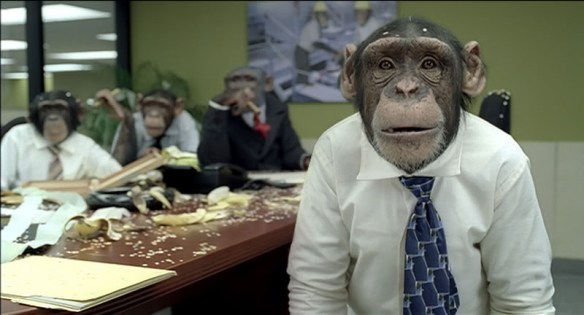
Here’s a question for entrepreneurs that can actually be a rather perplexing conundrum. What is the value that we are adding to what we do every day? Could a trained monkey do it too . . . and maybe even better? Here’s the thing. We sometimes tend to fall into a rut that’s usually within our comfort zone. And then we go through motions every day – over and over and over. Oftentimes we become very, very good at what we do and so it is really easy to keep doing it – over and over and over. But, is it a truly fulfilling experience?

My father-in-law was a funeral director. He was very, very good at what he did and it was evident that he liked helping people. But he always said that when he turned 65 he was done and would retire. And that’s exactly what he did. I concluded that while he liked what he did, he didn’t love it enough to never want to stop doing it. I never did get a chance to ask him before he died what value he brought to what he did every day.

Entrepreneurs think a lot about money. Yet, those I’ve known who do what they do just to make a lot of money tend to become restless and bored. Making a lot of money may be great, but after a while it’s really just a way to keep score. And if we’re winning every day and only doing it for the money, how does one keep the “fire in the belly?” There must be something more.

There’s no denying that we entrepreneurs want to make money. And there’s nothing wrong with this – after all, most of us are unabashed capitalists. But just focusing on the money can lead to a fairly hollow existence. Money is a commodity and eventually we find ourselves feeling like the proverbial trained monkey. That’s when the trouble can begin. Being restless and bored can lead to many issues the least of which might be extramarital affairs, drug or alcohol abuse or even daredevil types of hobbies. I’m not casting aspersion on thrill-seeking activities, but we must examine the real reason that we pursue them. Is it because we are feeling unfulfilled in our business and/or personal lives?

All of this pondering leads us to conclude that we need to be doing something of substance in order to feel fulfilled. I’ve written before about value propositions where customers are concerned. But we also need a personal value proposition that winds us up and keeps us excited, happy and content. My value proposition is the same as my personal WHY (thank you Simon Sinek) which is to make sense of complexity. This manifests in many ways including consistently developing creative ideas and solutions. If a day goes by where I wasn’t challenged creatively or didn’t become immersed in something complicated, I don’t feel fulfilled. Thus, I try and always put myself in situations where this never happens.

Each of us needs to find our own personal value proposition. Perhaps it’s doing things the right way every single time. Maybe it’s about innovation and doing things a better way. Some of us want to make a contribution or a difference in the lives of others. There are those of us who want to create trust and build relationships, while others just want to simplify things. A few entrepreneurs live for mastering what they do and others want to create clarity. Of course there are always a few Steve Jobs types who want to challenge the status quo and think differently.

Discovering our own personal value proposition energizes us and keeps us coming back for more. Being a great entrepreneur hinges on our ability to continually maintain a sense of fulfillment.

This blog is being written in tandem with my book, “An Entrepreneur’s Words to Live By,” available on Amazon.com in paperback and Kindle (My Book), as well as being available in all of the other major eBook formats.
trained monkeys

Urgent Care

Allow me to set the scene. We are about to embark upon a major project that could make or break our company. There are a wide range of complexities involving this project and it will require a supreme effort from our entire team to successfully bring it all together. But there’s just one problem. Invariably someone on the team is not as responsive as necessary or doesn’t seem to possess the same sense of urgency as does everyone else. As a result the ball gets dropped and we fail. Alternatively, others on the team step in to pick up the slack which creates resentment and hard feelings. How do we effectively deal with this rogue team member that is at the center of all this?

There are a number of steps that can be taken to stack the deck in our favor when it comes to ensuring responsiveness and urgency. Step one is to develop clear written roles and accountabilities for each member of the team. Considerable thought should be given to this process so that a high level of precision in role definition can be attained. Being as comprehensive as possible in describing a role will produce clarity. Vague and generic verbiage muddles the picture and may lead to confusion later on. As team members we have overall roles and accountabilities. For major projects it’s a good idea to dive even deeper into a separate set of intentions for each of us relative to the specific matter at hand.

Step two involves gaining a commitment from each team member. One of the best ways to accomplish this is to hold a team meeting to reaffirm the vision for the project. For example, suppose we are developing a proposal to win a major piece of business. We assemble the team that will be creating and implementing the proposal and paint the picture of what it looks like when we win (vision). In the meeting we review team member roles and accountabilities and ask each person to make a verbal (and maybe even written) commitment to do their part in this endeavor. It’s critical that this commitment be made among those on the team and not just to the enterprise.

The third step is for the team leader(s) to make an assessment of the capabilities of each team member. The roles and accountabilities have already been established for each position that will participate in the project. Will the individuals who fill those positions be able to perform the tasks assigned to them? And do they have the tools and resources that are needed to prosecute their roles effectively? If it’s determined that a team member isn’t equipped for his or her role – i.e. skills, training or experience – then that person becomes the weak link in the chain. A decision must be made at the outset whether or not to replace that team member with someone else, or be prepared to provide greater than normal support for that individual.

Finally, team members should be encouraged to set their own deadlines so long as they are compatible with the overall project timeline. When a deadline is imposed by others, there’s always the opportunity for someone to claim it to be unrealistic. Accountability is first to one’s self and then to the team. Self-imposed deadlines are congruent with this approach to accountability. As team leaders it’s equally important for us to be aware of all deadlines and check with team members well in advance of them. Then if there’s a chance that a deadline will be missed we can muster additional resources or take other steps to make sure that the train still runs on time.

Instilling responsiveness and a sense of urgency within a team is a process. When we clearly define roles and accountabilities, obtain commitment, assess capabilities and resources, and work with team-member established deadlines, the process should put us in a position to win the prize we are seeking.

This blog is being written in tandem with my book, “An Entrepreneur’s Words to Live By,” available on Amazon.com in paperback and Kindle (My Book), as well as being available in all of the other major eBook formats.

An early motorized version of a LICH ambulance.

An early motorized version of a LICH ambulance.

Swivel Head

A good pilot has his head on a swivel. He is constantly scanning his instrument panel as well as the skies around him. There may be other airplanes in the immediate area to avoid. Maybe there are TV towers or smokestacks to miss. Engine performance gauges must be monitored and navigational displays are critical to comprehend. All of this can be summarized in two words . . . situational awareness. Without situational awareness we are more vulnerable to physical dangers around us. A lack of it can result in an auto accident, stepping off a curb and breaking an ankle, or starting a fire when the grill is too close to the house.

In the entrepreneurial world, situational awareness is worth its weight in gold. Now, you may be wondering how this concept applies to business situations. It has less to do with physical proximity and more to do with possessing a sixth sense about a multitude of factors. As entrepreneurs we can attain a much higher degree of success as we develop our entrepreneurial awareness. For example, how well do we sense what is happening in our marketplace? There’s more to this than just crunching numbers. The key is to look behind the empirical data and understand what is truly happening. Here’s a simplistic illustration. A quick look at market share might show that our firm is way out in front of the competition. And yet, we know that a start-up company has won three of the last five contracts for which we’ve competed. Not enough to move the market share needle, but could signal trouble down the road. Situational awareness would have us take immediate action to understand why they are winning and we are losing, and then do something about it.

Situational awareness from an entrepreneurial perspective involves a deep understanding of our customers and what makes them tick. Customer satisfaction surveys help in this regard, but we may need more than data. In person meetings are the best bet for getting a good read on our customers. If not in person, the next best option is a phone conference. At the root, we’re looking for little tells that might indicate whether or not our customers are 100% in our camp. We encountered a situation a few years ago where we thought our client was totally satisfied with our services. Our team was convinced that we had performed as or better than expected. And yet, I had a gnawing feeling that something was amiss. When we dug in deeper we learned that the client was actually hiring a competitor. The reason had nothing to do with our performance and everything to do with the fact that a corporate decision had been made to consolidate its business to a national company. I’ve always wondered whether we might have saved the business by doing some things in a radically different manner had our situational awareness enabled us to act sooner.

Finally we must keep our finger on the pulse of our team. Are we on the lookout for signs of tension, boredom or anxiety? It’s easy to get caught up in the day-to-day chaos that we all experience and miss the signs that are flashing relative to our team. Perhaps an outgoing team member who normally participates in company activities gradually pulls back and is less gregarious. Without situational awareness, we could easily overlook that this individual is headed for the exits until it’s too late. Realizing this sooner might have given us a chance of resolving whatever issue is causing our teammate to look elsewhere.

Situational awareness at the entrepreneurial level requires a certain degree of intuition. But even more important is our being intentional about having a deeper understanding of that which is happening around us. Then we’re less likely to unwittingly step off the cliff and into the abyss.

This blog is being written in tandem with my book, “An Entrepreneur’s Words to Live By,” available on Amazon.com in paperback and Kindle (My Book), as well as being available in all of the other major eBook formats.

Shark

The Three-Legged Stool

We entrepreneurs have no shortage of books and other resource materials at our disposal to understand how to win in today’s environment. We’re barraged with a multitude of tips, tactics, strategies and a host of other concepts. Everyone has an opinion, and everyone insists theirs is the right way. Ask any coach or consultant and undoubtedly each will have their own secret sauce. I have no issue with any of this and believe that this diversity of ideas is healthy for entrepreneurship as a whole. Fortunately no one individual has it all figured out . . . so we continue to seek. As one of the “seekers” I might as well add my thoughts to the mix.

My approach involves a three-legged stool, and it’s a very simple calculus. The first leg is that of Culture. For most of my career I wasn’t very focused on Culture and we certainly didn’t do much to promote it. Our Culture just kind of happened in a laissez-faire manner. Oh sure, we had a company picnic every now and then as well as a Christmas party; and from time-to-time we would undertake a community service project. But for the most part it was nose-to-the-grindstone – chew ‘em up and spit ‘em out. However, I’ve learned a lot over the past few years and I’m now drinking the Culture Kool-Aid – lots of it. Why? Because I’ve found that Core Values matter. Not just to the company but to each member of our team. And we really live our Core Values every single day. As a result, we now have a team of people who have a common alignment and purpose. We are able to connect with millennials and Boomers alike and productivity has markedly increased. While Culture is more than just Core Values, they serve as the foundation for a Culture.

The second leg of the stool is Product. With the strengthening of our Culture we’ve become more creative and innovative with respect to the products and services we provide. The positive environment that has emerged in our companies has enabled us to shine a spotlight on our Product set. We’re constantly making tweaks every chance we get to differentiate from our competition that which we offer. “How is it different?” has become our mantra. We’ve become much more targeted with our marketing and sales effort in a manner that complements our Product refinement. A clear focus on Product has been the impetus for a much more strategic approach to decisions that we make as opposed to the small-ball tactics that we used to deploy.

Finally, the third leg of the stool is Customer. Many companies pay lip service to their customers. Everyone recognizes that without customers we don’t stay in business very long. But to succeed entrepreneurs must go far beyond basic customer service. We must do the deep dive into understanding what makes the Customer tick. It’s more than just needs and wants . . . it’s also a more comprehensive understanding of buying patterns and lifestyles. It’s about anticipating what the Customer will value. Thus, the value proposition becomes the Holy Grail. How does the customer experience attain complete and total satisfaction?

Maybe I’ve oversimplified this, but everything else seems incidental beyond Culture, Product and Customer. Without a strong Culture how can we possibly create a great Product and take care of the Customer? Without a great Product, our Culture begins to crack as team members become demoralized and the Customer eventually suffers. And yes, without the Customer, there’s no point in a Culture or a Product.

Culture, Product and Customer. A three-legged stool that looks simple, but is strong enough to support a long winning streak for us as entrepreneurs.

This blog is being written in tandem with my book, “An Entrepreneur’s Words to Live By,” available on Amazon.com in paperback and Kindle (My Book), as well as being available in all of the other major eBook formats.
3LeggedStool1

Simplicity

In today’s business world there is a constant drumbeat for clear communications. And without a doubt, we’ll find a lack of clear communication at the root of many of the issues that we have with each other. OK, I get it. We need to communicate more clearly. But here’s something you won’t hear as often. There is also a need to simplify our communications. Sometimes we may think we are communicating clearly when in fact the message we are conveying is so convoluted and complicated that our audience gets lost.

I’m involved with a venture capital business that screens large numbers of start-up companies in the biotech space as we look for potential investments. One company in particular stands out from the rest – not because of the product it was developing, but because its pitch was so impossible to understand. We have some technical people on our board as well as advisors with whom we work, and no one understood what the pitch was all about. This company used highly technical terminology and language that no one ever hears in day-to-day conversation. I suppose that it’s possible that the product could have been an amazing breakthrough in its field. But we’ll never know because we declined to invest for the simple reason that we couldn’t understand the pitch. Here’s an excerpt from the pitch summary.

(XYZ) technology allows RNA to be manufactured using well proven large scale fermentation processes. Prior to (XYZ) manufacturing innovations these large scale fermentation processes were not viable because of the ubiquitous and unavoidable presence of RNAses (enzymes that break down RNA) in the fermentation process environment. (XYZ) technology sequesters, inside a protein capsid, the RNA as it is produced thus protecting it from RNAse degradation. This protein capsid protects the RNA allowing subsequent isolation and purification. There is also a high level of interest in using the protein encapsidated RNA as a delivery mechanism.

The preceding is an extreme illustration of overly-complicated communications. But there are countless examples that occur daily to a lesser degree. I moderate panel discussions at several apartment industry conferences each year. We talk about a number of aspects of the business including debt, equity, construction and operations. Often we have audience members who are new to the industry. While the subject matter can be complex at times, the bigger problem is all of the acronyms that are the plague on our house.

It doesn’t matter whether the communication is written or verbal, we must redouble our efforts to simplify, simplify, simplify. When we write like we speak, we tend to accomplish this objective. And if we think before we speak, it’s likely our communication will be understood. Guarding against ego-creep is also in our best interest. We’ve all seen the pontificators who like to show everyone how smart they are by spouting a bunch of intellectual-sounding mumbo jumbo. Staying humble and being respectful of the audience’s desire to understand what we are communicating should be our guiding principle.

A man or woman of few(er) words conquers rambling purveyors of verbosity every time. Striving for clarity and simplicity in our communications will ensure that we are persuasive and convincing.

This blog is being written in tandem with my book, “An Entrepreneur’s Words to Live By,” available on Amazon.com in paperback and Kindle (My Book), as well as being available in all of the other major eBook formats.

einstein lecture

Tasty Crow

Crows are remarkably intelligent and can live as long as 20 years. They typically have a wingspan of more than three feet and weigh nearly three pounds. A crow can fly up to 60 miles per hour and have been found as high as 14,000 feet in mountain ranges. Being smart, fast and able to fly to great heights make them particularly hard to catch. Recently I had to catch one so I could eat it . . . metaphorically speaking of course.

To be a successful entrepreneur we must have an acquired taste for crow. We’ve all heard the saying “to eat crow” which connotes humiliation and having to admit the making of a mistake. Sometimes our ego gets in the way and we do everything we can to avoid admitting that we made a mistake. We may point the finger at others. Or we may try and cover up the mistake hoping that its results will somehow vanish into thin air. I can tell you that all of these tendencies are mistakes.

One of our companies is involved in acquiring apartment properties across the country. We sold two such assets within a much shorter holding period than we had initially projected because of an opportunity to generate substantial profits. Members of our team prepared a detailed spreadsheet that showed how the sale proceeds would be distributed. These were large and complicated transactions with several tranches of equity provided by different investors. I was pleased to call two such investors to deliver the good news that they would be receiving a significant multiple of their original investment. Needless to say they were thrilled.

Within days, I received a call from my partner who oversees our apartment acquisition business unit. Apparently there was a bust in the calculations and these two investors would be receiving less than what I had told them. They were still receiving a substantial gain on the sale, but not quite as much as the expectation I had set. The mistake was honest and unfortunate but it still had to be acknowledged. Thus, I went about the task of eating crow.

I called both investors and said the following, “I’m sorry to tell you that the distribution figure I provided the other day was erroneous. We made a mistake in calculating the sale proceeds and your new amount is $X. Happily your profit is still much greater than we projected when you made your investment three-and-a-half years ago. I wanted to get back to you as soon as I learned of the error and I hope that you will still be interested in looking at future investments with us.”

Because we are a team I did not point a finger at the person who was responsible for the calculation. Instead I said that “we” made a mistake. I did not make up an excuse for what had happened. Simple but painful. The result was an expression of understanding on the part of both investors. I’m sure they were disappointed but there were no angry words and in both cases, an indication of interest in looking at the next deal.

Relationships are built on trust and can be strengthened in situations where things don’t go as planned. But this happens only when honesty and transparency are the top priority.

This blog is being written in tandem with my book, “An Entrepreneur’s Words to Live By,” available on Amazon.com in paperback and Kindle (My Book), as well as being available in all of the other major eBook formats.

crow