
Goody Two-Shoes

Gil Penchina is a 20-year angel investor in start-up companies. He was one of the earliest members of the eBay team and has invested in unicorn companies such as LinkedIn, Dollar Shave Club, PayPal and Cruise Automotive. I heard him tell a fascinating story about what he sometimes does when he’s traveling. He posts on Facebook that he’ll be away and offers his apartment to whoever wants it. Total strangers are often staying in his apartment – and have been identified not through a formal Airbnb arrangement! He’s done this 15 or 20 times and simply asks that the apartment be left clean and the bed linens and towels put in the washing machine. Only once has he been burned and that was by one of his cousins. Why would he do this? As Gil tells it, he believes that people are inherently good and he doesn’t believe they will harm his property.

How many times do we “look for trouble?” Do we have expectations that someone is going to try and take advantage of us? I’ve known many people who always have their guard up. They truly believe that if they don’t aggressively take protective action that they are going to be screwed. I’ve worked with people who spend more time trying to figure out how they are getting the short-end of the stick in a transaction than time spent figuring out how to optimize the deal. Guess what? This mindset can become a self-fulfilling prophesy.

I believe as does Gil, that most of us operate in good faith. Sure there are bad people in the world – I’m not naïve enough to deny this. But the number is infinitesimally small and I will do nothing to seek them out. I’ve said it many times that I’m going to put as much Good out into the world with no expectation of getting anything in return. What I’ve always found is that Good comes back to me, often beyond my wildest dreams. While there’s no quid pro quo for specific actions, I know that as I am doing Good, I will attract Good into my life. This is applicable to business, personal relationships, our health and all other facets of our existence.

Let’s be clear about something. This isn’t about blithely skipping down Candy Cane Lane oblivious to obstacles and pitfalls. When we believe in all Good, we manage risk such that we aren’t worried about bad things happening. Why? Because we have a mitigation plan in place that we methodically work through if the unexpected occurs. Simply planning for risks does not mean we think they will come to fruition. It gives us the peace of mind to know that we can successfully deal with them and allows us to devote our time and energy to the positive aspects of whatever we are doing.

In my 42+-year career I can count on one hand the number of times someone has maliciously taken advantage of me. Conversely, I know many business people who are constantly embroiled in lawsuits and always complaining about how awful others are to deal with. I guess I must be running in the wrong circles because I just haven’t encountered that many of those kinds of people.

A number of years ago we were purchasing an apartment property and placed a large amount of earnest money in escrow. During our due diligence process we found some issues that were unacceptable and we informed the seller that we were cancelling the contract. The seller wanted to fight over returning our earnest money and we spent a few dollars on lawyers before settling with him. He received less than 50% of the earnest money and we moved on. All of us believed that the seller was acting in bad faith and we could have endured a long protracted legal battle and won. But to do this would have required a huge expenditure of negative energy and prevented us from pursuing other positive opportunities. It turned out to be a minor blip in our process and was soon forgotten.

The Law of Attraction is a powerful force in our lives. When we think positive thoughts and do good things for others, we attract the same for ourselves. Negative thoughts and negative actions are also attractors. The choice is pretty easy to make.

You can also listen to a weekly audio podcast of my blog. What you hear will be different than what you read in this blog. Subscribe on iTunes or wherever you get your podcasts. You can also click on this link – Click here to listen to Audio Episode 59 – Mousetraps Squared.

This blog is being written in tandem with my book, “An Entrepreneur’s Words to Live By,” available on Amazon.com in paperback and Kindle (My Book), as well as being available in all of the other major eBook formats.


Sabotage?

We’ve all seen the World War II movies where U.S. soldiers crept behind enemy lines and blew up bridges, tunnels and other elements of infrastructure. We hold our breath as our boys used cunning and guile to defeat the Germans at every turn. This was classic sabotage at its finest.

Would you believe that entrepreneurial leaders can sometimes be saboteurs too? Are you wondering how? Consider this. Nathan owns an internet marketing company with 24 employees. He has a couple of up-and-comers on the team. Nathan is a strong, hard-charging Type-A personality and is quite a taskmaster. He seldom expresses his gratitude to his rising stars. Instead, he can be hypercritical at times. Nathan claims that he is simply trying to push his best and brightest to excel. Because of his sense of urgency he tends to issue instructions in a rapid-fire manner. When mistakes are made, Nathan becomes impatient and can even unleash a tirade that is directed in a very personal manner. His colleagues do not want to bring him bad news – it’s not that they don’t want to let him down, but because they fear his wrath and tantrums. On the other hand he can be witty and charming. And his company has achieved enormous success.

By contrast, Amanda started a consumer products research firm while she was in college and has watched it grow over the past five years to 35 employees. Amanda is also a high-achiever and a similar Type-A personality. She sets lofty expectations for her team and they respond by meeting or beating their goals every quarter. While it’s clear that she’s the boss, team members love Amanda’s collaborative style. Even when a mistake is made she remains positive and upbeat while counseling the errant employee. Amanda never berates anyone and is always supportive. She’s no pushover either – if certain employees continue to underperform she will show them the door. During a 360 review, the most common statement made about Amanda is, “I always feel that she values my contribution.”

The difference in leadership styles between Nathan and Amanda is very stark. They are both generating eye-popping results, but their paths are totally divergent. Nathan is a saboteur and is succeeding in spite of his approach . . . for now. But like a Roman candle that pierces the night sky, eventually it flames out and disintegrates. Nathan’s company is always in a state of upheaval. Drama is occurring at every turn. Employee turnover is high and if it weren’t for his two blossoming lieutenants keeping everything together, the whole enterprise would blow up. When the boss constantly undermines his team the implosion clock is ticking.

Strong leadership – the kind demonstrated by Amanda – begins and ends with positive encouragement. A calm sense of urgency replaces the chaos, and team members do not fear for their sanity (or safety!) when a failure is experienced. The basic premise is pretty easy to understand. Are people more motivated to succeed in an upbeat and encouraging environment, or one that is negative and subjects people to personal embarrassment?

The legendary Steve Jobs of Apple fame was an awful boss. Ramon Henson, an instructor of Management and Global Business at Rutgers Business School wrote this about Jobs in 2011. “It is well-known that Steve Jobs could be arrogant, dictatorial, and mean-spirited.  Despite the observations of some about Mr. Jobs’ arrogant style, I believe that he had at least three qualities that great executive leaders have: a clear vision, a passion for the company and its people, and an ability to inspire trust.  This is what I would consider his leadership character. In fact, Mr. Jobs not only had a vision, he made sure that everyone in the company bought into that vision, and this created a ‘higher purpose’ for the company that really excited Apple employees. Of course, his passion for the company and its products is legendary. And employees trusted Mr. Jobs – not because he founded the company but because he showed time and again his competence in many areas, especially product design and marketing.  And because employees saw – through his behavior – that Mr. Jobs was not driven by his own ego or by some self-interested needs (like the outrageous pay packages of some executives), they trusted him. So if Mr. Jobs was at times arrogant, even nasty, employees viewed these behaviors in the context of these underlying qualities.”

I believe Steve Jobs was an anomaly as a leader. That Apple achieved great results while enduring his leadership style is a testament to this outlier notion. In other words, “don’t try this at home.” The probability of success is exponentially higher when creating an environment of positive encouragement than one of daily sabotage.

You can also listen to a weekly audio podcast of my blog. What you hear will be different than what you read in this blog. Subscribe on iTunes or wherever you get your podcasts. You can also click on this link – Click here to listen to Audio Episode 58 – The Really Big Bus.

This blog is being written in tandem with my book, “An Entrepreneur’s Words to Live By,” available on Amazon.com in paperback and Kindle (My Book), as well as being available in all of the other major eBook formats.

A Dirty Word

What two words in the English language couldn’t be further apart in their meaning, but are often intertwined for entrepreneurs? The first word by itself is part of the everyday life of an entrepreneur – and every other person in the world as well. This word is relatively innocuous. But when connected with the second word it’s like adding the primer to dynamite. The resulting explosion can have all sorts of detrimental effects on our lives.

That first word is “failure.” Many entrepreneurs (and others) fear failure. But successful entrepreneurs have almost always experienced failure in different ways and multiple times. They use their failure to recalibrate or pivot, and find a new way to make something work. David H. McConnell was a door-to-door book salesman who offered a little gift of perfume to female customers. Selling the books didn’t work out so well, but there was great demand for the perfume. So McConnell ditched the books and turned the perfume concept into what is now known as Avon. Ever heard of Traf-O-Data? It was a partnership between Bill Gates and Paul Allen for the purpose of developing reports from traffic counters for traffic engineers. Needless to say the business was not a success. But Gates went on to launch another venture called . . . Microsoft. And then there’s the famous story about a man named Fred Smith who wrote a paper for his Yale University economics class involving overnight parcel deliveries. The professor wasn’t impressed and gave him what Smith recalls was a C. Undaunted, Smith pursued the idea which today is known as Federal Express.

This brings us to the second word. The word is toxic to entrepreneurs for it can easily become a mindset. The word . . . “defeat.” Failure is part of a process of experimentation and discovery. Defeat is the end. Once defeat is admitted, there’s nothing more to be done. I knew a man who worked for someone else for several decades. Then he decided to spread his entrepreneurial wings and bought a business. He labored mightily but eventually had to close his doors. But rather than lean into the experience and use it as a stepping stone to success, he withdrew. His confidence was shaken and he began making unhealthy choices. He tried working for someone else again but eventually ended up driving a taxi. Now there’s nothing wrong with driving a taxi if it’s for the right reason. But in this case it was his way of curling up in the fetal position and saying, “I can’t.”

I think that it boils down to whether or not we have a “die trying” mentality. It boils down to whether or not we have a positive image of ourselves. It boils down to moving as fast as we can to kill our own bad ideas so we can make room for the good ones! When we are afraid to fail, we are setting ourselves up for defeat. One of the most important things about failure is making certain that it’s not so monumental that we can’t right our ship. A mindset of defeat occurs when we are convinced we’ve lost it all – forever.

Here’s what I’ve learned. I don’t set out to fail at anything but accept the fact that I will and I must, if only to find the good ideas that work. I always make sure there’s enough of a margin of safety that my failures aren’t going to “kill” me. This leaves room for a pivot or a more significant shift. Regardless of my failures I will always remain positive and optimistic. Sometimes this can be very hard but it’s fundamental to avoiding defeat. When I do fail I look for what can be salvaged from the experience to bolt onto the next iteration of whatever I’m doing. And finally, I know that I’m a step closer to success by eliminating a step in the process that didn’t work.

Failure and defeat are not connected in any way, shape or form. Great opportunity and great success can rise from failure. Nothing good comes from defeat.

You can also listen to a weekly audio podcast of my blog. What you hear will be different than what you read in this blog. Subscribe on iTunes or wherever you get your podcasts. You can also click on this link – Click here to listen to Audio Episode 57 – Headwinds

This blog is being written in tandem with my book, “An Entrepreneur’s Words to Live By,” available on Amazon.com in paperback and Kindle (My Book), as well as being available in all of the other major eBook formats.
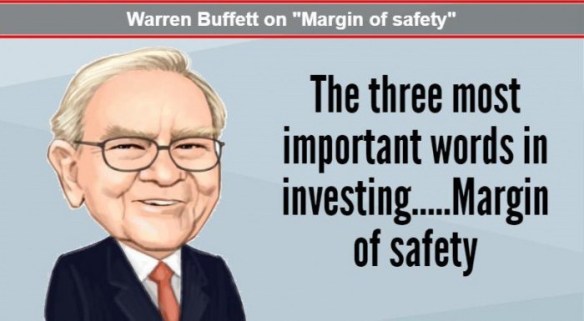
A Tip From Warren Buffet

We all know that life is full of risks. Some are more serious than others. I hold the view that I’d rather “manage” risk than “take” risk. I’ve said before that taking a risk seems a bit arbitrary. “Gee, I think I’ll try to run across this eight lane expressway right now!” Sounds silly, right? But in a way, that’s what taking a risk seems like to me. While it may not be as spontaneous as this overdramatized example, taking a risk feels like gambling. Meanwhile, managing a risk is calculated. It is studied and planned. Risk mitigation strategies are developed. If I’m to run across the eight lane expressway, I’m going to figure out every possible way to do so as safely as possible. That’s risk management.

One very important element of risk management is a concept that was espoused by one of the most revered investors of all time, Benjamin Graham (1894 – 1976). And this concept is practiced today by his acolyte, Warren Buffet. The concept is that of margin of safety. Entrepreneurs absolutely must understand margin of safety – but every member of society would benefit from practicing it as well. Graham and Buffet narrowly defined margin of safety as the difference between the intrinsic value of a stock and its market price. I look at margin of safety on a broader basis and define it as the difference between success and failure. In some cases this difference can be razor thin, and in others, it can be as wide as the Pacific Ocean. The key is to take the steps necessary to push the margin as wide as possible.

In our businesses, organizations and lives in general, we have an opportunity to become expert at creating margins of safety. One of our companies purchases apartment properties. Because we tend to hold these assets for five to seven years or longer, there can be a great deal of uncertainty about the future. What can we do to stack the deck in our favor and create a healthy margin of safety when we’re looking so far down the road? Obviously we make year-by-year financial projections that are based upon a set of assumptions. Those assumptions include rent levels, rent increases, operating expense levels, expense increases, occupancy percentages, rates of return on which a sale price can be calculated and various aspects surrounding debt financing. The Excel spreadsheet is quite comprehensive with all of these assumptions and projections – but how do we overlay a margin of safety on the process?

With one of our properties, we obtained a certified appraisal as a part of the due diligence process that indicated a value $3 million higher than we paid for the property. That’s a margin of safety right there. Perhaps we budgeted an initial increase in rents of $110 after making a number of physical improvements, but were actually able to achieve $200. Our assumptions might have anticipated a stabilized economic occupancy of 91%; but in actuality we were able to operate at 93%. Operating expenses may have been right on the money, but rent increases averaged 3.25% each year rather than the 3% that we had forecasted. And remember our baseline started $90 higher than the $110 initial increase that was projected. In summary, we pushed a number of levers to create several different margins of safety that when combined, produced a much better bottom line throughout the holding period than expected. In so doing, we are better protected from market factors that could degrade the future value of our asset.

The principal takeaway here is to find as many margins of safety as possible. If we make decisions based upon 100% optimal results, there’s no room for error. Then a blip in the market or a miss with operations could mean failure. I have learned the hard way that if there’s no way to create sufficient margins of safety, the risk I am contemplating may be too difficult to manage. So I move on to something else.

Developing the concept of margin of safety is an exercise in positive thinking. We are looking for ways to increase the probability for success – and that’s always a good thing.

You can also listen to a weekly audio podcast of my blog. What you hear will be different than what you read in this blog. Subscribe on iTunes or wherever you get your podcasts. You can also click on this link – Click here to listen to Audio Episode 56 – The Mystery of the Undercooked Steak.

This blog is being written in tandem with my book, “An Entrepreneur’s Words to Live By,” available on Amazon.com in paperback and Kindle (My Book), as well as being available in all of the other major eBook formats.