
The Outwardly Focused Entrepreneur

I was talking with a friend the other day and he mentioned that he gets up tight speaking in public. I’ve had conversations over the years with others who expressed varying degrees of self-consciousness about a myriad of issues. In some cases, there was a dislike for attending functions that would require meeting large numbers of people. In other instances, it was a solo meeting with a high profile individual. Someone even mentioned how nervous they were during a radio interview. Entrepreneurs are thrust into a multitude of situations that require interacting with others and we must be able to do so gracefully and easily.

Being self-conscious is inwardly focused. I remember having no issue speaking in public during high school. And in my early college days I spoke at political events and in other situations with relative ease. Then one day I went to class completely unprepared and had to make a presentation – and I bombed. What an embarrassing and humiliating experience! It rattled me to the point that I was self-conscious about public speaking for a number of years thereafter. I tried everything advised by the experts. Take deep breaths. Smile. Tell a joke. I even envisioned a naked audience! I suppose these tips worked to a small degree, but they weren’t the panacea.

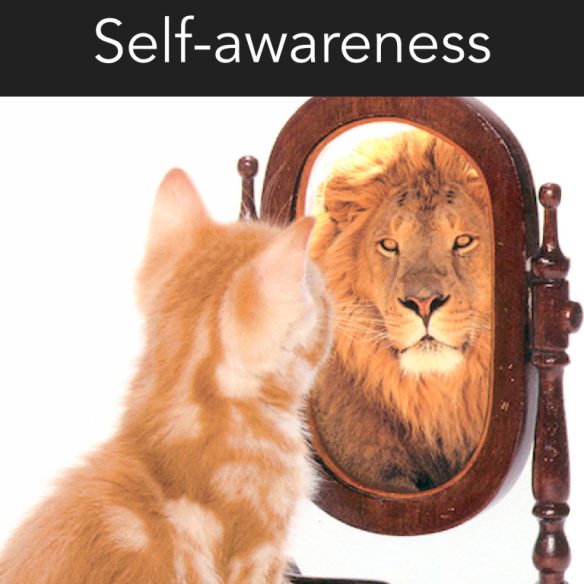
What I eventually figured out was that I needed to get out of myself. In other words, I needed to get out of my own way. I was holding me back. Notice that there were a lot of “I” and “me” words in what I just said. And that was the problem. I was looking inward rather than outward. I was making the situation about me and not what I was truly there to do. Over the years I’ve spoken countless times in public and actually enjoy it. Now there’s more an anticipation of excitement rather than dread. And I’m energized meeting people in large and small groups alike.

Allow me to illustrate the notion of “getting out of myself” with another story. In October 2016, my mother-in-law passed away; she had asked me to deliver the eulogy at her funeral. I prepared and practiced my remarks and thought a great deal about how I might react in the moment. My biggest concern was the possibility of becoming emotional during the eulogy. This in itself wouldn’t necessarily be a bad thing, except this sort of emotion can be contagious – especially for a grieving family. When the time came, I understood immediately that the remarks to be made were not about me. This was an occasion to honor and celebrate my mother-in-law. And thus, I became totally outwardly focused.

Most of us have an innate desire to be liked and/or thought well of by others. When we begin to have doubts that others may not like us, we can become very nervous or even embarrassed. I suppose for many of us this goes back to childhood days when we may have been mocked at some point in time. Young children can be brutally candid to the point that scars are caused and invariably must be dealt with when we become adults. Developing a strong sense of self-worth – warts and all – is important to overcoming self-consciousness. And when we can get out of ourselves and focus on others, we push unhealthy self-awareness totally out of the picture. This is true for public speaking as well as interactions with others – in groups or one-on-one. Warren Buffet speaks often in public. He’s not a handsome man and he’s not particularly articulate. But his words can be captivating because he is incredibly comfortable in his own skin and clearly is focused on his audience rather than himself.

So, here’s the simple truth. When we are preparing for a presentation, a speech or interacting with others in a group setting, think about who it’s for. Is it about us? Or is it for others? When we can shine the spotlight away from ourselves, we are getting out of our own way and our encounter will be filled with ease and grace.

This blog is being written in tandem with my book, “An Entrepreneur’s Words to Live By,” available on Amazon.com in paperback and Kindle (My Book), as well as being available in all of the other major eBook formats.
The Modern Entrepreneur/Leader

I recently came across an article by Stefan Stern from the Financial Times publication dated November 10, 2008. “While cleaning out his attic, a British business leader stumbled upon some typewritten notes on leadership from the 1950s. ‘Leadership is the art of influencing a body of people to follow a certain course of action, the art of controlling them and getting the best out of them.’” Sounds kind of old-fashioned, doesn’t it? The “art of controlling them?” That’s an attitude that’s not likely to win many awards in this day and age. The article and this statement in particular got me to thinking about leadership. And because I’ve lived long enough, I’ve had the good fortune to experience many different leadership styles. So, here are some personal observations that have helped me develop my own leadership style.

Entrepreneurs are often “quick on the draw.” A team member asks a question or brings us a problem and our instinct is to provide the answer or solve the problem. Then we move on . . . quickly. In the old days, that would probably have been considered “leadership.” One of my goals is to develop a sustainable organization that is no longer dependent solely upon me. If I answer every question and offer every solution, how does this support others in their quest to step-up and become leaders in their own right? I believe that leadership involves leading people to answers and solutions rather than simply telling them.

I’ve heard certain pro athletes and a number of entrepreneurs who say it’s not their job to be role models. It seems to me that anyone who has the megaphone ought to savor the opportunity to set an example for others. Doing so also enables us to become more accountable to our team. Back to the sustainable organization concept for a moment – do I want to display anger; yell at people; exhibit boorish behavior, and generally put my ego front and center? When I model this way, what message does it send to up-and-coming leaders? Here’s the simple truth for me. I don’t want to show any sort of negative behavior for which I should apologize.

One of the toughest aspects of being an entrepreneur is communicating our vision to our team. Most of us have a vision of some sort locked away in our brains. I was asked for years by my teammates for my vision, but never could figure out how to articulate it clearly until recently. Having a vision and communicating that vision are two entirely different things. When I mentor other entrepreneurs, I ask them a very basic question. What does it look like when we get there? Focusing on this question eliminates the psychobabble and gets to the heart of the matter. In plain English it requires that we paint a word picture that everyone can understand. We should never forget that people are drawn to leaders who can express a strong and powerful vision.

As a leader, how much time do you spend working on your business rather than in your business? I can tell you that I love doing complicated real estate deals. Without question, that’s working in my business. It would be very easy (and profitable) for me to focus all of my time and energy on buying and owning apartment properties. But that doesn’t advance the cause for the sustainable organization that I have envisioned. Thus, I must spend significant time working on my business. This involves developing a wide range of strategic initiatives, cultivating and educating team members, and helping to define our mission. A great leader will spend far more time working on his or her business than working in it.

While there are many other modern leadership traits to be explored, the last one on which I want to focus is that of attitude. Leaders with negative attitudes generally produce negative results. Over the past four-plus decades I think I’ve become more and more positive and optimistic. I realized that it’s not much fun to work in a negative environment. And as a leader, if I’m down-in-the-mouth it’s pretty hard for that attitude not to become contagious. I’ve come to realize that there’s always a silver lining in every situation and it’s my aim to find it. This doesn’t mean that negative things won’t happen – they do. But the faster we can move on and regain positive footing, the faster we’ll get back on track. It’s my goal to be a positive and optimistic leader every second of the day.

Modern leadership still embodies ageless basics and fundamentals. But there are some “new age” twists that help propel us to new heights of success and create sustainable organizations in the process.

This blog is being written in tandem with my book, “An Entrepreneur’s Words to Live By,” available on Amazon.com in paperback and Kindle (My Book), as well as being available in all of the other major eBook formats.

Four Customer No-No’s

Once upon a time there were entrepreneurs who cared about their customers. They understood what it took to make their customers happy and keep them coming back. Then their businesses grew and grew until one day they weren’t small anymore. Instead they became large behemoths that cared less about the customers and more about bureaucracy, CYA, policy and how to squeeze more dollars out of their customers. In the process, a number of their customers had experiences that were unacceptable and downright maddening. In this blog, I would like to relate several stories about encounters I’ve had as a customer of several larger companies. The names of the companies are irrelevant. What is instructive are the lessons we can learn as entrepreneurs and especially what we don’t want to emulate.

Let’s start with the airlines. The large domestic carriers are consistently stepping in it with their customers. One summer we made flight reservations on a major airline and then a few weeks later needed to change one leg of the flight. The airline’s website was impossible to negotiate to figure out how to make such a change. So, I called the customer service line and got into the queue. Thirty minutes later they called back and were ready to assist me. I was informed that because I had a “special” fare, I would have to pay the difference of $173 plus a $200 change fee. I protested and pointed out that the special fare was still being advertised on the flight to which I was changing. And I also said that I found it unreasonable to charge a $200 change fee for a couple of minutes of re-booking. The representative wouldn’t budge. I said that I would leave the original reservation in place and in the future, find another airline to fly with friendlier policies. The “haughty” young man representing the airline said, “All of the legacy carriers are charging the $200 change fee.” Wow! Of course we know this is true, but a statement like this sounds like blatant collusion. The message to me, the customer was, “We’re going to screw you and so are the other major airlines.” Lesson #1: Never use the “everyone else is doing it” explanation when interacting with a customer.

My wife and I were in Washington, DC and made reservations for dinner at a major national steakhouse chain. It was a Tuesday evening and when we placed our order we naturally wanted – you got it – steak. Well, steak wasn’t an option at this restaurant. They were out of every cut of beef with the exception of a low-end sirloin. When I spoke to the assistant manager, she said that there had been a delivery issue. Seriously? They do have grocery stores and meat markets in Washington, DC. My entrepreneurial instincts caused me to wonder why someone hadn’t simply gone to the store and purchased enough steaks to cover until the delivery arrived. I’ve been to other restaurants where the server or the manager has literally made a mad dash to the store and purchased something I wanted, and they didn’t have. Lesson #2: Never tell a customer “we’re out of that.” Do whatever it takes to ensure that the customer gets what he or she wants.

Here’s a classic. A national chain store closes at 8:00 PM. I arrive at exactly 8:00 PM. What do you suppose happens next? The store manager won’t allow me to enter and says, “Sorry, we’re closed.” So here I am, a ready, willing and able customer and the store representative doesn’t want to serve me. Adding insult to injury, I’m told to come back the next day when they reopen at 9:00 AM. But what if that’s not convenient for me? In this case it’s apparently more important to avoid inconveniencing the store employees than the customers. Lesson #3: Always remain open for business until the last customer leaves. And if someone else wants to enter and it’s after hours, by all means accommodate him or her.

Finally, here’s another one that I’m sure will sound familiar. I made an appointment for an MRI at a large chain of imaging centers. I arrived 15 minutes early to make sure that all the paperwork was completed prior to my appointment time. Then I waited, and waited, and waited. About 20 minutes after my appointed time I asked once how long it would be and was told, “We should get to you soon.” After another 15 minutes I inquired again and the receptionist said in exasperation, “Sir, I have no idea how long it will be before we will get to you.” I left. Lesson #4: Never tell a customer that you have no idea when he or she will receive service.

As our businesses grow it’s critical that we amplify our efforts to maintain customer focus even if it costs extra to do so. The additional investment will more than payoff when our happy customers continue to return and refer other customers to us as well.

This blog is being written in tandem with my book, “An Entrepreneur’s Words to Live By,” available on Amazon.com in paperback and Kindle (My Book), as well as being available in all of the other major eBook formats.

Entrepreneurial Snakes

Here’s a set-up question. What do you think of companies that aren’t honest with their customers? The answers range from, “That’s terrible” to “It happens every day.” Unfortunately, both answers are correct. What’s particularly irritating is when those companies beat their chests about how much they care about their customers. There’s a disconnect between words and actions which is pretty disturbing and serves as an excellent lesson for entrepreneurs.

Allow me to tell you a personal story. Each summer we look forward to spending a couple of weeks at a beautiful destination spot in the mountains with enormous trees, blue skies and a fabulous lake. We fly into a nearby airport, collect our bags and head to the car rental counter where we’ve previously made a reservation. After checking in we venture to the car pick-up area – and every single year, bar none, our vehicle is never ready. We’ve waited anywhere from 20 minutes to as long as 45 minutes. The attendants smile and promise that “They are just cleaning up the car as we speak – it will only be a few more minutes.” Fifteen or twenty minutes later they smile again and disappear to go “check” and see where things stand. Sometimes we go through the same drill with two or three more attendants – they seem to work in a tag team sort of manner. Finally, someone tells us that “They’re bringing around the car right now.” Any reasonable person would conclude that would mean the car would arrive in two or three minutes. But it never happens. Eventually we may get the car we ordered. More often than not, we end up with a different vehicle – sometimes better and sometimes worse. Adjustments are made to the price and we’re finally on our way. 

Here’s what’s so bothersome about this experience. We are never told the truth. The attendants are friendly enough. They explain that they’ve been slammed with returns and pickups. But the string-a-long routine is always the same. Yes, I know. I should probably use a different car rental company – though I’ve encountered similar issues elsewhere with other firms. With this particular car rental company, on their website they make a big deal about how they focus on the customer. Part of their mission statement extolls their desire “To exceed our customers’ expectations for service, quality and value.” Elsewhere we’re told that, “Take care of your customers and employees first, and the profits will follow.”

This situation is emblematic of a pervasive problem in the business and entrepreneurial world today. Sometimes we’re so afraid of disappointing a customer that we’d rather try to give them hope while we juggle difficult circumstances. We say things that aren’t quite true and eventually we’re in worse shape than if we would have just been totally honest. Lying doesn’t usually end well. I learned this as a kid and have watched others suffer the consequences as an adult. What should the car rental company have done? For starters, they have a very sophisticated IT operation and could easily have collected data from every hour of every day at every location. Then they would know from my stated pick-up time that there usually is a 30-minute wait and set my expectation accordingly. But we all know that sometimes things unexpectedly go wrong. Training their employees to have empathy in such situations and be totally honest would go a long way.

In a circumstance like this, here’s what I would rather have someone say to me. “We had 50 cars returned within a 30-minute timeframe. Normally we never have more than 20 cars returned in such a short period of time. We’re running at least 45 minutes behind. I’m going to give you a 15% discount for the delay and recommend that you come back at 3:30. In the meantime, here are some drink coupons for the bar inside the airport terminal. Please accept our most sincere apologies.” This statement is pro-active and wrapped with empathy, honesty and realistic expectations. The customer may not be pleased, but at least the company can’t be criticized for not doing everything possible to atone for a bad situation.

We need to ask ourselves whether we set honest and realistic expectations for our customers. When we do, we’ll have a much greater chance of solidifying customer loyalty – even when things don’t go as planned.

This blog is being written in tandem with my book, “An Entrepreneur’s Words to Live By,” available on Amazon.com in paperback and Kindle (My Book), as well as being available in all of the other major eBook formats.