
Unknown's avatar

About anentrepreneurswords

R. Lee Harris grew up in Manhattan, Kansas and has lived in the Kansas City area since 1977. A 1975 graduate of Kansas State University, Harris began his career with Cohen-Esrey, LLC as an apartment manager two weeks after he graduated. Now president and CEO, he is involved in apartment management, development and investment; construction and tax credit syndication on a nationwide scale. Over the course of his career Harris has overseen the management of more than 27 million square feet of office building, shopping center and industrial space and nearly 60,000 multi-family units. He has started dozens of business enterprises over the past 40+ years. In 1991, Harris wrote a book entitled, The Customer Is King! published by Quality Press of Milwaukee. In 2012 he authored the book, An Entrepreneur's Words to Live By. He has mentored a number of business people over the years and has been a long-time participant in the Helzberg Entrepreneurial Mentoring Program. He and his wife Barb have two grown daughters and one grandson. They are active in their church, community and university.

Blockages

Question: Lately it seems like everything is harder than it should be. My concentration isn’t as good as it needs to be and I feel like I’m running into walls. What is wrong?

Answer: Sometimes we experience blockages in our lives. We create these blockages and don’t even realize we are doing it. To understand and  effectively deal with blockages, we must first understand the flow of positive energy. I believe that every human being is born into a constant flow of positive energy. Do you know what it feels like when everything seems to be going right? That’s the flow of positive energy. Now some may say that this sounds a little “woo-woo.” Woo-woo or not, there’s not a doubt in my mind that this river of positive energy is always there.

What happens when we place a log or a rock in a river? It blocks the water flow at that immediate point, though the water continues to flow over, under and around the log or rock. We create blockages that interrupt the flow of positive energy. When we have thoughts of limitation – a blockage will form. Every time we say “I can’t,” that’s a blockage. And these blockages aren’t targeted. They permeate every cell of our being. Blockages are also caused by disease, anger, envy and general negativity, just to name a few.

Armed with the knowledge that we create our own blockages we can proceed to eliminate them. The word elimination is the key here. I’m sure someone will say, “You claim that disease is a blockage – I can’t help it if I get sick!” Ah, but how we choose to deal with disease determines whether or not it will be a blockage. If we continually affirm that we are sick, the blockage to our positive energy flow will be created. As entrepreneurs, we must be on the lookout for blockages and eliminate them each time we become aware. Entrepreneurial spirit thrives on positive energy and dies under the weight of negative blockages. As an entrepreneur, there are times when I find myself in a funk and am not experiencing normal levels of success. The first thing I do is look for blockages and once identified, I eliminate them. If I’ve had an unhappy experience with a particular individual, I will apologize and try to make things right. Waiting to do this only keeps the blockage in place that much longer and has a profound impact on our lives.

Restoring and maintaining our flow of positive energy is crucial to our happiness and success. Quickly identifying the source of blockages and eliminating them ensures that we will stay in the positive flow at all times.

This blog is being written in tandem with my book, “An Entrepreneur’s Words to Live By,” available on Amazon.com in paperback and Kindle (My Book), as well as being available in all of the other major eBook formats.


beaver-dam

Perfectly Perfect

Question: I’m striving to achieve Six Sigma in my business but I’m getting a lot of internal resistance. What can I do to convince my team that this should be our ultimate goal?

Answer: Maybe it shouldn’t be the ultimate goal. Six Sigma is an admirable concept, but only in certain situations. It was developed by Motorola as a manufacturing process in 1985 with an end result of 99.99966% defect-free products. I can remember the business world was abuzz with this revolutionary idea – everyone was trying to apply it to their own company, regardless of what that company did. In essence, everyone was trying to achieve near-total perfection.

Should perfectionism truly be our goal? It depends. If you are a heart surgeon, Six Sigma is for you – in fact, your work should be 100% defect-free. If you’re a banker transferring money in or out of my bank account, 99.99966% correct ain’t good enough – you need to be absolutely perfect with the transfer! As entrepreneurs we’ve grown up with the belief that everything needs to be 100% perfect.

I have changed my mind on this as the years have passed. No longer do I believe without question that everything deserves total perfection. Why the change of heart? I know you’ve heard of something called “diminishing returns.” As entrepreneurs we must deliver top quality with our products and services. But in a great many situations something less than 100% perfection is just fine with our customers or clients. They may be ecstatic if we deliver 80% or 90% perfect. The cost to get to 100% may be extraordinarily high and eat into our profit margins when we set this as our goal. And if our competition is delivering 75%; we deliver 80% and our customers are thrilled, what’s the point in achieving total perfection?

You might say that I’ve relaxed my standards. But as entrepreneurs we need to find a healthy balance between what needs to be perfect and what doesn’t. Blindly striving to make everything 100% when 80% is good enough, may not be a good deployment of resources. There’s a parallel to this in our personal lives. Are we trying so hard to be perfect in so many areas that we’re wasting our lives on things that really don’t matter? Does the Christmas video really need to be defect-free? So what if there is a weed or two in the front lawn (especially if the only person who notices is you). Is the world going to come to an end if we miss the high note while singing in the church choir on Sunday morning?

A slight imperfection here or there makes life more real. This doesn’t give us license not to try and achieve a flawless outcome. But learning when it matters and when it doesn’t is a sign of wisdom.

This blog is being written in tandem with my book, “An Entrepreneur’s Words to Live By,” available on Amazon.com in paperback and Kindle (My Book), as well as being available in all of the other major eBook formats.

Arrows in a bullseye

Cucumber Cool

Question: Some people never seem to get flustered when situations become chaotic. How do they do that?

Answer: We all would like to stay cool, calm and collected when the pressure rises. Sometimes it’s not easy to do. My dad was one such individual. He was trained as a scientist and was absolutely steady as a rock. When my mother would become excited about something, he was unflappable. I studied his quiet manner for many years and often wondered if what I saw on the outside was really happening the same way on the inside. As an adult I was finally able to answer this question the more mature I became.

Dad really was cool as a cucumber inside and out. His scientific background helped him analyze everything and find the facts rather than getting caught up in the emotion. Dad also never took himself too seriously. I can’t remember a single display of egotistical behavior in all of the years he was alive. These attributes are instructive for all of us.

When things start to spin out of control, we can look for the facts. Analytical thinking tends to be a calming process and may be a steadying influence. Imagine a circumstance where we are feeling “fight or flight.” Suppose a large customer has just indicated that it is no longer going to purchase from us. The revenue loss from this customer will mean employee layoffs and potential losses for the company. The staff is upset and panicked over the news. What is needed is someone who hasn’t lost his or her cool. This can happen if we focus on obtaining the facts about the situation. Our words and demeanor are soothing and our pursuit of a logical conclusion is comforting to those around us. Panic and discouragement give way to our team figuring out how to turn lemons into lemonade.

In addition to calmly tackling the situation in a clinical fashion we also avoid letting our egos get in the way. We show concern for others and help them manage through their feelings. We stay positive and upbeat. The people around us see that we’re unruffled and in a problem-solving mode and they respond in kind. Our approach to an unsettling situation helps to defuse the anxiety and channel it productively.

Staying cool, calm and collected is not an act but a mindset. Generally an emotional response to a negative situation does little to produce a resolution. When we shift into analyzing the facts and subordinate our egos to others, they are reassured and able to function in a fruitful manner.

This blog is being written in tandem with my book, “An Entrepreneur’s Words to Live By,” available on Amazon.com in paperback and Kindle (My Book), as well as being available in all of the other major eBook formats.
Cucumber on White

No One Washes a Rental Car

Question: I understand that to succeed in life and as an entrepreneur, I cannot play the victim. But it seems like there should be more to this premise. What is it?

Answer: You are right on with the philosophy that you cannot buy into a mindset of victimization. When we let ourselves think this way we are giving someone else the power over us. Avoiding a victimization mindset is an important step for us to take but as you sensed, there is more to it.

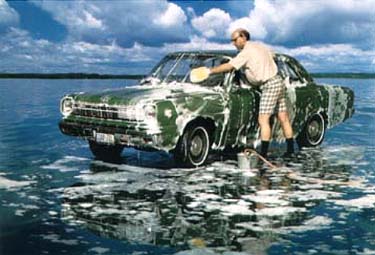
Why do you suppose it is that no one washes a rental car? Think about it. I will confess that in all my years of travel, I’ve never once even thought about driving a rental car through a car wash – no matter how filthy it might have been. There is a very good reason for this. We know that the rental car company automatically washes every rental car when it’s returned. And we know we don’t own the rental car. Our success and happiness is based upon the same concept. Others may help us in our quest for success and happiness but that’s all they do . . . help.

It’s up to each of us to take ownership of our own life. Earlier in my career I relied on a lot of people – and I still do today, but in a different way. There were times in the past when I might have thought, “I’ll do my part but someone else will ‘carry the ball across the goal line.’” As I think back I remember many disappointments along the way where having this mindset resulted in failure. Most likely this is because others were thinking the same way. Not a single one of us truly “owned” a particular project in such a way as to see that we did whatever it took to achieve a successful result. Taking ownership in a work environment doesn’t mean doing everything ourselves. But it does mean that someone (maybe it’s us) must be responsible for seeing that all of the plays are called and executed, and that the team eventually scores. Any time a goal or an objective is set, always remember to ask, “who is going to own this?”

In our personal lives it should be easier. When we ask the question, “who is going to own this,” the answer is pretty obvious. And we need to create some sort of accountability for ourselves to make sure that we follow through and truly “own” it. This accountability might be in the form of a journal, a checklist, working with a buddy or mentor – whatever is necessary for us to take our ownership seriously. If we want to exercise more; lose weight; be more aware of current events; become deeper spiritually; find a significant other; be a better parent, or be more prosperous, the road to success begins with our taking ownership of our situation and committing to see it through to a successful end.

Taking ownership is a liberating experience. In so doing, we cease to worry about whether or not we will succeed. Instead, we live in the knowledge that through our ownership we will achieve whatever it is that we have set forth to do.

This blog is being written in tandem with my book, “An Entrepreneur’s Words to Live By,” available on Amazon.com in paperback and Kindle (My Book), as well as being available in all of the other major eBook formats.

car_wash(2)

Soaring

Question: I’d like to become more imaginative and creative. What suggestions do you have?

Answer: I’ve heard theories that imagination and creativity are innate – you either have it or you don’t. I’ve also heard some people state, “I’m just not a creative person.” In my opinion, everyone is born with imagination and creativity. With some people it’s “closer to the surface” than with others, but it’s still present within every one of us. The key is what we do to bring it into reality.

As entrepreneurs, we tend to spend a lot of time in a left brain mode. We’re analyzing, planning, verbalizing, logical and detail-oriented. But imagination and creativity emanate from the right brain. And if we don’t spend much (if any) time in a right brain mode, how then can we develop our ability to imagine and create the good that we seek? There certainly are things we can do that are outside our comfort zone. What might they be?

I used to read business books and magazines all the time. Nothing else was in my library. Growing up I loved to read, but as I began my career it was all about learning everything I could about business methods, theories and case studies. I participated in education sessions and seminars to obtain a professional designation – all related to my industry. I wrote articles for trade publications. Again, they were all focused on the business of my business. After a few years it became clear to me that my one-dimensional approach to reading, learning and writing wasn’t doing anything to make me more creative or innovative. There is no doubt that I was becoming an expert in my field, but so what? Who wants to be a boring expert? And I noticed that solving problems wasn’t as easy or as fun as it was when I first started my journey.

A course correction was in order for me. I began reading a wide variety of publications. I actually began reading fiction books! Rather than allowing my whole life to revolve around business and more particularly, my business, I decided it was time to be much more curious about a whole lot of things. As a kid, I remember rainy Saturday mornings spent with World Book encyclopedias. I would pore through them in fascination. Somehow I had moved away from exercising my right brain. Living a more varied life was a gradual thing. But I found that the more I got out of my comfort zone and did things unrelated to my business, the more creative and imaginative I became. Today I believe that my levels of creativity and imagination are at an all-time high because I touch everything that I can – music, literature, spirituality, philanthropy, social studies, psychology, sports and the list goes on.

In order for our imaginations to soar we must step out of the forest and into the sunlight. Then we can look around and see beyond our limits. When we become curious about and interested in an infinite number of things, our creativity and intuition will become stronger and new ideas will flow effortlessly.

This blog is being written in tandem with my book, “An Entrepreneur’s Words to Live By,” available on Amazon.com in paperback and Kindle (My Book), as well as being available in all of the other major eBook formats.

soaring

Why Do They Quit?

Question: In this day and age of heightened customer service awareness, why are there still businesses that deliver such a lousy customer experience?

Answer: You are so right about this observation. For a number of years we’ve seen a barrage of books and articles about how companies are more focused on delivering top quality customer service. But for some reason, on a regular basis there’s still a disconnect between the theory and the practice.

For more than 20 years my wife and I went to the same dentist – every six months like we’re supposed to do. During my final encounter with this dentist I asked him to do some minor cosmetic work on my front teeth and inquired as to the cost. He quoted an amount; we scheduled an appointment, and the work was performed. When I received the bill I was in for a shock. It was double what he had told me. Because he is so hard to reach in person during the day, I sent him an e-mail explaining the situation. His response was, “What I quoted was for one tooth.” Now I don’t know about you, but I liken this to having the brake pads replaced on your car and the mechanic gives you a quote for one brake pad. I told the dentist how disappointed I was that he had not made his pricing clearer. He responded that in the future, each patient would receive such a quote in writing to eliminate any confusion. What he failed to do however, was apologize to me and knock some amount (any amount would have been fine) off my bill. As a result, he lost two patients forever. How simple it would have been to show a bit more consideration by simply acknowledging the mistake and making a minor financial adjustment.

Here’s another 20+ year story. A certain pool company has received thousands of dollars from me over that timeframe through opening and closing our swimming pool as well as replacing the liner two or three times and servicing our hot tub. This year the pool was opened on schedule. Normally the cover is removed, chemicals dumped in the water, the pump and filter are started and the crew comes back a few days later to vacuum and finish the clean-up. We’ve had a wet spring and as a result the company fell behind on its schedule and never came back to finish the job. Of course they weren’t hesitant to send me a bill which I quickly paid. I placed several phone calls during which I was told they’d “take care of it.” An e-mail went unanswered. Finally a month later I hired someone else to finish the job and sent a letter to the owner of the pool company terminating their services. Ironically, the same day the opening was finally finished, the pool crew showed up only to realize their job had been completed by another party. To this day I haven’t heard a peep out of the owner of the pool company. And of course he wasn’t honorable enough to refund a portion of what I had paid.

It is important to remember that when serving others the key to keeping a customer happy is honesty and communications. We humans will tolerate an awful lot as long as we feel that we are being treated fairly and have expectations communicated to us in a clear and timely manner. Lack of these elements shows disrespect and is the main reason we quit companies that serve us. Yes, we want performance and quality products. But the way we are treated is equally important if not more so.

There’s a very simple yet powerful adage to remember that will ensure that we will keep our customers happy. It goes like this. Do unto others as you would have them do unto you.

This blog is being written in tandem with my book, “An Entrepreneur’s Words to Live By,” available on Amazon.com in paperback and Kindle (My Book), as well as being available in all of the other major eBook formats.

customer-service

Judgment Day

Question: Where is the fine line between constructive and negative criticism?

Answer: The very word “criticism” has negative connotations for many, so we’re starting from minus territory to begin with. Why? Because criticism is often associated with hurtful, manipulative language. Think about a situation where you feel like you’ve received negative criticism. How does a statement like this feel? “You really screwed up that presentation. You offended the client and couldn’t close the deal. I should have had someone else handle this assignment.” Wow. This sounds like a direct attack on you as a person. It’s no wonder that this type of criticism is not received favorably.

As entrepreneurs we must have thick skin in order to receive criticism of all types. And we must also be able to deliver criticism – but only in a constructive manner. First consider the audience. To deliver constructive criticism it must be perceived as constructive by the receiver. If this person is a highly resilient individual, your criticism may need to be offered more directly and bluntly. Conversely, someone who tends to be more sensitive may need to receive constructive criticism a bit more subtly.

Second, we must measure the intent of our criticism. Do we truly desire to be honest and constructive with what we have to say? Or do we want to send a message of disapproval in order to make the other person feel badly? Sometimes in our personal relationships – with a spouse or significant other – we may have a tendency to be less constructive and our criticism becomes hurtful.

Finally, constructive and effective criticism should always contain some suggestion for improvement. When this is done, our criticism can be perceived as helpful and positive. For example, the statement we read earlier could be modified as follows. “May I make a suggestion? The client may have been offended during the presentation because he thought we were ignoring his needs. The next time, you might consider spending a few moments reviewing the client’s specific needs and then show him how our product meets those needs.” There’s no mistaking that this is a positive and constructive dialogue and will most likely be perceived as intended.

Criticism should be focused on what someone has done or is doing, rather than the person himself. By being honest and appropriately sensitive to another’s feelings, criticism can be used as a positive and productive tool for improvement.

This blog is being written in tandem with my book, “An Entrepreneur’s Words to Live By,” available on Amazon.com in paperback and Kindle (My Book), as well as being available in all of the other major eBook formats.

judgment

30,000 Feet

Question: Sometimes I tend to get caught up in the details and miss the big picture. What should I do to develop my abilities to have a broader focus?

Answer: Life in general and entrepreneurship specifically, is a mixture of strategy and tactics. It is very easy to fall into a routine of dealing with tactics on a daily basis and letting someone else worry about strategy. After all, this subject is a bit fuzzy anyway. The work has to get done and if the details aren’t tended to, then everything falls apart – right?

Actually the reason many people are extremely tactical is because the overall strategy has never been adequately explained to them. Let me give you an example that borders on the absurd, but will illustrate the point well. Let’s say that you are blindfolded and led into the cockpit of an airplane. The blindfold is removed and you are told that your job is to fly the plane. Let’s also assume that you actually know how to fly the plane. Great. Now what? No other instructions are given. Are you supposed to fly the plane to another destination? If so where? Will there be passengers on the plane or are you flying cargo? Maybe this is just a test flight. Are you starting to get the picture? You know how to fly the airplane – that is to say, that you understand the tactics. But you have no idea what the end result is supposed to be – that is to say, the strategy. By now it’s pretty obvious that the “What” is the strategy, and the “How” are the tactics.

Stop and think about you daily routine. Do you understand the strategies to which your tactical efforts are aimed? If you are a leader, how well do you explain the strategies to those you are expecting to implement tactics to deliver said strategies? This may sound like a very simple premise but it’s one of the biggest areas of miscommunication in our lives today. As a result, many people toil in frustration, feeling like one more cog in a wheel that is going nowhere.

Starting today, resolve to understand the strategic aspects of what you are doing. Make certain that you communicate the strategies to everyone involved if you are the leader. If the strategy is to deliver better customer service than any of your competitors, make sure that you clearly articulate this and make everyone aware of the metrics to be used for accountability. If your team understands the strategy, it can develop the tactics that will lead to success. But if the strategy is unclear and poorly communicated, don’t be surprised if you don’t have the buy-in of the team members.

Each of us wants to feel as though what we are contributing matters. Only when the strategy is clear to all do the tactics matter. And then our sense of self-worth can be fulfilled.

This blog is being written in tandem with my book, “An Entrepreneur’s Words to Live By,” available on Amazon.com in paperback and Kindle (My Book), as well as being available in all of the other major eBook formats.

cockpit_B777

Ne’er a Discouraging Word

Question: I’m a pretty optimistic person most of the time. But sometimes when things don’t go quite right I get a bit discouraged. What can I do to avoid these kinds of feelings?

Answer: There is no doubt that maintaining a positive and an optimistic mindset 100% of the time is a high bar to clear. But to be successful entrepreneurs it must be our goal and we must always strive to achieve it. Why? Because an entrepreneur’s worst enemy is negative energy. It saps us of our creativity and our drive. If unchecked, it can trap us in a downward spiral.

I’ve been discouraged at times earlier in my career. And here’s what I learned. Being discouraged never solved one thing for me. Wallowing around in despair never made me feel one whit better. I’m pretty sure that I never made a single nickel as a result of being discouraged. Some might say that discouragement is simply a normal human reaction and that it’s Pollyana-ish to ignore it. Perhaps this is true, but it’s a human reaction that we must eliminate. But how?

Generally discouragement is the result of some sort of adversity. Teaching ourselves not to feel discouraged requires us to examine the way we feel about adversity. Remember this – adversity is a perception and only a perception. It is not reality. What we may have previously perceived as adversity instead is an opportunity for growth and experience. Staying cool, calm and collected when everything seems to be crumbling around us takes courage which is the antithesis of “discourage.” A colleague of mine stepped into his role running one of our business units at a time when that unit was experiencing some significant challenges. He had never run his own business before and not only did he have to learn how to do that, but he also had to learn how to fix some pretty big problems pretty quickly. I am pleased to say that he mastered both and in a big way!

Along the way, my colleague told me that he felt discouraged often. I can remember a number of times when he came into my office in a state of hopelessness and near-panic. There was no doubt that he could not see the light at the end of the tunnel. We talked a lot about how he was choosing to look at his situation. Eventually he understood that he was gaining an amazing amount of experience in a relatively short period of time. He concluded that any adversity he encountered in the future would pale in comparison to what he had initially dealt with. He also started to catch a glimpse of what his business would look like when his “trial by fire” was over. Today he has much thicker skin; he has sharpened his instincts; he has a much more consistently positive mindset, and his business unit is thriving.

When we become discouraged – when the task at hand looks insurmountable – the mindset we choose will lead us to succeed or fail. And if we resolve to maintain a positive perspective and look for the opportunity in adverse conditions, we will succeed beyond our wildest dreams.

This blog is being written in tandem with my book, “An Entrepreneur’s Words to Live By,” available on Amazon.com in paperback and Kindle (My Book), as well as being available in all of the other major eBook formats.

Discouragement

Symmetry

Question: I’m a bit obsessive about some things and it’s causing a bit of friction in my life. How do I know what to be obsessive about?

Answer: I’m certainly an expert on this subject, so you’ve come to the right source. I’m a neat freak; my wife – not so much. In the past that’s driven me nuts. Suits hang in my closet in a certain order; the crease of a napkin always faces the outside; the trash can in the bathroom sits inside a specific floor tile – you get the picture? When it comes to being obsessive-compulsive, I get the grand prize every time.

A number of famous people have various obsessions. Donald Trump refuses to shake hands because of his germ phobia. Cameron Diaz constantly rubs doorknobs to get rid of germs. Justin Timberlake likes to line objects up perfectly. David Beckham and Jessica Alba are obsessive about cleanliness and tidiness.

What I’ve had to learn is how my idiosyncrasies affect others as well as their impact upon my own productivity. Is anyone being hurt by my obsessions? Am I resentful that others don’t conform to my fastidious nature? Trying to convince my wife that she should be in my league when it came to neatness was a fantasy and unreasonable. It finally dawned on me that my constant harping was just causing strife and wasn’t solving the problem. So we hired someone to clean our house to the point that it’s acceptable to me, and I built her an office where she can pile up her stuff to her heart’s content. I’m pleased to report that these compromises have worked.

To resolve my OCD I now ask myself, “Is there a legitimate purpose served with my metaphorical ‘straightening of paperclips’?” For example I’m known for despising the sight of cigarette butts outside the entrances to our apartment communities as well as dirty elevator tracks. Yes, this is an obsession but one I believe to be healthy. After all, the crisp and clean appearance of our properties is important in attracting new residents and retaining existing ones. Verdict – legitimate purpose for this obsession. Here’s another example. I refuse to send e-mails and even text messages with typos and grammatical errors. This seems to fly in the face of the way society communicates today. But for me there are several things in play. I take great pride in using the English language correctly. I also want to send a message to my colleagues, clients and partners that I am exacting and precise. These are qualities that I believe to be important in my line of work. Verdict – legitimate purpose once again.

Life for some of us is symmetrical and for others it’s abstract. Either works. If we lean toward perfect alignment, we need to do so in moderation. While our obsessions may bring a sense of order, they can be destructive if they offend others and no legitimate purpose is served.

This blog is being written in tandem with my book, “An Entrepreneur’s Words to Live By,” available on Amazon.com in paperback and Kindle (My Book), as well as being available in all of the other major eBook formats.

ocd