
The Relationship-Building Entrepreneur

Earth, Wind & Fire recorded a song in 1979 called, After the Love Has Gone. And of course, there was the classic 1976 tune by KISS, Love ‘Em and Leave ‘Em. There’s an eerie parallel between these titles and our relationships – with our friends and with our customers. Remember when we were growing up? Most of us had several friends during our school years. Then we launched our careers and families, and guess what? Many of those friendships went on hold. We found ourselves burning the candle at both ends and struggling to make the kids’ soccer games, juggle business trips with date nights, and generally keep our heads above water. Sound familiar? Gradually we sort of drifted away from all but a very small, close-knit group of friends. If we are introspective about our entrepreneurial lives, is the same thing happening with our business relationships?   

I’ve written before about my philosophy on relationships. I want to build and nurture as many relationships as possible over the course of my career for the purpose of serving them. And I’ve said before that I try to do this without any sense of quid pro quo. Deep at my core I believe that if we are truly committed to serving our relationships in whatever way possible, the Law of Attraction will bring great good into our lives.

So, what happens after the sale? We work hard for six months (sometimes much longer) to build a relationship with a prospective customer. Then she buys what we’re selling. We’re elated and we make sure that the product or service is delivered in fine fashion. Then what? Six months later, what have we done to maintain the relationship? If the customer is going to buy our product or service on a recurring basis, chances are that we’ll stay in touch and continue “selling.” Maybe we will take the customer to a ballgame or out for dinner. But what about a customer that has purchased something and there’s virtually no chance that another purchase will occur in the future? Do we “love ‘em and leave ‘em?

It’s rare that we find an entrepreneur who builds the relationship for the purpose of serving it. Usually there are strings attached. I’ve been on the receiving end of this my entire life. When someone wants to sell me something, they butter me up and shower me with accolades, gifts, and other forms of attention. If I don’t “buy” they may try for a while, but eventually they drift away. If I do buy and there’s not a reason to buy the same product or service again, I’m usually dropped like a hot potato within a week. The National Sales Executive Association says that 80% of sales are made on the fifth through the twelfth contact. This means that a significant amount of time and effort must be invested in building a relationship sufficient to close the deal. This being the case, why would we not want to continue to maintain that relationship in perpetuity?

Some of us may be thinking, “This makes sense. Even though the customer might not buy again from us, keeping the relationship alive could be good for referrals.” Yes, this may be true, BUT once again we’ve attached strings to the relationship. What if we maintained the relationship because it’s the right thing for us to do? What if we maintained the relationship because we genuinely want to help other people? What if we maintained the relationship because it’s a form of expressing gratitude for all the wonderful things that others have done for us? If we’re thinking that we just don’t have time to nurture relationships after the sale, then we are working against the Law of Attraction. There’s good flowing all around us – but if we start putting limits on our relationships, we’re preventing that good from flowing our way.  

Maintaining friendships and business relationships requires intentional effort. When we do so successfully can, we find these relationships can be our most valuable asset.

This blog is being written in tandem with my book, “An Entrepreneur’s Words to Live By,” available on Amazon.com in paperback and Kindle (My Book), as well as being available in all of the other major eBook formats.

The Entrepreneurial Juggler

Have you ever heard of Anthony Gatto? I hadn’t either. Gatto has been on the list of the world’s best jugglers every year since 2003 when the list was first compiled. He started juggling when he was almost four years old and is the only juggler ever featured on a Topps trading card. Among his amazing performances were juggling eight balls for one minute and 13 seconds; nine balls for 54 seconds; seven rings for 15 minutes and six seconds and 12 rings with 12 catches. All are world records. I’ve tried many times and can’t even master juggling two balls – much less eight. I did notice that Gatto doesn’t hold any records for juggling chainsaws – so he must be a pretty smart guy!

For entrepreneurs the obvious metaphor here involves the juggling act that we perform every day. But I want to talk about it in a bit of a different context. The question I want to pose is that of focus vs. diversification. What do I mean by this? I’ve said before that I don’t like to take risks, but I’ll manage risks all day long. This is a Grand Canyon-huge distinction. Taking risks for me is akin to gambling – and I’m not a gambler. Managing risk is a process and allows me to stack the odds in my favor. So, what does focus vs. diversification have to do with managing risk?

There is a school of thought that says we should focus on what we do best. And we should hone our craft to the point that we then are the best at what we do. Several very successful companies are focused on a single product. Crocs, Spanx, Michelin, Roku, and Gorilla Glue are all such companies. They have developed their product to the point that it’s in such high demand that there is no need to add to their product mix. Southwest Airlines has focused for decades solely on flying the Boeing 737 aircraft. The advantages for them are numerous including the way they stock spare parts, train their mechanics and flight crews, route and position planes, etc.

I believe that there is an inherent risk to being so focused on a single product line. This risk includes business cycles where a particular product type might fall out of favor. Technological advances have been known to make many products/services obsolete. Remember Blockbuster Video? It was a high-flyer for a long time and was pretty much focused on a bricks and mortar delivery of videos. But it became so focused that it failed to realize that it needed to change its entire business model and product suite to adapt to rapidly changing consumer preferences. Now the company is out of business.

This brings me to the strategy of diversification. Our organization has always had multiple product lines. In the 1970s through the 1990s, we were primarily involved in the commercial real estate industry with leasing, brokerage, and property management. And we handled office buildings, shopping centers, industrial facilities, and apartment communities. In some years the leasing and brokerage business might be slow, but the property management business would be booming. Then there were times when the opposite occurred. Yet we were able to maintain consistent revenues and margins throughout the various cycles we encountered.

Since 2000 we’ve diversified even more extensively including construction, maintenance service, building components distribution, tax credit syndication, apartment acquisitions, apartment development and venture capital investments (outside of the real estate world). We’ve organized into business units specializing in these areas with a managing director leading each. With this structure each leader can focus on being the best in class. The overall enterprise benefits from a highly diversified product/service offering balanced with a focus sufficient to excel. To accomplish this, a considerable investment was made in human resources to enable the focus and specialization. Our organization also wins with the vertical integration that has resulted. Multiple business units can participate in various internally generated projects as well as provide products and services to third parties.

Keeping a lot of balls in the air requires considerable focus. When we can do both successfully, we are able to minimize the risks that we face as entrepreneurs.

This blog is being written in tandem with my book, “An Entrepreneur’s Words to Live By,” available on Amazon.com in paperback and Kindle (My Book), as well as being available in all of the other major eBook formats.

The Urgent Entrepreneur

Allow me to set the scene. We are about to embark upon a major project that could make or break our company. There are a wide range of complexities involving this project and it will require a supreme effort from our entire team to successfully bring it all together. But there’s just one problem. Invariably someone on the team is not as responsive as necessary or doesn’t seem to possess the same sense of urgency as does everyone else. As a result, the ball gets dropped and we fail. Alternatively, others on the team step in to pick up the slack which creates resentment and hard feelings. How do we effectively deal with this rogue team member that is at the center of all this?

There are several steps that can be taken to stack the deck in our favor when it comes to ensuring responsiveness and urgency. Step one is to develop clear written roles and accountabilities for each member of the team. Considerable thought should be given to this process so that a high level of precision in role definition can be attained. Being as comprehensive as possible in describing a role will produce clarity. Vague and generic verbiage muddles the picture and may lead to confusion later. As team members we have overall roles and accountabilities. For major projects it’s a good idea to dive even deeper into a separate set of intentions for each of us relative to the specific matter at hand.

Step two involves gaining a commitment from each team member. One of the best ways to accomplish this is to hold a team meeting to reaffirm the vision for the project. For example, suppose we are developing a proposal to win a major piece of business. We assemble the team that will be creating and implementing the proposal and paint the picture of what it looks like when we win (vision). In the meeting we review team member roles and accountabilities and ask each person to make a verbal (and maybe even written) commitment to do their part in this endeavor. It’s critical that this commitment be made among those on the team and not just to the enterprise.

The third step is for the team leader(s) to assess the capabilities of each team member. The roles and accountabilities have already been established for each position that will participate in the project. Will the individuals who fill those positions be able to perform the tasks assigned to them? And do they have the tools and resources that are needed to prosecute their roles effectively? If it’s determined that a team member isn’t equipped for his or her role – i.e. skills, training, or experience – then that person becomes the weak link in the chain. A decision must be made at the outset whether to replace that team member with someone else or be prepared to provide greater than normal support for that individual.

Finally, team members should be encouraged to set their own deadlines so long as they are compatible with the overall project timeline. When a deadline is imposed by others, there’s always the opportunity for someone to claim it to be unrealistic. Accountability is first to oneself and then to the team. Self-imposed deadlines are congruent with this approach to accountability. As team leaders it’s equally important for us to be aware of all deadlines and check with team members well in advance of them. Then if there’s a chance that a deadline will be missed, we can muster additional resources or take other steps to make sure that the train still runs on time.

Instilling responsiveness and a sense of urgency within a team is a process. When we clearly define roles and accountabilities, obtain commitment, assess capabilities and resources, and work with team-member established deadlines, the process should put us in a position to win the prize we are seeking.

This blog is being written in tandem with my book, “An Entrepreneur’s Words to Live By,” available on Amazon.com in paperback and Kindle (My Book), as well as being available in all of the other major eBook formats.

Is the Grass Really Greener?

The U.S. unemployment rate is at its lowest since 1969. As I’m writing this, unemployment is hovering around 3.5%. Companies are becoming more and more creative in their recruiting efforts. From an employee’s perspective, times have probably never been better. There’s certainly a temptation to job-hop the way up the compensation ladder in the belief that an employer is going to be much more generous than would have been the case during the Great Recession and for many years thereafter. But the question must be asked, is the grass really greener on the other side of the fence?

Everyone knows that there’s much more to a career than a paycheck. Those who blindly chase the dollars may get what they want – but there may be a whole lot more than they bargained for. I know many people who were thrilled with the amount of money they were going to make only to find out that their new boss was ridiculously difficult, the stress levels were off the charts and working conditions were abysmal. Yet, it’s very tempting to jump at the chance to make a lot more money and pick up a cool new title. So, how should we look at the “grass” on the other side of the fence?

Over the past 48+ years, I’ve had numerous opportunities to make the jump. I resisted every time. Why? Long ago I realized that 1) I was working for and with honorable people; 2) I was allowed incredible freedom to be creative and experiment, and 3) I was working in an industry that I loved and had dreamt about since I was in the 8th grade. You’ll notice that nowhere did I mention money. The reason is simple. I was allowed to continually figure out how to add value to whatever I was pursuing, and my compensation increased accordingly. This approach is my suggested template for viewing the “grass is greener” dilemma.

I’ve always believed that most people work a job. A few pursue a career. And then there are those of us who are lucky enough to live our passion. I don’t think I’ve felt at any point in time (after the first three months in the mid-1970s) that I was working a job. For a while I was pursuing a career. But for most of my adult life I’ve been able to live my passion. This is important to understand for it’s one of the three foundational elements to answering the “grass is greener” question. Each of us must find our own passion to pursue, and the sooner the better.

Let’s assume that we generally know that we are in the right industry – yes, I know – that’s a big assumption to make. But we must start somewhere. This brings us to the other two foundational elements. Am I working for and with honorable people? There’s much more to this question than its literal interpretation. What is the company’s culture? Is there a vision of where the organization is heading? Are there core values that are more than slogans in a fancy frame on the wall? Are employees valued and treated fairly? Do senior leaders express gratitude? Do they seek out feedback; listen to it, and act upon it? No situation is going to be perfect. But if the environment is comfortable and efforts are constantly being made to improve, that’s a good sign that we are amid honorable people.

Finally, we need to measure how likely we will be to succeed over the long haul. In my case, I was pretty much allowed to make my own way. Sure, I had specific roles and responsibilities, but I always wanted to do more and be more. I saw a myriad of opportunities and developed plans to exploit them. I made plenty of mistakes – more than I can count. But I was allowed to make them and learn valuable lessons in the process. I always figured that if my successes exponentially outweighed my failures, I was on solid ground. And that turned out to be true. You’ve likely heard the adage, “the cream rises to the top.” If we are working for and with honorable people, we can always know that we earn more trust and more latitude through our performance.

Ultimately there’s no need to look at the grass on the other side of the fence so long as we can grow a lush, green lawn on our side. When we do this, we’ll surely reap the benefits accordingly.

This blog is being written in tandem with my book, “An Entrepreneur’s Words to Live By,” available on Amazon.com in paperback and Kindle (My Book), as well as being available in all of the other major eBook formats.

The No-Struggle Entrepreneur

How many times have you heard that entrepreneurship is a struggle? Heck, we’ve all heard how life in general can be a struggle. But is it really? I think it’s worth exploring the notion of “struggling.” Various definitions of the word “struggle” reference adversaries, opposing forces, bodily effort, fight, conflict, or contest. I’m just not feeling it.

Let’s paint a picture. Three years ago, Entrepreneur Ed launched his new enterprise. He has encountered many interesting issues along the way. There have been untimely resignations of key team members; nail-biting moments when it was questionable whether he would make payroll; a patent infringement lawsuit; shortages of raw materials that were critical in producing Ed’s product; brutal competition resulting in a price war; cancellation of a liability insurance policy, and the loss of a key customer. Many might say that the last three years have been a “struggle” for Entrepreneur Ed, after all, it appears that he has faced a great deal of adversity. But Ed doesn’t see it that way.

Here is Ed’s perspective. What others see as negative experiences Ed sees as puzzles to solve. Challenging – sure! But Ed believes that what doesn’t kill him will make him stronger and smarter. The utopian view would have us sail along on calm seas growing our businesses from 8 to 5, then going home to play with the kids and spend weekends at the beach. Uh, sorry, it doesn’t work that way. What matters most is the mindset we have as we move through the course of each day. Do we feel like we’re on a perpetual treadmill, grinding away and being attacked from all sides? Do we wonder when the proverbial “other shoe” is going to drop? Perhaps we have become totally overwhelmed to the point of depression. It doesn’t have to be.

Here’s the antidote to the “struggle.” We know we’ve signed on for an adventure – both in the entrepreneurial world and for life in general. That adventure is going to be whatever we make it. If we are fearful and expect disaster . . . we’re likely to find ourselves with a front row seat on the deck of the Titanic as it slowly sinks into the North Atlantic. However, every challenge does not need to end in catastrophe.

We have been rapidly scaling our companies for the past few years. There have been many moments when someone looking in from the outside might believe we were seconds from colliding with a massive iceberg (sorry, I can’t seem to shake out of the Titanic metaphor). I have never believed for a moment that we were on the wrong course. I’ve seen each challenge as a positive opportunity for creativity and growth. And guess what? It’s working! Every time we think we’re flirting with disaster we seem to pull a rabbit out of a hat – except there’s really nothing magical about it at all. Instead, we have a well-thought plan, and we have an extremely positive mindset. We know there will be detours along the way. Sometimes we’ll have to backtrack to find the trail, but we are never lost, and we are always focused on our vision.

As I write this, it’s worth noting that I’ve been with the same company and on the same quest for nearly 49 years. I can now look back and realize how incredible the ride was. Did it ever seem like a struggle? There definitely were times early in my career where I wondered if we were going to survive. But the older (and maybe wiser) I’ve become, the more I’ve come to understand that success comes from within us. While there may be some external influences, it’s really all about how we see the world when we get up in the morning; how we choose to look at each experience throughout the day, and the impression with which we are left when our head hits the pillow at night. In other words, we’ll struggle if we believe we are struggling. Or we’ll see the incredibly short time we are riding this planet as a golden opportunity for experimentation, innovation, mastery, and joy.

We throw off the chains of “struggle” when we embrace a life filled with positive energy and gratitude. And then we can pursue our purposeful vision with confidence.

This blog is being written in tandem with my book, “An Entrepreneur’s Words to Live By,” available on Amazon.com in paperback and Kindle (My Book), as well as being available in all of the other major eBook formats.
Third Choice Was the Right Choice!

Every successful entrepreneur needs inspiration. This can take many forms and there can certainly be multiple elements of inspiration throughout our careers and our lives. I’d like to tell you a story about one such inspiration that has been a constant throughout the past five-plus decades.

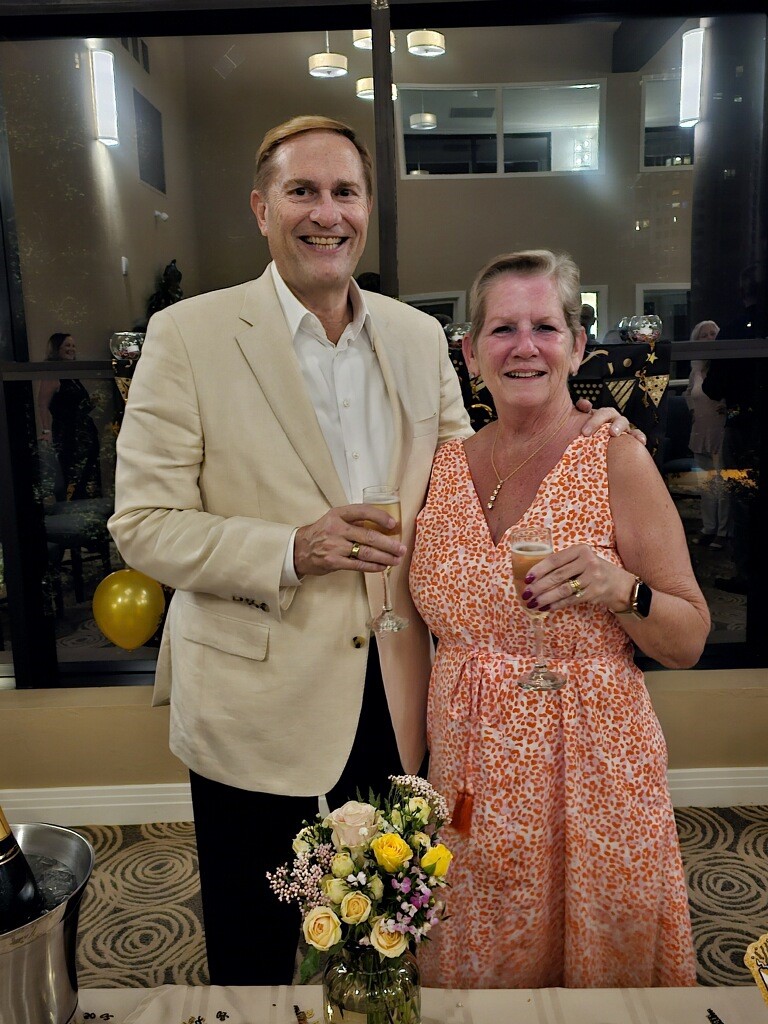
Barb and I grew up in the college town of Manhattan, Kansas. We sang in the church choir and casually got to know each other as a result. On June 6, 1971, we were putting our robes away after church and I saw this newly minted 16-year-old very shy girl walk up to one of my friends and ask him if he would be her date for a dance that was being sponsored by an organization to which she belonged. He summarily said, “No.” She then approached another of my friends and asked him the same question. He told her he was going to be out of town (or some such excuse). Finally, she made her way to me with the same inquiry. I was third choice!! I promptly told her that I needed to check with my mother. A day or so later I called and said I would accompany her to the dance.

On June 19, 1971, the big day of the dance arrived. It was a statewide event and was held on the Kansas State University campus. Now get this – there were 500 girls, 500 mothers, and three guys – I was in the group of three. At 17, I was a VERY experienced dater, and I must tell you that this was the worst date I’d ever been on. But there was something magnetic about this girl, and a couple weeks later we went to a movie and got a bite to eat – and it turned out to be a great date. And the relationship bloomed thereafter.

Roll the tapes forward to January 5, 1974. It was a bitterly cold night – minus five degrees was the actual temperature and there was snow on the ground. On that night, an 18-year-old girl and a 19-year-old boy tied the knot . . . and that was back in the day when you had to wait nine months to prove to everyone you didn’t have to get married. We smartly waited seven years to bring our daughters into the world. The ensuing decades have been a whirlwind. Much laughter, a few sorrows, tremendous successes, and many wonderful memories have been made. Through it all, Barb has been the center of my universe to which I will be eternally grateful.

We don’t talk about business very much though I tell her anything she wants to know. She was a nurse in the neonatal intensive care unit at Children’s Mercy Hospital in Kansas City for 29 years before she retired. She has a wide range of interests and activities – but above all, she “levels me out” which helps keep my Type A personality in check. We celebrated our 50th wedding anniversary a couple of days ago and I surprised her with a trip she never thought we would take, and a surprise party with our friends. Her tears of joy flowed throughout the evening, and I was overwhelmed with the knowledge that I had made her so very happy.

As an entrepreneur, it’s fascinating to see how the twists and turns in my life have resulted in the kind of inspiration I have experienced since that first date in 1971. Barb’s calm, unflappable demeanor has been critical to the positive energy that I’ve channeled into my career. We trust each other unequivocally which has developed into a partnership of equals with shared responsibility and 100% respect for each other. I can practice my professional craft knowing that I have a rock at home who is my biggest cheerleader and advocate. Our love for each other grows by the day – and having such a deep foundational relationship has allowed me to express my creativity in a multitude of ways. If I fail at something, she does not judge me. If I succeed at something, she celebrates with me. This sort of unconditional love is an accelerant for my entrepreneurial instincts.

I pinch myself every day knowing how fortunate and blessed I am to have been third choice! What an inspiration this beautiful, amazing, not-so-shy (now), wonderful woman has been to me! I love you forever, dear!

This blog is being written in tandem with my book, “An Entrepreneur’s Words to Live By,” available on Amazon.com in paperback and Kindle (My Book), as well as being available in all of the other major eBook formats.

The “We” Entrepreneur

Entrepreneurship is a team sport. Successful organizations are built on the collective effort of many talented and dedicated people. As leaders, we need to look for every opportunity to acknowledge the contribution of others. I’ve seen study after study that tells us that recognition and appreciation is very important to the culture that we are building – in some cases it is valued as highly as compensation and benefits. And yet there are countless instances where leaders shine the spotlight on themselves and take the credit for a successful endeavor. How does this manifest?

A business leader has been asked by a reporter how his company competed for and won a very large piece of business. Listen to how this statement sounds. “I have had a long-term relationship with the client and have worked for years to get to this point. I developed an innovative strategy that worked just as I thought it would. It’s all queued up so that all my employees must do is execute.” A more thoughtful leader might have said it this way. “We have had a long-term relationship with the client, and our team worked hard to develop and implement an innovative strategy that was spot-on. Our entire organization had a hand in this success, and we are grateful to each and every team member for their contribution. We especially want to thank Alice Doe and John Smith who led the effort.” Notice the second statement did not contain the word “I” a single time? It was filled with the words “we” and “our.” It acknowledged the entire team and focused the spotlight on those team members who were at the forefront of the initiative.

What does it take to become a “We” Entrepreneur? First and foremost, we must have a genuine and authentic attitude about who gets the credit. If we are secure enough in our own skin, we check our ego at the door and do whatever we can to shine the spotlight on the good work provided by members of our team. This means that we must reverse some of the patterns we received as children. When I was young and attending school, we were praised for properly answering a question posed by the teacher. While there was nothing wrong with this, it did create an attention-craving atmosphere for some students. We wanted to receive the approval from an adult which was our proof that we were worthy of their accolades. Parents, teachers, coaches, and a host of other adults were a party to this endless cycle.

Breaking out of the childhood approval-and-acceptance-seeking mode to become an authentic “We” Entrepreneur requires a couple of steps. First, we need to come to a deep understanding within ourselves that we are worthy. In the early years of my career this was a difficult concept because I had little to no experience. I felt a compelling need to prove to the world that I belonged in the big leagues. Eventually I found that when I excelled, my actions spoke louder than chest-beating. In other words, we develop the understanding of worthiness by challenging ourselves and steadily performing at high levels.

Once we have developed a strong sense of self-worth, we look for ways to focus on the accomplishments of others and celebrate when they occur. In other words, we fix the “inner” (me) first and then move to the “outer” (others). This will take practice. We won’t become adept at the “We” concept overnight as I, me, my and mine will creep into our consciousness periodically. Here’s something that helped me and I still do to this day. When I write an e-mail, a text message, a letter, or any other form of written communication, I review it before sending and remove any I, me, my and mine references and replace them with we, our and us, wherever it makes sense. This approach helps keep me mindful of my mission to be a “We” Entrepreneur and spills over into my verbal communications as well. And after doing this for an extended period, it will be more than just a communications tool – you’ll really believe it! We will see the value in the contribution of others and be truly grateful. At that point our acknowledgement will become a genuine part of our persona.

The “We” Entrepreneur is gracious and unassuming. He or she is always appreciative of what others contribute to the success of the team and makes a special effort to shine the spotlight accordingly.

This blog is being written in tandem with my book, “An Entrepreneur’s Words to Live By,” available on Amazon.com in paperback and Kindle (My Book), as well as being available in all of the other major eBook formats.

The Bus Riding Entrepreneur

Here’s a scenario. Sales are flat. The product development team is feuding with the marketing folks. Production is lagging and customer complaints are trending in the wrong direction. Sounds like a nightmare situation – right? It’s at a time like this that makes us wonder why we became entrepreneurs in the first place! As we try to sort out this mess, something becomes quickly apparent. We have the wrong people on the bus.

The whole problem wouldn’t even have existed if we had selected the right people in the first place. But for most of us, we are where we are and must deal with an unwise hire here and a hopeful hire there. Rarely do we make the right hiring decisions from the get-go and find smooth sailing forevermore. Something I’ve grappled with for decades is when to change out the people on the bus – and sometimes the bus driver to boot! The mistake I’ve made over and over has been to give people too many chances and believe that if I just find the “right slot” for someone, that I can “save” him or her. In recent times I’ve come to realize that we’re not in the business of doing social work and it does no favor to someone who is miscast to continue to try and salvage them.

Most of us have a level of empathy that prevents us from being the type of person who simply says, “You’re fired!” But there’s undoubtedly a middle ground. We don’t have to have a hair trigger and instantly terminate someone who is beginning to struggle. And we also don’t need to continue to enable someone for months or even years who can’t get the job done.

As with much about entrepreneurship, there is a process that can make the decision to invite someone off the bus both humane and timely. We start with clear written roles and accountabilities. It’s imperative that our team members truly understand what is expected of them. Roles and accountabilities should be quite comprehensive, and they must be measurable. We also must make sure that our team members understand how to perform their roles and accountabilities and that they have the proper resources to succeed. If I tell a non-pilot that he is responsible for flying a passenger jet from New York to LA I can be very clear about this. But if he’s not trained to fly the plane, then it will either fail to get off the ground or if it does, well, what happens might not be pretty. I realize that this is a bit of an exaggeration, but it illustrates the point.

Hand-in-hand come key performance indicators. These are the metrics by which we determine if the roles and accountabilities are being sufficiently executed. Ongoing performance reviews are also an important element in ensuring that the right people are on the bus. Some companies do an annual performance review. This may be fine in a formal sense, but team members need a continual feedback loop. Then there will be no surprises when the annual review is performed. It’s also helpful (and often judicious) to offer a written assessment as part of the continual feedback process. It’s not so much to build the file as it is to make sure that everyone is on the same page regarding where improvement is needed.

Often when things are going poorly, it’s the result of a lack of roles and accountabilities; or a lack of training; or a lack of proper resources to get the job done; or a lack of measuring results; or a lack of providing team member feedback, or all the above. When this happens and we must make a change in personnel, we dread having to act. Why? Because we know deep inside that we probably didn’t do everything necessary to be completely fair with our team member.

Ensuring that we have the right people on the bus is a strong step toward building a successful culture and producing the results we desire. And following a well-designed process to invite people off the bus who aren’t the right fit will allow us to act objectively and at the right pace.

This blog is being written in tandem with my book, “An Entrepreneur’s Words to Live By,” available on Amazon.com in paperback and Kindle (My Book), as well as being available in all of the other major eBook formats.

The “Looking for the Good” Entrepreneur

When you look at me, what do you see? When you look at others, what do you see? Am I judged by my appearance? Are you skeptical or wary? These thoughts offer an interesting commentary on our society in general and on entrepreneurship in particular. Here’s what I have observed – about others and sometimes about myself. Are we looking for the good in our fellow man, or are we focused on finding fault? The political situation has disproportionately magnified this concern. Our country is so divided and partisan that it’s easy to instantly brand another person based upon what we perceive to be their ideology. Rightly or wrongly, if they are branded as a liberal or conservative; a Democrat or Republican, we may automatically draw conclusions that don’t serve us well.

I am renewing my efforts to work harder to see the good in others; to help build others up, rather than tearing them down. Does this sound trite? Think about it for a moment. Jonathan is negotiating to purchase a piece of equipment for his factory. There are major dollars involved and he has located the item that is only slightly used. Jonathan’s first thought is, “I wonder how I’m going to get screwed by the seller?” Right out of the blocks he’s telling the universe that he expects to be taken advantage of. He knows nothing about the individual who is selling the equipment. When asked why he feels this way, he responds, “Well, you can’t trust anyone these days.” Wow! We’ve all heard this before. But why would we set expectations this way? The transaction is immediately infused with negative energy from the start.

Here’s another one. Molly is the 28-year of vice-president of marketing at a consumer products company. While interacting with a prospective client who is in his sixties, he makes a rather inartful comment. Molly is immediately triggered into thinking that she is being harassed. The comment was harmless to the client from a generational perspective, but Molly now sees him as a horrible person. From this point forward, everything he says and does is seen by Molly in a negative light.

Here’s the last example. Henry is interviewing candidates to fill a software development position. One individual had a very pronounced southern accent and was slightly overweight. These traits were off-putting to Henry, and he scratched the candidate from consideration. This was a classic case of “judging a book by its cover.”

Now let’s look at the flip side of these encounters. For Jonathan, he had no idea that the company selling the used piece of equipment had a new piece of equipment arriving within two weeks and needed to quickly remove the old piece. To accomplish this, the company marked down the price significantly to move it.  The equipment had been maintained in pristine condition and was truly a bargain. Instead of her knee-jerk reaction to the older client, Molly might have chalked it up as a comment that was not intended to be offensive and watched to see if there was any other behavior that warranted concern. Finally, had Henry tested his candidate, he might have found a brilliant mind hiding inside that southern good old boy.

Ronald Reagan once used the term, “trust but verify” when answering a question about nuclear disarmament. This concept remains as viable today as it was back in the 1980s. Rather than thinking the worst about others, we instead genuinely think the best about them and through our interactions, verify that they deserve our positive feelings and goodwill. Instead of being on guard all the time, we embrace others and reject the notion that they intend to do us harm. If at some point it is clear they are intentionally breaking our trust, then we change our feelings toward them.

Our entrepreneurial endeavors are enhanced when we see the best in others. When we establish our relationships in a positive manner they will flourish. When we help build others up, both parties will be the beneficiaries. Several years ago, I had the opportunity to begin working with an individual that represents a company with which we’ve done business for years. Another member of our team had previously dealt with him numerous times and had negative things to say about their encounters. I chose not to have preconceived notions about this individual and after several e-mails and conversations, found him to be most pleasant and helpful. He conducted himself honorably and while a little slow with his responses, always managed to follow through. I believe that if I had bought into my teammate’s feelings, my interactions might have been less positive.

When we adopt the trust but verify attitude, we can build strong and lasting relationships that will flourish over time. Thus, when you ask me what I see, I say that it’s all good.

This blog is being written in tandem with my book, “An Entrepreneur’s Words to Live By,” available on Amazon.com in paperback and Kindle (My Book), as well as being available in all of the other major eBook formats.
Timeless Leadership Ideas

There’s an interesting article by Stefan Stern from the Financial Times publication dated November 10, 2008. “While cleaning out his attic, a British business leader stumbled upon some typewritten notes on leadership from the 1950s. ‘Leadership is the art of influencing a body of people to follow a certain course of action, the art of controlling them and getting the best out of them.’” Sounds kind of old-fashioned, doesn’t it? The art of controlling them? That’s an attitude that’s not likely to win many awards today. The article and this statement got me to thinking about leadership. And because I’ve lived long enough, I’ve had the good fortune to experience many different leadership styles. So, here are some personal observations that have helped me develop my own leadership style.

Entrepreneurs are often “quick on the draw.” A team member asks a question or brings us a problem and our instinct is to provide the answer or solve the problem. Then we move on . . . quickly. In the old days, that would probably have been considered “leadership.” One of my goals is to develop a sustainable organization that is no longer dependent solely upon me. If I answer every question and offer every solution, how does this support others in their quest to step-up and become leaders in their own right? I believe that leadership involves leading people to answers and solutions rather than simply telling them.

I’ve heard of certain pro athletes and several entrepreneurs who say it’s not their job to be role models. It seems to me that anyone who has the megaphone ought to savor the opportunity to set an example for others. Doing so also enables us to become more accountable to our team. Back to the sustainable organization concept for a moment – do I want to display anger; yell at people; exhibit boorish behavior, and generally put my ego front and center? When I model this way, what message does it send to up-and-coming leaders? Here’s the simple truth for me. I don’t want to show any sort of negative behavior for which I should apologize.

One of the toughest aspects of being an entrepreneur is communicating our vision to our team. Most of us have a vision of some sort locked away in our brains. I was asked for years by my teammates for my vision, but never could figure out how to articulate it clearly until recently. Having a vision and communicating that vision are two entirely different things. When I mentor other entrepreneurs, I ask them a very basic question. What does it look like when we get there? Focusing on this question eliminates the psychobabble and gets to the heart of the matter. In plain English it requires that we paint a word picture that everyone can understand. We should never forget that people are drawn to leaders who can express a strong and powerful vision.

As a leader, how much time do you spend working on your business rather than in your business? I can tell you that I love doing complicated real estate deals. Without question, that’s working in my business. It would be very easy (and profitable) for me to focus all my time and energy on buying and owning apartment properties. But that doesn’t advance the cause for the sustainable organization that I have envisioned. Thus, I must spend significant time working on my business. This involves developing a wide range of strategic initiatives, cultivating, and educating team members, and helping to define our mission. A great leader will spend far more time working on his or her business than working in it.

While there are many other modern leadership traits to be explored, the last one on which I want to focus is that of attitude. Leaders with negative attitudes generally produce negative results. Over the past four-plus decades I think I’ve become more and more positive and optimistic. I realized that it’s not much fun to work in a negative environment. And as a leader, if I’m down-in-the-mouth it’s hard for that attitude not to become contagious. I’ve come to realize that there’s always a silver lining in every situation and it’s my aim to find it. This doesn’t mean that negative things won’t happen – they do. But the faster we can move on and regain positive footing, the faster we’ll get back on track. It’s my goal to be a positive and optimistic leader every second of the day.

Modern leadership still embodies ageless basics and fundamentals that, unlike bread, never grow stale. But there are some “new age” twists that help propel us to new heights of success and create sustainable organizations in the process.

This blog is being written in tandem with my book, “An Entrepreneur’s Words to Live By,” available on Amazon.com in paperback and Kindle (My Book), as well as being available in all of the other major eBook formats.