
The Hustling Entrepreneur

The legendary Sir Richard Branson was 16 when he launched his first business venture in 1967 – a magazine called Student. He followed this with a business selling records through the mail. Thus, was born Virgin Records and ultimately a multitude of companies under the Virgin brand.

Mark Cuban was 25-years old when he started software company, MicroSolutions. Seven years later he sold it at a price that put $6 million in his pocket. He reinvested his winnings into another of his start-ups, Broadcast.com, which netted $5.7 billion when sold.

John Paul DeJoria bounced around in the foster system as a boy. He was involved with crime and spent time in the military before he borrowed $700 to start John Paul Mitchell Systems. His humble beginnings included door-to-door sales and a lot of blood, sweat and tears. Later he founded Patron tequila, another killer brand. Today he’s worth more than $3 billion.

What did all three of these entrepreneurs have in common? They were all “hustlers.” I know that when many of us hear that term, it doesn’t have positive connotations. We have images of a smarmy, greasy, fast-talking character who is constantly trying to run a con. But this isn’t the kind of hustle to which I refer. Instead, this kind of hustle is all about a desire to win.

Entrepreneurs who have hustle are resilient. They are creative and they are fearless. The easiest way to describe an entrepreneurial hustler is to look at the parallel of a hard-fought basketball game. We’ve all seen players scrambling after loose balls, flying into the stands, and throwing themselves onto the floor. They are willing to sacrifice their bodies with reckless abandon in their quest to achieve victory.

When we hustle we have a warrior’s mindset. Our initial focus is on survival. How many successful entrepreneurs started from deep and dark places? Remember how J. K. Rowling faced tremendous adversity in the early days before her celebrity as the author of the Harry Potter books? Her mother passed away; she gave birth to a child and went through a divorce; was clinically depressed and lived on welfare for a time. But her only choice was to write to survive. When we are ready to curl up and hide from the world, we should remember how others were able to make it through the tough times and come out the other side stronger and ready to whip the world. Resilience is a major key to survival.

Perhaps our business isn’t growing like we planned. Maybe we’ve even seen it slide backward. Now is the time to get into “hustle mode.” This can take many forms but the most important is a mindset of renewed determination. We examine our strategy and tactics so that we can make the necessary adjustments . . . with renewed determination. We push to new levels of innovation . . . with renewed determination. And we may even do things we’ve never done before . . . with renewed determination, so that we can survive.

Eventually we begin to achieve momentum. We begin to win. And we continue to hustle. Our mindset shifts away from simple survival, and the focus is now on how to thrive. We are relentless in discovering ways to become even more creative. We absolutely, positively, know that we are going to succeed. Our “hustle” now involves an even greater sense of urgency along with commitment and dedication to setting our goals even higher. We ignore our critics and all the naysayers. We work hard and we endure the pain. There is no question we’ll make many sacrifices along the way. I can remember in the early years of my career when we were building our business. We had passed the point of survival and were beginning to thrive. I would sometimes arrive at work very early – 3:00 AM. And I would meet another colleague who was leaving to go home for a few hours of sleep. We were hustling and we were winning.

The entrepreneurial hustle often begins with survival and eventually results in a breakthrough where we thrive. Resilience, hard work, creativity, a fanatically positive mindset, and laser like focus are some of the more important factors to this equation.

This blog is being written in tandem with my book, “An Entrepreneur’s Words to Live By,” available on Amazon.com in paperback and Kindle (My Book), as well as being available in all of the other major eBook formats.

Keep the Line Moving

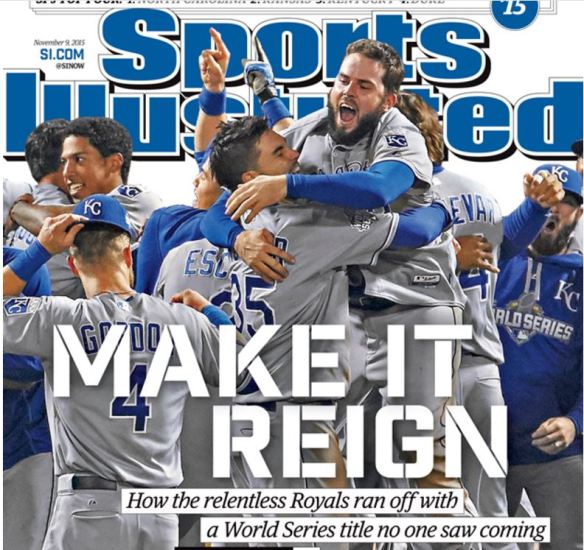
In November 2014, I wrote a blog about the Kansas City Royals major league baseball team and its losing effort in the World Series. A year later I’m pleased to once again write about the Kansas City Royals and the World Series . . . but this time the outcome is different because the Royals won the Series in five games. There’s a real symmetry with the parallels between how the Royals won and how entrepreneurs can win.

The 2015 Kansas City Royals was not a team of superstars. They were not a team of power hitters swinging for the fences and hitting the ball out of the park. In fact, Kansas City only hit two home runs during the World Series, and one was inside-the-park. The Royals won for a combination of reasons. First, all of the players bought into the culture and the plan that was conceived during spring training to win the championship. The players were aggressive at the plate and simply aspired to hit the ball and put it in play. They were intentional about trying to make contact with the ball and send it through the gaps. Once a player was on base the mantra became “keep the line moving.” In other words, the key to producing runs was to generate singles, doubles, walks – whatever it took for the next player to get on base and advance runners across home plate.

Kansas City players and coaches spent considerable time doing research on their opponents. But it didn’t stop there. They also analyzed data on the umpires to understand how strike zones were being maintained. They watched how certain infielders threw the ball to first base; how quickly outfielders got the ball back into the infield and the tendencies of pitchers with their windup motions. The Royals used this information to decide when to stretch singles into doubles – or when Eric Hosmer decided to make a mad dash from third base to home on a ball hit to the third baseman in Game 5. This was a team that hustled. This was a team where it was obvious that all of the players were having fun and enjoyed playing the game. Probably the most amazing trait of the Kansas City Royals was their ability to come back from being behind in the later innings of a game and win. Seven times in the postseason they came from multiple runs behind to win, and outscored their opponents 55 – 11 after the sixth inning. Every player believed that no matter what the odds, they would win and they literally willed it so.

Each of our entrepreneurial endeavors would be well served to use the 2015 Royals as a model. Do we have superstars in our midst who require the feeding of big egos? Do they sulk or create drama when things don’t go their way? Are we focused on hitting the big time, or do we work hard to apply the basics and fundamentals that produce the singles (and sometimes a double) in our everyday business lives? Have we developed a winning culture within our organization that values the contribution of every team member? Christian Colón, a Royals backup infielder, hadn’t played a single game in the post season. And yet he was asked to bat in the 12th inning of the final Game 5 against the Mets. Down in the count with two strikes he proceeded to hit the go-ahead run that led to the championship. Manager Ned Yost trusted Colón to bat as a backup just as he trusted every starting player on the team.

Are we sticklers for diving in and digging up data, then translating it into the myriad of ways that will help us win? Is our team all about hustle and having fun? Do our team members have resilience and a comeback mindset? When the chips are down do they give up or do they truly believe that they can cobble together whatever it takes to put a W on the scoreboard? Sports often offer a plethora of wonderful metaphors that correlate with the business world. But the winning ways of the 2015 Kansas City Royals may be the ultimate example in this respect.

“Keep the line moving” is both an aspirational and an inspirational business concept. It certainly worked for the Royals and is a winning notion for us as entrepreneurs.

This blog is being written in tandem with my book, “An Entrepreneur’s Words to Live By,” available on Amazon.com in paperback and Kindle (My Book), as well as being available in all of the other major eBook formats.

Royals World Series