
Oh Those Surly Bonds

I’m proud to say that I’m an entrepreneur in a state of denial. And I suggest that you too should be in a similar state of denial. Why you ask, would an entrepreneur want to be in denial? After all, we’re eternal optimists and have a never-say-die approach to everything . . . right? Here’s what I’m in denial about.

I deny fear. I realize that fear freezes me into a state of inertia, or causes me to make irrational decisions. Fear saps my energy and causes me to ride an emotional roller-coaster. Fear robs me of my creativity and my initiative. I will not be afraid.

I deny all thoughts of self-doubt. Self-doubt is my mortal enemy. It causes me to question my instincts and clouds my intuition. I become tentative and worry about making mistakes. Self-doubt destroys my confidence and causes me to question my abilities. I will not allow self-doubt to manifest in my life.

I deny any belief that I’m a victim. There may be times when I feel that I’ve been wronged or believe someone has done something that prevents my success. I realize that when I feel victimized I’m giving away my power to someone else. Playing the victim fills me with negative energy. I will not be a victim to anyone for anything.

I deny all thoughts of lack and limitation. I stop myself when I start to utter phrases such as, “I can’t because,” “I’m not able,” and “if only.” My entrepreneurial spirit is dulled when I think that I am limited in some way. I realize that the only limitations I have are those that I place upon myself. I will not allow thoughts of lack and limitation to creep into my consciousness.

Being in denial about fear, self-doubt, beliefs of victimization, and thoughts of lack and limitation is only the first of two critical steps. It’s not enough to simply deny these negative factors. We must replace them with positive action-oriented affirmations. I deny fear and embrace faith. I deny self-doubt and have total confidence in who I am and what I’m doing. I deny any belief that I’m a victim and take full responsibility for my actions. I deny all thoughts of lack and limitation and know that my opportunities have no bounds.

Denying that which will inhibit me and affirming the positive direction I will take, allows me to release the surly bonds that hold me. And then I can soar to new heights.

This blog is being written in tandem with my book, “An Entrepreneur’s Words to Live By,” available on Amazon.com in paperback and Kindle (My Book), as well as being available in all of the other major eBook formats.

space-shuttle-atlantis

Grrrr!

I know someone who always seems to have the worst luck with personal encounters. This person relates harrowing tales of being cut off by other drivers and nearly having an accident on a daily basis. This person is regularly aggrieved by others – slights of all types and magnitude. This person is opinionated and not the least bit shy about sharing views on a wide range of subjects, often causing discomfort for others. In short, this person lives in a constant state of conflict.

Conflict can be a healthy thing if it’s properly managed. But I sure don’t want to live there. Some people dread and avoid conflict as much as others seem to constantly be embroiled in it. As entrepreneurs it’s next to impossible to completely avoid situations where conflict may arise. And trying to do so may damage our relationships if we fail to be genuine and authentic for the sake of what we perceive as “keeping the peace.” So just how should we manage conflict in a healthy manner? I have learned through experience that there are four elements to managing conflict.

First, we must never play the victim. Conflict begins when we give someone else our power by letting our feelings be hurt or believe that we are being taken advantage of in some way. These feelings bubble up and our resentment builds as we buy into this story that we are telling ourselves. It’s critical that we break this cycle before it starts thereby allowing us to avoid wallowing in and exaggerating the fiction that we have created. Of course there may be instances where someone really is trying to hurt us and take advantage of us. But if we don’t give our power away the perpetrator won’t be able to escalate the conflict.

Second, maintaining a positive attitude is critical to successfully managing conflict. After we eliminate any stray feelings of victimization we need to shift into a 100% positive frame of mind as quickly as possible. Our positive energy is vital to creating the end result that we desire. Think about it. Are we more likely to end up in a good place with negative energy or positive energy? The choice is pretty simple.

Third, we stay in “fact mode.” Let’s assume for a moment that the conflict involves an employee who has accused you of showing favoritism to another employee. The accuser is so upset that he has pleaded his case to a number of his co-workers, causing a minor uproar in the organization. You know this guy is flat wrong but you resist the temptation to feel like a victim and take offense that your integrity and leadership is being impugned. You choose to stay positive and move directly into the fact finding mode. You have a calm and non-accusatory conversation with the angry employee to find out specifically why he believes you are showing favoritism. Perhaps the facts lead you to the realization that this person misunderstood a key piece of information that led to his misperception. You are easily able to share the real facts and quickly defuse the situation.

Finally, we must know when to compromise when appropriate. It’s easy when we know we’re right to become entrenched in our position and dig in our heels. And it might be just as easy to say something like, “I’m sorry for the misunderstanding,” even if we truly aren’t at fault. I do not advocate compromising our core values or our principles. But sometimes it’s better to offer the olive branch when neither is at stake. The conflict may quickly de-escalate at that point and our leadership may be admired and respected.

Managing conflict can be a positive opportunity to build relationships. Entrepreneurs should embrace this opportunity by not playing the victim card; staying positive; pursuing the facts and compromising when it makes sense to do so.

This blog is being written in tandem with my book, “An Entrepreneur’s Words to Live By,” available on Amazon.com in paperback and Kindle (My Book), as well as being available in all of the other major eBook formats.

boxing-babies

Impresario of Improv

Question: I’m a planner and I work my plan. But every once in a while things don’t go according to plan and I don’t handle it very well. What can I do to stay on track?

Answer: One year when I was on vacation my wife’s suitcase didn’t make it onto the plane. Compounding the problem was the fact that we were scheduled to take a ferry to our final destination and get on a sailboat charter the next morning. And to top it all off, our final destination was in another country! What a mess. My wife was pretty upset about all of this and it dawned on me as to why. She felt totally powerless to solve the problem that wasn’t her fault at all. Fortunately she had packed some extra clothes in her carry-on, purchased some toiletry items and was able to make do until the bag arrived two days later (we had to sail back to port to pick it up).

The lesson here is two-fold. When things go awry we must first and foremost discard any feelings of victimization. Clearly my wife was a victim. The airline screwed up and so did the ferry operator once the suitcase was in its possession. But wallowing in the victim mentality solves nothing (and to be clear, my wife did not wallow). It’s natural to feel a bit helpless in such situations but critical that we move beyond such feelings as quickly as possible. Do you remember the story of “The Little Engine That Could?” I have used this silly childhood story when I have a momentary feeling of helplessness. For me it’s a trigger that helps me get out of the defeated mental state I may be in at the time. Simply saying, “I think I can, I know I can” is enough to start the rally.

Once we clear our head the next step in this process is to improvise. My wife didn’t realize it, but she had already begun to improvise when she packed some clothes in her carry-on. Over the years we’ve learned from experience that this is a good idea. For my wife, improvising was not that big of a deal. But there are plenty of situations when something goes wrong where we need all of the MacGyver skills we can muster. We step back assess the whole situation. We look around and see what resources we might be able to cobble together that will solve the problem and get us back on track. Our creativity must be called upon at this point. I choose to turn this into a process that I write down on paper. I state the problem in writing; identify the resources in writing and lay out the deployment of those resources – in writing. This is the way my brain works to improvise and solve a problem. We each need find a way that works best for us.

When the metaphorical train runs off the rails, removing the emotion of victimization is critical. Then we can get down to the business of solving the problem through improvisation. “I think I can, I know I can.”

This blog is being written in tandem with my book, “An Entrepreneur’s Words to Live By,” available on Amazon.com in paperback and Kindle (My Book), as well as being available in all of the other major eBook formats.
Macgyver198

No One Washes a Rental Car

Question: I understand that to succeed in life and as an entrepreneur, I cannot play the victim. But it seems like there should be more to this premise. What is it?

Answer: You are right on with the philosophy that you cannot buy into a mindset of victimization. When we let ourselves think this way we are giving someone else the power over us. Avoiding a victimization mindset is an important step for us to take but as you sensed, there is more to it.

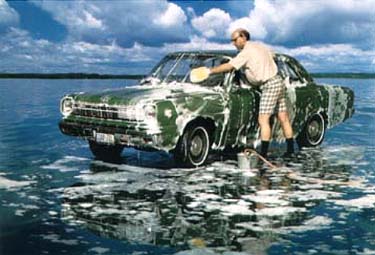
Why do you suppose it is that no one washes a rental car? Think about it. I will confess that in all my years of travel, I’ve never once even thought about driving a rental car through a car wash – no matter how filthy it might have been. There is a very good reason for this. We know that the rental car company automatically washes every rental car when it’s returned. And we know we don’t own the rental car. Our success and happiness is based upon the same concept. Others may help us in our quest for success and happiness but that’s all they do . . . help.

It’s up to each of us to take ownership of our own life. Earlier in my career I relied on a lot of people – and I still do today, but in a different way. There were times in the past when I might have thought, “I’ll do my part but someone else will ‘carry the ball across the goal line.’” As I think back I remember many disappointments along the way where having this mindset resulted in failure. Most likely this is because others were thinking the same way. Not a single one of us truly “owned” a particular project in such a way as to see that we did whatever it took to achieve a successful result. Taking ownership in a work environment doesn’t mean doing everything ourselves. But it does mean that someone (maybe it’s us) must be responsible for seeing that all of the plays are called and executed, and that the team eventually scores. Any time a goal or an objective is set, always remember to ask, “who is going to own this?”

In our personal lives it should be easier. When we ask the question, “who is going to own this,” the answer is pretty obvious. And we need to create some sort of accountability for ourselves to make sure that we follow through and truly “own” it. This accountability might be in the form of a journal, a checklist, working with a buddy or mentor – whatever is necessary for us to take our ownership seriously. If we want to exercise more; lose weight; be more aware of current events; become deeper spiritually; find a significant other; be a better parent, or be more prosperous, the road to success begins with our taking ownership of our situation and committing to see it through to a successful end.

Taking ownership is a liberating experience. In so doing, we cease to worry about whether or not we will succeed. Instead, we live in the knowledge that through our ownership we will achieve whatever it is that we have set forth to do.

This blog is being written in tandem with my book, “An Entrepreneur’s Words to Live By,” available on Amazon.com in paperback and Kindle (My Book), as well as being available in all of the other major eBook formats.

car_wash(2)