Alligator Food

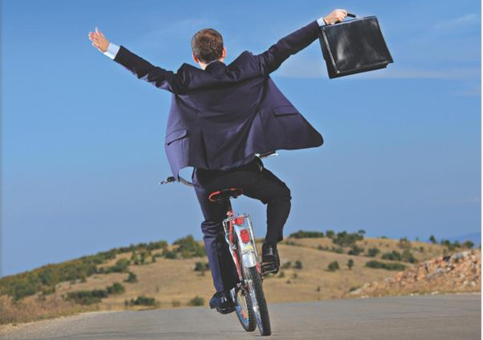
When is the last time you thought about being eaten by an alligator? When was the last time you contemplated being run over by a cement mixer? Or, how about being beaned in the head by a meteorite? Probably never – right? The risk of any of these things ever happening is so low they never even crossed your mind. But there’s that pesky word that entrepreneurs love to hate . . . risk. As I write this we’ve launched a new year and it’s a good time to take stock of a lot of things.

Have you ever created a Risk Matrix? If not, let me provide some context. We entrepreneurs tend to rock and roll a lot. We have a lot on our plate and are generally an optimistic bunch. When it comes to the subject of risk we may not spend much time in contemplation. We roll with the punches and keep moving forward. This philosophy works most of the time – until it doesn’t. Sometimes what interrupts that forward movement is a risk we didn’t see coming.

Here’s how the Risk Matrix works. Slow down for a moment. Stop juggling. Don’t worry about e-mails, sales figures, meetings, personnel issues and the host of other things that occupy our mind throughout the day. Instead become singularly focused on this exercise. Let’s brainstorm for a while and identify all of the different risks that we encounter in our business or whatever endeavor in which we are engaged. I know that it may be hard, but it’s very necessary for us to follow through and complete this inventory. We need to turn over every stone even if we believe there’s nothing under some of them. There are competitive risks, operational risks, capital risks and macro risks. It’s important that we not leave a single one off of the matrix.

Once we have determined all of the risks we must then figure out how to mitigate them. This will undoubtedly require some strategic thinking on our part. What will we do if our top salesperson walks out the door? How will we respond if a competitor opens a store right across the street? If raw material prices increase by 20% how will we preserve our margins? Suppose our largest client wants to double the amount of business that it does with us? All of these are risks that need to be addressed. And our cataloging of risks has come about based upon the knowledge and understanding we have gained toiling in the trenches day-in and day-out.

Ultimately our Risk Matrix is populated. Perhaps we’ve flagged 20 different ways our train could derail. And maybe there are 30 different mitigation strategies and tactics that we’ve developed to address those risks. Regardless, we’ve spotted the gaps and done our best to plug them as effectively as possible. But there’s still another step to be taken. Suppose that a few of our mitigation strategies or tactics don’t work as advertised? Maybe one or more of the risks leak through and actually have an adverse impact on our organization. What now? We can solve this by also creating contingency plans for that “just in case” situation where a risk overpowers our mitigation efforts. In other words, what specifically will we do if our mitigation strategy to keep that top salesperson in the fold actually fails because he/she gets eaten by an alligator? Gee, we didn’t think about that!

I was a Boy Scout and everyone knows that our motto is “Be Prepared.” Entrepreneurs need to adopt this motto relative to the risks that we face every day. In doing so, we move from being risk takers to risk managers. As individuals the concept is also just as applicable. What personal risks are we exposed to? We deal with personal risks to the loss of our home, car, health and life through various forms of insurance. Perhaps there are other risks that aren’t insurable in a traditional sense, to which we should give thought.

Here’s the bottom line. We can blithely wander through life oblivious to the alligator lurking around the corner that wants to eat us. Or we can spend a few minutes once in a while and think about what could bite us and what we can do to avoid the unpleasant side effects.

 You can also listen to a weekly audio podcast of my blog. What you hear will be different than what you read in this blog. Subscribe on iTunes or wherever you get your podcasts. You can also click on this link – Click here to listen to Audio Episode 28 – Blah, Blah, Blah.

This blog is being written in tandem with my book, “An Entrepreneur’s Words to Live By,” available on Amazon.com in paperback and Kindle (My Book), as well as being available in all of the other major eBook formats.

alligator

The Anatomy of an Entrepreneur

As entrepreneurs exactly who are we? What makes us tick? Is there some sort of DNA gene that we can point to? I’ve thought a lot about some of the exceptional entrepreneurs I’ve known over the past four decades and have identified some of their traits and tendencies that stand out.

Let’s start with creativity and innovation. Entrepreneurs use their creative powers to innovate and find a better way to do something. Elon Musk has to be one of the most prolific entrepreneurs when it comes to innovation – Tesla Motors, SpaceX, Pay Pal and Solar City come to mind to name a few. Often, creative entrepreneurs are also visionaries. They have an uncanny ability to see into the future and understand what their customers will want and how their company needs to be designed to win. GoPro CEO Nick Woodman, is one of the foremost visionaries in America today. Who could ever have imagined a series of high definition video cameras that are small, durable and light enough to capture our daily adventures – daring and mundane? And successful entrepreneurs understand risk. Rather than taking risk they are adept at managing it.

When they get knocked down, great entrepreneurs get back up – over and over and over. They are amazingly resilient and don’t see failure . . . only opportunity. Walt Disney was fired by his employer, the Kansas City Star, because he supposedly lacked creativity. That didn’t seem to impact his storied career. When things don’t work out as planned they are flexible and know how to adapt and make the best of every situation. Top flight entrepreneurs are persuasive and can convince others to say yes. They do so through the power of their passion. Does Steve Jobs come to mind? Look what he convinced us to buy! Along with their persuasive powers, successful entrepreneurs are strong communicators in both verbal and written formats.

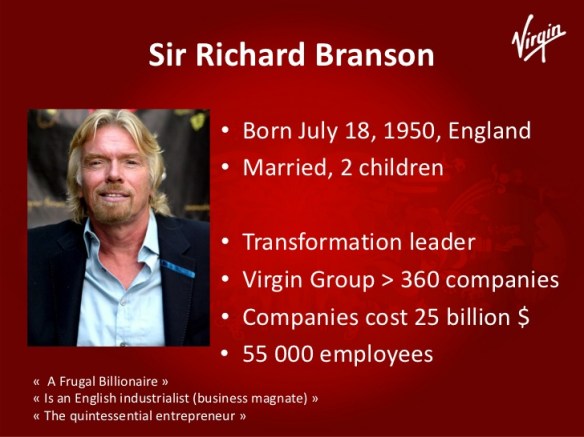
Entrepreneurs are assertive – the great ones are less aggressive than assertive. They have a healthy degree of empathy and are sensitive to the feelings of others. Entrepreneurs at the top of their game have a certain amount of charisma. They can be sociable and gregarious – even if those aren’t their core tendencies. Without charisma an entrepreneur will find it tougher to raise money, develop important relationships and influence others. Billionaire entrepreneur Sir Richard Branson is one of the most charismatic leaders on the planet. And he has woven his charisma into a tapestry of empathy and caring about other people.

Culture King is another descriptor for the cream-of-the-crop entrepreneur. Ben Chestnut is the founder and CEO of MailChimp fits into this category in the ways he has empowered the 500+ members of his team. Hand-in-hand with a strong culture is a smart entrepreneur’s ability to delegate. According to a 2013 Gallup survey of Inc. 500 CEOs, an average three-year growth rate of 1,751% was realized where the CEO had a high Delegator talent. Entrepreneurs typically have a high sense of urgency and tend to be very self-structured – there’s no way anyone is going to tell them what to do! Entrepreneurs simply don’t want to be a cog in someone else’s machine. Most entrepreneurs also have the ability to juggle many things at once and in fact need to feel the rush and excitement of pursuing multiple projects and initiatives simultaneously. Finally, ultra-successful entrepreneurs are generally positive and optimistic people. They don’t dwell on mistakes and never play the victim.

Remember the DNA thing I mentioned at the beginning of this blog? Well, there may be something to it. A February 17, 2016, research paper published in the Austin Journal of Molecular and Cellular Biology reported on the Dopamine Receptor D4 Gene and concluded that entrepreneurs have a higher tolerance for risk-taking in part, due to this gene (Link to research publication.). Apparently genetics govern approximately 30% of what makes one an entrepreneur. But that leaves 70% to a wide range of personality traits and tendencies.

There are many such traits and tendencies that are identified with entrepreneurs. No one person possesses them all, but the more to which we lay claim the closer we come to attaining world class status.

You can also listen to a weekly audio podcast of my blog. What you hear will be different than what you read in this blog. Subscribe on iTunes or wherever you get your podcasts. You can also click on this link – Click here to listen to Audio Episode 2 – The When Affliction.

This blog is being written in tandem with my book, “An Entrepreneur’s Words to Live By,” available on Amazon.com in paperback and Kindle (My Book), as well as being available in all of the other major eBook formats.

richard-branson-as-a-leader-4-728

Balls in the Air

Have you ever heard of Anthony Gatto? I hadn’t either. Gatto has been on the list of the world’s best jugglers every year since 2003 when the list was first compiled. He started juggling when he was almost four years old and is the only juggler ever featured on a Topps trading card. Among his amazing performances were juggling eight balls for one minute and 13 second; nine balls for 54 seconds; seven rings for 15 minutes and six seconds and 12 rings with 12 catches. All are world records. I’ve tried many times and can’t even master juggling two balls – much less eight. I did notice that Gatto doesn’t hold any records for juggling chainsaws – so he must be a pretty smart guy!

For entrepreneurs the obvious metaphor here involves the juggling act that we perform every day. But I want to talk about it in a bit of a different context. The question I want to pose is that of focus vs. diversification. What do I mean by this? I’ve said before that I don’t like to take risk, but I’ll manage risk all day long. This is a Grand Canyon-huge distinction. Taking risk for me is akin to gambling – and I’m not a gambler. Managing risk is a process and allows me to stack the odds in my favor. So what does focus vs. diversification have to do with managing risk?

There is a school of thought that says we should focus on what we do best. And we should hone our craft to the point that we then are the best at what we do. Several very successful companies are focused on a single product. Crocs, Spanx, Michelin, Roku and Gorilla Glue are all such companies. They have developed their product to the point that it’s in such high demand that there is no need to add to their product mix. Southwest Airlines has focused for decades on solely flying the Boeing 737 aircraft. The advantages for them are numerous including the manner in which they stock spare parts, train their mechanics and flight crews, route and position planes, etc.

I believe that there is an inherent risk to being so focused on a single product line. This risk includes business cycles where a particular product type might fall out of favor. Technological advances have been known to make many products/services obsolete. Remember Blockbuster Video? It was a high-flyer for a long time and was pretty much focused on a bricks and mortar delivery of videos. But it became so focused that it failed to realize that it needed to change its entire business model and product suite to adapt to rapidly changing consumer preferences. Now the company is out-of-business.

This brings me to the strategy of diversification. Our organization has always had multiple product lines. In the 1970s through the 1990s, we were primarily involved in the commercial real estate industry with leasing, brokerage and property management. And we handled office buildings, shopping centers, industrial facilities and apartment communities. In some years the leasing and brokerage business might be slow, but the property management business would be booming. Then there were times when the opposite occurred. Yet we were able to maintain fairly consistent revenues and margins throughout the various cycles we encountered.

Since 2000 we’ve diversified even more extensively including construction, maintenance service, building components distribution, tax credit syndication, apartment acquisitions, apartment development and venture capital investments (outside of the real estate world). We’ve organized into business units specializing in these areas with a managing director leading each. With this structure each leader is able to focus on being the best in class. The overall enterprise benefits from a highly diversified product/service offering balanced with a focus sufficient to excel. To accomplish this, a considerable investment was made in human resources to enable the focus and specialization. Our organization also wins with the vertical integration that has resulted. Multiple business units are able to participate in various internally generated projects as well as provide products and services to third parties.

Keeping a lot of balls in the air actually requires considerable focus. When we can do both successfully we are able to minimize the risks that we face as entrepreneurs.

This blog is being written in tandem with my book, “An Entrepreneur’s Words to Live By,” available on Amazon.com in paperback and Kindle (My Book), as well as being available in all of the other major eBook formats.
juggling

Grrrrrrreat!

Question: Is there a secret formula for “greatness?” Some people seem to be destined that way. The rest of us . . . I’m not so sure sometimes.

Answer: Think about the people who you might consider being great – they can be living or dead. Who do you include? Albert Einstein? George Washington? Jonas Salk? Mother Teresa? What do all of these people have in common? They were all human beings, just like you and me. Each of them faced trials and tribulations similar to our own. None of them set out to be great. So just how did they rise to the level of respect and achievement that they did?

Each of these great people worked hard to live to their full potential. No one actually does this completely. But some people seem to get closer than others. So what does this say about mankind? We all are meant to do great things. When I was a child my parents pushed me hard to be better. My teachers did the same. On the basketball court my coaches rode me hard. There were times when I resented this but as an adult I realize that each parent, teacher and coach saw that I had potential and wanted me to achieve it. I attribute some of my success to having these people believe in me and encourage me to reach for the stars.

Some of us weren’t pushed as hard during our formative years as was I. So how do we do great things? Here’s the formula:

(Big Dreams + Risk Something) + (Resilience + Perseverance) + Positivity = Greatness

We can’t do great things if we don’t dream big dreams. Why don’t more people dream bigger? Because often there is risk involved or they don’t believe they can realize their dreams. But when we dream big and we put ourselves at risk, then we have a chance to make a real difference. And there’s no doubt that when we do both of these things we may not always succeed immediately. So it’s imperative that we bounce back and keep on trying. In the immortal words of Winston Churchill – we never, ever, ever, ever, ever give up. Finally we must maintain a positive outlook on everything we’re doing. Negativity blocks the flow of positive energy that we need to make the formula work. There’s one word that describes all of this . . . mindset. Great people who do great things have a great mindset.

You and I can have a great mindset. It requires practice every single day. Our DNA is programmed for us to do great things. When our mindset is in the right place, our greatness will manifest.

This blog is being written in tandem with my book, “An Entrepreneur’s Words to Live By,” available on Amazon.com in paperback and Kindle (My Book), as well as being available in all of the other major eBook formats.

Einstein