
Exactly What is Accountability?

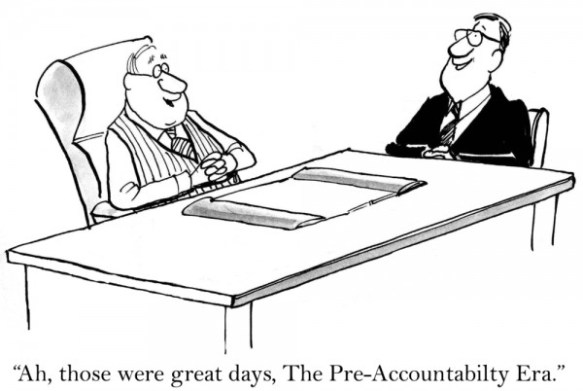
Here’s a term you’ll hear a lot in the entrepreneurial world – accountability. In our organization every team member has written Roles and Accountabilities. There is a lot of talk in the business world about holding people accountable. So, exactly what does all of this mean?

There are some leaders who are confused and think that accountability is a binary choice. They boil it down to believing that either someone keeps their job or they don’t. In other words, if someone doesn’t perform in satisfactory fashion the only option is to fire him/her. Otherwise there’s no way to hold that person accountable. Fortunately this is a misconception – there are many different aspects to accountability.

In some cases performance issues may be the result of a team member not fully understanding what is expected of him or her. The solution is simple. That person obviously needs further clarification of his/her role. This can be accomplished by making certain that the position description is comprehensive enough followed by a meeting to clarify the expectations and gain an acknowledgement by the team member as to his/her understanding.

Perhaps a team member is struggling to perform in a satisfactory manner because he or she isn’t adequately trained or properly equipped. The leader must make this determination fairly and then prescribe the antidote. In this situation it’s important to understand exactly which elements of the position the team member need re-training. After the re-training takes place, it might be wise for the team member to take a test of some sort to make certain that the training has been effective. Part of the analysis needs to be ensuring that the team member has the proper tools and/or resources to do the job. It’s unfair to hold someone accountable if the company hasn’t done its part in this regard.

I remember in my earlier days as a property manager, encountering difficulties getting a certain maintenance person to perform. He should have been able to close out many more job tickets than he was. I made sure that he understood his role, was properly trained and had the right equipment. After doing so, I began to suspect that he didn’t have good organizational skills. Rather than hand him multiple job tickets, I began doling them out one at a time. When he finished one, he would come back to me for another. This worked quite well and I was gradually able to help him learn how to prioritize. This type of accountability was a combination of additional training and closer supervision.

We’ve all experienced situations where a particular team member continues to miss the mark in terms of meeting expectations. Role clarification, re-training and closer supervision didn’t do the trick. Naturally this can be incredibly frustrating and our initial instinct may be to terminate this team member. But there are other steps in the accountability process to consider. One is more frequent performance reviews. The team member meets with his/her supervisor at the end of each week and is apprised of the progress (or lack thereof) made for the week. The conversations may become sterner over the course of time if there’s no evidence that the team member is trying to improve.

Suppose this team member isn’t making progress and doesn’t appear to care. Eventually more severe consequences must be taken. This could include a demerit type of action involving a write-up for the team member’s file. A second write-up might result in a probationary status for the team member. At the end of the probationary period – two weeks, 30-days, etc. – the team member could be terminated if the issue hasn’t been resolved.

Other techniques for holding team members accountable might include re-assignment, suspension, demotion, or a reduction in compensation. In the case where a person just isn’t cutting it, a re-assignment to a different role might be a relief and save a valuable member of the team. I’ve seen cases where the individual is really trying but just isn’t meant for the job. A re-assignment needs to be mutually agreeable – if not, a termination would be a better avenue.

We had a situation where a senior member of our firm was abusive to the administrative staff. She was repeatedly counseled and advised that this behavior was unacceptable. We then threatened to suspend her for two weeks for the next infraction. After another incident of abuse we followed through on the suspension. I was sure she would quit but she didn’t. When she returned there was never another instance of her abusing the staff.

Accountability takes many forms. The most important thing for an organization is to identify the different methods for accountability and have a process for their use.  

You can also listen to a weekly audio podcast of my blog. What you hear will be different than what you read in this blog. Subscribe on iTunes or wherever you get your podcasts. You can also click on this link – Click here to listen to Audio Episode 77 – Anatomy of an Entrepreneur.

This blog is being written in tandem with my book, “An Entrepreneur’s Words to Live By,” available on Amazon.com in paperback and Kindle (My Book), as well as being available in all of the other major eBook formats.
A Mt. Everest Mindset

Allow me to introduce Colin Timothy O’Brady. Born on March 16, 1985, O’Brady was raised in Portland, Oregon, and graduated from Yale in 2006 with a degree in economics. After graduation he went on a trip to an island off the coast of Thailand. During a fire-rope jumping event he accidentally caught on fire and suffered second and third-degree burns to 25% of his body with the most damage to his legs and feet. Doctors said he might never regain full functionality of his lower extremities.

O’Brady defied the odds and completed more than 50 triathlons as a professional, between 2009 and 2015.  Then roll the tape forward to 2016 and enter the Explorer’s Grand Slam. The Slam involves climbing the highest mountain on each of the seven continents plus expeditions to both the North and South Poles. O’Brady launched this effort on January 10 and completed it on May 27, 2016, setting the record for the fastest time. This included climbing Mt. Everest, the tallest mountain in the world at 29,029 feet. According to CBS News fewer than 50 people in history have completed the challenge and only two in under a year. He made it to the top of Mt. Kilimanjaro (19,341 feet) in less than 12 hours – a normal person takes six to seven days to climb it.

The extreme physical nature of this feat is beyond incredible. Imagine the stamina and endurance he had to have, not to mention the talent and agility it would take to conquer these dangerous towering peaks! But that pales in comparison to the mental focus and toughness O’Brady had to maintain. “I hope that people take away from this the power of the human spirit,” he said. “When you believe in yourself, and you dream big, that anything is possible.” The obstacles he faced were numerous. Fifty mile-per-hour winds, temperatures of -40˚ F., headaches (early signs of acute mountain sickness), icy conditions, a guide who suddenly left with his climbing ropes while on Mt. Elbrus in Russia in the middle of the night, and a cracked ice runway at the North Pole – just to name a few. Meditation was a staple for his mental health.

Colin O’Brady’s life experience offers a parallel to the life of an entrepreneur. Fortunately we don’t have to face the same physical dangers but the obstacles can certainly loom as large. Competitive pressures, cash flow (or lack thereof), recruiting talent, legal issues, unhappy customers, production problems, product problems, regulations, difficult economic conditions and maturing bank lines can add up to a challenge as daunting as a cracked ice runway at the North Pole.

To thrive and succeed we need more than perseverance and resilience. We need a Mt. Everest mindset. Just trying to “muscle” through often is not enough. A steadfast belief in a strong sense of purpose is a great place to start. For Colin O’Brady, he had been told that he might have difficulty in walking normally after his horrific accident in 2007. This provided a level of motivation that propelled him well beyond simply walking normally. Instead he set out to do something no other human being had ever done before – and he did it.

What is our sense of purpose? If it’s only to make a lot of money we may not be able to reach the summit. On the other hand, if we are driven to change the world in a profound way, our entrepreneurial endeavors may have a much better chance for success. We’ll press on through the pain and suffering. We’ll become calm as 50 mile-per-hour winds hammer us with metaphorical ice and snow. I submit that without this strong sense of purpose, we cannot muster what it takes to achieve the Grand Slam of whatever we are undertaking.

We can have a successful entrepreneurial career playing it safe – and there’s nothing wrong with this. However, if we want to dream really big dreams . . . and realize them, we’ll need to have a Mt. Everest mindset. It will be incumbent upon us to find that deep-rooted sense of purpose that drives us upward and onward. Have you discovered your strong sense of purpose, and do you hold a steadfast belief in it?

You can also listen to a weekly audio podcast of my blog. What you hear will be different than what you read in this blog. Subscribe on iTunes or wherever you get your podcasts. You can also click on this link – Click here to listen to Audio Episode 76 – The World’s Most Expensive Chocolate Bar.

This blog is being written in tandem with my book, “An Entrepreneur’s Words to Live By,” available on Amazon.com in paperback and Kindle (My Book), as well as being available in all of the other major eBook formats.

The Age of Shame

There’s an epidemic of massive proportion moving across this country at the speed of light. It has swept up the high and mighty – politicians, actors, corporate chieftains and many a lesser soul. Careers have been ruined and reputations destroyed. Why? All because of a pattern of bad behavior that is no longer being tolerated in today’s society. Claims of sexual assault, sexual harassment and racism are reaching a crescendo with no sign of abatement. We have officially entered the Age of Shame.

Entrepreneurs need to pay particular attention to this trend. We have an opportunity to do great things, but we can easily be derailed by our own actions. This is really very simple. We must be respectful of others at all times – period. We don’t make inappropriate comments to or advances on anyone else. We don’t take actions that could be construed as discriminatory of others. We treat others as we would want to be treated.

There’s a dangerous downside to the Age of Shame. The frenzy of accusations has created a lynch mob mentality. No longer are we innocent until proven guilty. Now, convictions are swift in the court of social media. There are no trials in the current “me too” environment. We can easily become ensnared in this cycle unless we take extra care to avoid it.

Harvey Weinstein, Al Franken, Kevin Spacey, Roy Moore, Mark Halperin, Bill O’Reilly and Matt Lauer all have something in common. It’s called arrogance. These men thought their station in life entitled them to boorishness and worse. This sense of entitlement led them to become arrogant and fostered a belief that they were bulletproof. As entrepreneurs we may realize a great deal of success. The best way to inoculate ourselves from arrogance is to remember this. The more successful we become the more humble we should become. It’s easy to develop “swagger” with success. I’m not a fan of swagger. It’s too easy for it to become an in-your-face gesture which in turn can lead to the arrogance we must guard against.

We can avoid the Age of Shame and its corresponding pain, and replace it with our own Age of Gain. We have much to gain if we do it right. We can display the highest level of integrity and model the type of behavior that others can admire. We are color-blind, gender-blind, sexual-preference-blind and national-origin-blind. Our objective is to focus on pursuing our mission and vision utilizing all of the talent that we have available. Once again the simple calculus is that we are respectful of others at all times.

The notion of respect is easy to understand. When our team members, our customers and our vendors feel respected, they are much less likely to take offense at something we might say or do that could be misconstrued. In other words, we buy goodwill that allows us the benefit of the doubt. Harvey Weinstein didn’t get the benefit of the doubt because he was such a tyrant. On the other hand, if everyone we know sees our motives as pure, an unintentional faux pas may be overlooked.

Character really counts these days. Rightly or wrongly there’s a lot of judging going on. Walking the straight and narrow truly matters. Being completely honest isn’t just a hallmark – it’s absolutely necessary to survive in the current environment. Keeping our reputation intact is essential to navigating the minefield of shameful accusations and hyper-reactions that we are witnessing daily.

When we are respectful of others at all times, we are less likely to be a casualty in the culture war that is raging. In so doing, we can sleep at night without worrying about the consequences that we might otherwise face.

You can also listen to a weekly audio podcast of my blog. What you hear will be different than what you read in this blog. Subscribe on iTunes or wherever you get your podcasts. You can also click on this link – Click here to listen to Audio Episode 75 – O-Fer.

This blog is being written in tandem with my book, “An Entrepreneur’s Words to Live By,” available on Amazon.com in paperback and Kindle (My Book), as well as being available in all of the other major eBook formats.

June 1, 2014 – Frankfurt Am Main, Hessen, Germany – Sexual harrassment at work: A businessman is touching his female co-worker’s leg. (Credit Image: © Frank May/DPA via ZUMA Press)

Asshole Self-Test

We entrepreneurs have some interesting personality traits. Many of us are particularly hard-charging. We are generally assertive and often have aggressive tendencies as well. Other descriptors might include a high sense of urgency, a less than accommodating nature and low empathy. We’re on a mission and we have no time to waste. We don’t have time for nonsense, and no patience for incompetence or perceived laziness. Here’s the danger with this combination of behaviors. We can sometimes become total, unadulterated assholes.

Some entrepreneurs wear this moniker as a badge of honor. I don’t and I’ll bet you don’t want to either. Unfortunately we may be in a position where our colleagues aren’t comfortable pointing out our “assholeness.” So, here’s an Asshole Self-Test that we can perform to make certain we aren’t becoming one.

  1. Do I berate people – especially in front of others? This is an easy one. Assholes in this category can be screamers. They have a hair trigger and are easily infuriated. Rather than calmly having a conversation to solve the problem, they become loud and personalize their displeasure. Everyone who witnesses an incident like this wants to sink through the floor – whether they are the focus of the asshole’s ire or not.
  2. Do I ignore people and fail to show sufficient appreciation? Assholes are ingrates. People do things for them without as much as a please or a thank-you. They have an entitlement mentality and can totally ignore those around them. Other accurate terms are self-centered and self-absorbed.
  3. Am I overly demanding and unreasonable with my expectations? There’s nothing wrong with pushing our team to excel. Stretch goals are fine and can be quite healthy. Assholes go above and beyond in this category – way beyond. Think about the boss that demands that his team work late on Friday night and all weekend to complete a project – but he goes home early and is nowhere to be found all weekend.
  4. Am I a backstabber? Backstabbers are sweet to our faces and then say and do terrible things behind our backs. Joe says to Tony, “I think you did a great job landing the Acme contract!” Then later he says to Isabel, “Tony got all the credit for the Acme contract, but he really didn’t have to work very hard to land it.” Why can’t Joe be gracious and have praise for Tony when he’s talking to Isabel and others?
  5. Am I insulting? Assholes seem to enjoy being mean and insulting. They make snide and cutting remarks. They run people down and tend to be cynical, taking pleasure in the misfortunes of others. I used to watch Don Imus on television. He had a morning show that could be pretty funny. But he was one of the most insulting characters I’ve ever seen. He had no filter whatsoever and didn’t seem to care whether he hurt someone’s feelings with his comments.
  6. Do I take credit for the accomplishments of others? The best entrepreneurial leaders are quick to celebrate the accomplishments of their team members. They are gracious and acknowledge the contributions of others. Assholes will take credit for every positive result that occurs and point fingers at others when something less than positive happens.
  7. Am I condescending, rude and arrogant? The late Leona Helmsley was a wealthy real estate magnate in New York. She was known as the Queen of Mean and her infamous statement has become the national anthem for assholes, “We don’t pay taxes. Only the little people pay taxes.” Do I think I’m better than everyone else and do I let others know?
  8. Am I conniving and constantly on the lookout for ways to screw other people? Yeah, you know the type. This person is always scheming and not in a nice way. A common statement might be, “You’ll never believe what I pulled off! I spoke with an ex-employee of our closest competitor and found out that the CEO has cancer. I dropped the hint to one of their customers that the company might be in trouble if the CEO has to step down. I think they are going to move their business to us!” There’s going to be a special seat at the table for this guy in a very warm place one of these days!

Well, how did you do? Thankfully assholes are few and far between and they are easy to spot. As we strive to build our organizations it’s always smart to beware of asshole tendencies that can creep into our behavior. When this begins to occur we need to immediately come to a screeching halt, turn around and run as fast as we can in the other direction.

You can also listen to a weekly audio podcast of my blog. What you hear will be different than what you read in this blog. Subscribe on iTunes or wherever you get your podcasts. You can also click on this link – Click here to listen to Audio Episode 74 – Trust Me.

This blog is being written in tandem with my book, “An Entrepreneur’s Words to Live By,” available on Amazon.com in paperback and Kindle (My Book), as well as being available in all of the other major eBook formats.

Exciting Disappointment

Every entrepreneur will experience disappointment at one time or another – that’s a fact. We tend to be optimistic and visualize very positive outcomes. Of course not every outcome is realized exactly the way we anticipate. To succeed we need to have a heavy dose of resilience. But there’s more to it than just the ability to bounce back.

We had a really big deal blow up recently. It involved the sale of several apartment properties and would have resulted in a very large financial gain after holding these properties for nearly 20 years. The buyer had made a preliminary inspection of the properties, and a purchase and sale agreement had been executed by both parties. Then the buyer claims that our broker misrepresented an element of the transaction that would ultimately result in a substantial reduction in the price – something we were unwilling to accept. We believe that the buyer never intended to pay the agreed-upon price and was starting the process of “chiseling” once the documents were signed.

This isn’t the first time we’ve had a deal blow up and it certainly won’t be the last. And it isn’t the first time that a buyer acted less than honorably – nor will it likely be the last. Our initial reaction was one of disappointment. It would have been wonderful to monetize an investment that was many years in the making, and we would have disposed of some smaller assets that no longer fit our strategy going forward. Naturally, resilience kicked in and we didn’t shed any tears over this situation. The broker went back to the drawing board and worked to find another buyer. Here’s what may be a surprise to you though – our mindset in the moment.

After I understood the transaction wasn’t moving forward, I actually became excited in a positive way. Why? Because I tend to look at situations like this as a sign that “something better is in store!” Yes, we would have had a very favorable result had we closed the deal. But I’m convinced that there’s something much bigger and better to come from this.

Some may snicker and laugh when they hear this. They might say that this is simply naïve and wishful thinking. I would tell them that I’ve been living my life this way for 40+ years and more often than not, I’m right. Here’s why. By knowing and believing that something better is in store, I’m telling my creative juices to kick into overdrive. In the case of this apartment sale, our broker might come up with another buyer. Yet I have an idea that will require a bit more innovation and take a bit more time, but the end result could be even more profitable than originally planned. And it jazzes me to develop and execute the strategy necessary to make this happen.

A more conventional approach might be to lament the loss of the original buyer. It might be to play the victim and become angry that the original buyer was less than honorable in his dealings with us. We could be mad at the broker for his misstep in the way he worded the offering document that purportedly caused the issue in the first place. But what purpose is served with all of the negativity? The fact still remains that the buyer backed out. The choice is ours as to which fork in the road we take. The one that leads to an even greater success or the one that leaves us wallowing in misery and limited thinking.

When we realize that our entrepreneurial lives are continually unfolding as a series of opportunities, we never look at unexpected outcomes as setbacks. Instead they give us a chance to use our skills, our resilience, our experience and our creativity to achieve even better results than we initially sought. Allowing negative thoughts and emotions enables limitations on our creativity. What might otherwise be viewed as a disappointment is simply a nudge to adjust, modify and tweak in such a way as to eventually win a better prize.

Entrepreneurs need a baseline level of resilience to survive. Seeing greater opportunity in what others might term as failure is a step beyond resilience. And knowing and believing that something better is in store enables us to thrive in amazing ways.

You can also listen to a weekly audio podcast of my blog. What you hear will be different than what you read in this blog. Subscribe on iTunes or wherever you get your podcasts. You can also click on this link – Click here to listen to Audio Episode 73 – The 1,057 Point Swing.

This blog is being written in tandem with my book, “An Entrepreneur’s Words to Live By,” available on Amazon.com in paperback and Kindle (My Book), as well as being available in all of the other major eBook formats.