Unknown's avatar

About anentrepreneurswords

R. Lee Harris grew up in Manhattan, Kansas and has lived in the Kansas City area since 1977. A 1975 graduate of Kansas State University, Harris began his career with Cohen-Esrey, LLC as an apartment manager two weeks after he graduated. Now president and CEO, he is involved in apartment management, development and investment; construction and tax credit syndication on a nationwide scale. Over the course of his career Harris has overseen the management of more than 27 million square feet of office building, shopping center and industrial space and nearly 60,000 multi-family units. He has started dozens of business enterprises over the past 40+ years. In 1991, Harris wrote a book entitled, The Customer Is King! published by Quality Press of Milwaukee. In 2012 he authored the book, An Entrepreneur's Words to Live By. He has mentored a number of business people over the years and has been a long-time participant in the Helzberg Entrepreneurial Mentoring Program. He and his wife Barb have two grown daughters and one grandson. They are active in their church, community and university.

Entrepreneurial Insecurities

Let’s go exploring. Let’s explore the mind of an entrepreneur. What types of thoughts are entrepreneurs thinking? The answer may surprise you. Many people see entrepreneurs as self-confident, assertive individuals who always have it “all together.” Look at the roster of famous entrepreneurs – Sir Richard Branson, Mark Cuban, Steve Jobs, Bill Gates, Jeff Bezos and Mark Zuckerberg. Certainly no shrinking violets in this bunch!

So, we’re all like this star-studded list of entrepreneurs – right? Well . . . maybe not so much. All that moxie and nerves of steel gives way to self-doubts and uncertainty. Am I a fake? Am I not good enough? What if I fail and lose all my money? No one likes me or my idea. These thoughts are insidious and destructive. And yet we think them anyway.

We’ve all heard the “fake it till you make it” mantra. This implies that an entrepreneur is continuing to perfect his or her product/service while still pulling out the stops to sell it. Products and services are iterative and there will always be newer and better models. Our entrepreneurial insecurities emerge when we worry that there may be flaws in the current version that cause such a strong level of customer dissatisfaction that our whole enterprise bombs. This is where the “fake it” part of the equation can spill over into our psyche and cause us to question whether or not we really know what we’re doing.

“What if I’m not good enough?” Often we’ll see other entrepreneurs who seem to be riding the wave. Everything is going right for them and we surmise that they are on top of the world. Perhaps we’ve just suffered a setback of some sort. We look at the competitive landscape and begin to wonder if we’re losing the race. This feeling intensifies as this cycle persists – others seem to be winning and we aren’t.

It’s 3:00 AM and we wake up in a cold sweat. Our hearts are pounding and we’re a bit disoriented. We’ve just launched a major project that by our assessment, involves more risk than we’re used to taking. Then the mind games begin. We see the endeavor cratering which will cost us a lot of money . . . not to mention reputation. This is followed by the thought that we’re losing our mojo and our business will eventually fail. Ultimately we declare bankruptcy, lose our house, are divorced by our spouse and end up living under a bridge!

Finally, some of us may be feeling rejected. Again, we may have been told “no” so many times that we begin to wonder what is wrong with us. Is there something about our personality, the way we look, the things we say or the way we act? Maybe it has something to do with where we live, the car we drive, the people who are our friends or even where we went to school. Our natural reaction is to feel hurt and maybe even victimized.

Entrepreneurial insecurities are understandable but unproductive. It’s important that we recognize them; resolve them as quickly as possible, and move on. Allowing them to fester can be a slippery slope to some serious career or life-threatening behaviors. Drug and alcohol abuse, deteriorating health, extramarital affairs, gambling, physical and psychological abuse of loved ones and even suicidal tendencies are some of the more prevalent examples.

We entrepreneurs thrive when we have a healthy self-image. Developing great resilience is critical to our success in this arena. Smoothing out the ups and downs of our fast-paced lives is also a step in the right direction. Earlier in my career I would experience the euphoria of winning to the fullest. But similarly, I would experience the depression of losing to the fullest as well. These wild emotional swings would result in my feeling on “edge” much of the time. The feeling of victory was fantastic, but I always wondered when the other shoe was going to drop.

I’ve learned to moderate my emotions. When I am part of a winning experience, I know I’ve been there before. And it’s the same with the losses. I know what it takes to achieve victory and I know what to do to avoid defeat. Some of this is simply age and experience. But I believe most of it is the mindset I have chosen for myself. The key word in the previous sentence is “choice.”

We can avoid the pitfalls and traps that are set when we have entrepreneurial insecurities. This is accomplished by celebrating our success not by spiking the ball in the end zone, but through understanding exactly how we won and replicating it over and over. Steadfastly focusing on our vision for the future is paramount to warding off negativity and self-doubt. Above all, we build our resilience by maintaining our optimism and positive attitude, no matter what.

You can also listen to a weekly audio podcast of my blog. What you hear will be different than what you read in this blog. Subscribe on iTunes or wherever you get your podcasts. You can also click on this link – Click here to listen to Audio Episode 71 – Civil War.

This blog is being written in tandem with my book, “An Entrepreneur’s Words to Live By,” available on Amazon.com in paperback and Kindle (My Book), as well as being available in all of the other major eBook formats.

Alarm clock on night table showing 3 a.m.

Gut Check

Entrepreneurs make decisions every day. Some are large and many are small. Have you ever stopped to determine how it is that you go about making your decisions? Some entrepreneurs are deliberate and others tentative. Some are procrastinators and some use a consensus approach. I’d like to focus on two methodologies that present quite a conundrum for entrepreneurs – gut vs. data.

How many times have you heard the expression, “go with your gut?” We all know what this means. When presented with a choice or several choices, we use our intuition to select the one that “feels” right. Gut level decisions typically require no cognition or rational thought. To a great extent they are based simply on a feeling that we have. But . . . that feeling is generally developed over time on the basis of a wide range of experiences. The word “experience” is the key here. I’ll grant that there may be times when a gut decision can be successful without foundational experience. But I do not believe that gut-driven decision making can consistently be accurate in the absence of incrementally derived experience.

Decisions that are made utilizing factual data and logic may seem like a safe bet. But . . . there are a couple of caveats. First, we can sometimes be too analytical. We ponder the data and agonize over it. Do we have every last fact that might make a difference? What if one or more of the facts aren’t correct? Ultimately we can end up in an analysis paralysis situation that turns into a first class muddle. Second, even with data we still must interpret it. Assume that all of the facts are correct and that we have everything we need. The wrong conclusion can be reached if the information is improperly interpreted.

Early in our careers we should make decisions much more on the basis of facts and logic. As much as we might want to “trust our gut,” we just don’t have the experience necessary to do so and consistently make the right decisions. As we gain age and experience there’s a possibility that we also become a bit wiser. Wisdom is the magical ingredient that allows us to listen to our gut and make the right call. This doesn’t mean that we ignore fact-based decision making. But there will be situations where we’ve seen this rodeo several times. And as a result, we can pretty much predict what is going to transpire.

We all have intuition at the earliest stages of our adult lives. The big question is whether or not to trust it. Steve Jobs famously said, “Have the courage to follow your heart and intuition. They somehow know what you truly want to become.” This is all fine and good. However, lofty and soaring statements like this aren’t necessarily helpful. The point I’m trying to make is that we can sharpen our intuitive skills by validating the patterns we observe over time. Here’s an analogy that will put this in a better perspective. Suppose we have a 26 year-old airline pilot. He’s very good at executing the mechanics of flying a jet aircraft. He’s been flying since he was 16 and has logged nearly 5,000 hours in the cockpit including 400 in his current aircraft type. Suppose you are one of 120 passengers aboard his aircraft. How comfortable are you placing your life in his hands if he tends to be more “intuitive” about the way he flies? Compare this to a 60 year-old airline captain who has been flying for more than 40 years. He has over 35,000 hours of flight time including 10,000 hours in the Boeing 757 that he currently drives around the sky. Which pilot’s “intuition” are you more likely to trust?

The veteran pilot has developed a sixth sense – aka intuition – for his aircraft and for flight in general. He’s seen it all over the course of his career. While he flies by the book and always checks the facts on all things weather, mechanical and aeronautical, he just “knows” when he needs to act on something that may not be factual in nature. Perhaps a little voice is telling him that there’s a problem with an engine even though the gauges are in the green. That little voice might be a subtle tone or vibration that only he can feel. Why? Because he knows his airplane so well that he has almost become one with it.

When we combine age, experience and wisdom, we sharpen our intuitive skills. Laying such a foundation enables us to rely more and more on our gut as we move down our career path.

You can also listen to a weekly audio podcast of my blog. What you hear will be different than what you read in this blog. Subscribe on iTunes or wherever you get your podcasts. You can also click on this link – Click here to listen to Audio Episode 70 – Get Outta the Way!

This blog is being written in tandem with my book, “An Entrepreneur’s Words to Live By,” available on Amazon.com in paperback and Kindle (My Book), as well as being available in all of the other major eBook formats.

Whale Sharks

Solving problems is a hallmark of entrepreneurship. Challenges are presented every single day of our existence – some small, some large and some that are the size of a 41,000 pound Whale Shark. Regardless of their size, we know that we must persevere and work through the many issues we face. Let’s stop for a moment and think about our problem-solving encounters. Are they particularly stressful or do we handle them on a pretty even-keeled basis?

There have been periods in my career where problem-solving was extremely hard. Why? Because I made it so. There were times when nothing seemed to go right. It was like putting together a jig-saw puzzle and there was a piece that I absolutely, positively knew belonged in a specific location, but it wouldn’t quite fit. It was a maddening experience until I eventually figured out that I had jammed the correct piece in another spot – and that was also wrong. How did I feel? Frustrated is an understatement. At other times I’d be cruising along fixing little nits and nats along the way, only to find that other minor issues would keep cropping up. I remember putting together model airplanes as a kid. I might get a little too much glue on one part that would leak out through the seam. Or my hand wasn’t as steady as necessary and I’d get some paint in the wrong place. How did I feel? Irritated is the proper term.

Frustration, irritation, anger and anxiety are all emotions that we can feel when we are dealing with our challenges du jour. Then when a Whale Shark-sized problem swims by, it can push us over the edge into a full-blown meltdown. I’ve been there with all of this and I’m betting that you’ve been there too. Eliminating the drama in my life has been a priority in recent years. I decided to try and become more like a robot in this regard  . . . a robot named Zen! As time has passed, I’ve become much friendlier with Zen. I’m much less inclined to major in drama where problem-solving is concerned.

Here’s how I’m succeeding at experiencing less in the way of negative emotions when dealing with business and personal obstacles alike. I’m not a poker player but have watched enough poker to understand what a “poker face” is all about. So I try and emulate a poker player when I’m working a problem. It’s become a game for me to see if I can reach a solution without anyone (including myself) detecting frustration, irritation or any other unfavorable emotion. This works most of the time for small issues.

For larger problems I take a deep breath, smile and gulp in a healthy dose of positivity and optimism. Starting from a positive place is critical. Recently I heard someone reject optimism in favor of hope. To me, optimism is more of an action-oriented belief system. Hope is like keeping my fingers crossed. I’d rather place my trust in visualizing a positive outcome than keeping a rabbit’s foot in my pocket. Each step of the way I remind myself to stay positive and avoid the negative emotions. I look for the small victories along the way. And guess what – there are small victories in the midst of solving large challenges if we look for them. They are like stepping stones that take us from one side of the stream to the other without getting our feet wet.

Finally, here’s my approach to the Whale Shark problems. I get into a clinical state of mind. I map out a process from A to Z. My business colleagues know that I work a lot with spreadsheets and diagrams. I use these tools quite often to figure out the really big, hairy, tough stuff. This is where my robot, Zen, enters the picture. I love the story about Captain Sully Sullenberger who landed his US Airways aircraft on the Hudson River when both engines flamed out after ingesting a flock of geese. This man became a robot. In his mind he mapped out a solution to the problem. He remained calm and didn’t panic. Sully didn’t agonize over the decisions he made because there wasn’t time to do so. Embracing a process-driven approach and maintaining focus is the best way to avoid destructive negative emotions when solving the Whale Shark-sized problems.

We will succeed to a much greater degree when we learn how to control or eliminate negative emotions when solving problems. Then it doesn’t matter if the issue is small, large or of a Whale Shark scale – we’re well prepared.

You can also listen to a weekly audio podcast of my blog. What you hear will be different than what you read in this blog. Subscribe on iTunes or wherever you get your podcasts. You can also click on this link – Click here to listen to Audio Episode 69 – Old Fashioned or New-Fangled?

This blog is being written in tandem with my book, “An Entrepreneur’s Words to Live By,” available on Amazon.com in paperback and Kindle (My Book), as well as being available in all of the other major eBook formats.

A Boomer’s Advice to Millennials

Baby Boomers and Millennials. Two massive generations – 74.9 million Boomers and 75.4 million Millennials, and as different as night and day. But then, most generations are quite different. And I’m sure that every older generation shakes its collective head about the younger generation. The music, the attire, the idioms and the social mores are all puzzling to both. There’s no doubt from a work perspective that Boomers and Millennials aren’t always on the same page. For the sake of generational harmony I want to offer some ideas that hopefully will be helpful in bridging the gap.

  1. Use the phone. As a Boomer I’m a telephone guy. I use e-mail extensively but have learned that it’s not always the right communications tool for every situation. Why? Because it’s one-dimensional. E-mail – and I include text messages, Facebook Messenger, LinkedIn messaging and Snapchat in this category – is dangerous for complex subjects that requires interpretation, and for situations where there is the potential for conflict. I’ve seen too many instances of hurt feelings stemming from what someone read (and misinterpreted) in an e-mail. Many of my Millennial friends and colleagues aren’t as inclined to use the telephone. I urge them to do so when the subject needs more than just a factual recitation.
  2. See people in person. No, this advice does not contradict what I previously said about using the phone. The personal touch is all about building relationships and culture. It’s much harder to do sitting behind a desk or a computer screen. I really enjoy getting out of my office multiple times during the day and going to see someone else in person – inside and outside our office. This gives me a chance to “read” the feelings of another person with whom I’m interacting. And I can clarify anything about my communications when I notice puzzlement or discomfort emanating from the other party. By the way – if I can’t meet someone in person, I’d much rather connect via a videoconference than just an audio phone call for all of the same reasons.
  3. Build relationships. Meeting people in the flesh is all part of the relationship building process. And relationships are the lifeblood of success in entrepreneurship. I subscribe to the philosophy that I want to avoid trying to “sell” anything to someone else. Instead, I want to be in a position to help them “buy.” I strongly believe that this is much easier to accomplish through relationships. Ultimately the foundation for my relationships is service. I want to serve other people in whatever way I can without the thought of quid pro quo. I’ve seen firsthand how the world embraces this. When I do good for others without any expectation from them in return – great and wonderful things happen to me. It’s that simple.
  4. Develop resilience. Millennials, guess what? We Boomers may have been too protective of our offspring when they were young. Life isn’t fair and the same goes for business. When we avoid all thoughts of victimization and concentrate on perseverance we eventually succeed. Quitting is not an option but being smarter than the problem is. Get up off the ground, dust yourself off and figure out a different way to get the result you are seeking.
  5. Differentiate. Speaking of a different way, the world keeps becoming more competitive. It’s more important than ever to find a way to differentiate our products, services and even ourselves. This means becoming more creative, more innovative and more customer-centric. Believe me when I say that understanding true differentiation requires a lot of heavy lifting. Those who think this is a relatively easy task are missing the fact that there’s a great deal of nuance in differentiation. This means that the customer must really perceive the value of differentiation – it doesn’t matter that’s how we see it.
  6. Be prepared to sacrifice. We all want work/life balance. But I’m sorry to say that it’s not always possible. As Boomers, it was ingrained in us that hard work was necessary to get ahead. That meant “paying our dues” and making many sacrifices early in our career. As Millennials, you may not have to be as obsessed as were we. However you will have to make sacrifices at some level to achieve great things. We worked hard and a lot. You will need to work hard, but you can also work smart. The key today is to replace working a lot with working smart.

Baby Boomers and Millennials have much to learn from each other. I believe that the advice I’m offering as a Boomer transcends generations. Hopefully you will find it helpful in your life.

You can also listen to a weekly audio podcast of my blog. What you hear will be different than what you read in this blog. Subscribe on iTunes or wherever you get your podcasts. You can also click on this link – Click here to listen to Audio Episode 68 – Danger Will Robinson; Danger!

This blog is being written in tandem with my book, “An Entrepreneur’s Words to Live By,” available on Amazon.com in paperback and Kindle (My Book), as well as being available in all of the other major eBook formats.

Robin, the Hamster

Robin goes to work every day at the consumer products company where she has been employed for the past two years. She faithfully performs her roles and accountabilities and has received relatively high marks from her supervisor. In fact, she has never taken a sick day and is proud of the fact that she’s never missed a day of work other than scheduled holidays and vacations. But recently, Robin has begun to feel more and more like she’s on a hamster wheel. She believes her compensation is relatively fair and she likes what she does. However she often wonders about what she might be missing at another firm.

Robin is feeling unappreciated and undervalued. No one has been disrespectful or mean to her, so that’s not the problem. More than anything no one outside of her operating unit seems to really care whether she’s part of the team or not. It’s this level of apathy that’s eating at her. She sees the “big boss” almost every day, but he’s never once spoken to her. She rationalizes this by acknowledging that there are over 1,000 employees in the company and it’s impossible for him to know everyone. Still, her accomplishments are seemingly unnoticed and taken for granted.

The scenario just described is repeated countless times every single day across a wide spectrum of companies – large and small. There are multiple studies showing that feeling valued is more important to many people than what they are paid. And this is not a problem that is easily solved with a large company event, a cruise or other significant activity. No, our team members need to feel valued on a regular and ongoing basis.

Leaders need to understand that helping others to feel appreciated and valued is one of the most important functions we can perform. It requires a genuine and authentic mindset that we are here to serve. Yes, you read that correctly. We are servant-leaders. The objective is to look for every way we can to make others feel important and fulfilled. It’s not a mindset that we can turn on and off depending upon who we encounter. We can start creating this mindset by trying to find something good and positive about every situation and everyone. When we are served in a restaurant, we can call the server by name and tell him or her what great service was provided. In public spaces there are always people cleaning the floors or polishing the glass. We can compliment them on how they are creating a sparkling appearance.

We continue to practice our appreciative mindset at our workplace. We make certain to greet everyone we walk by and call them by name. We go out of our way to acknowledge the efforts of others and thank them for their contribution. As leaders, it’s our job to encourage other leaders to create a culture of gratitude.

An initiative we launched several years ago involves sending a letter to each of our team members on their work anniversary. It’s a form letter that changes annually and is signed by me as the CEO. But we’ve taken it a step further. A spreadsheet is created onto which is recorded comments about each team member’s accomplishments provided by his or her supervisor. Toward the bottom of the letter I hand write a personal note – several sentences – citing these individual accomplishments and thanking the team member for being a part of the team. I write several hundred of these every year and can tell you that it’s one of the high points of my month. I also call team members when I hear about exceptional performance and express my appreciation for their service.

It’s equally important for our team to feel as though their input is needed. Mandates from on high are sometimes necessary, but soliciting feedback from team members and involving them in the decision making process whenever possible promotes buy-in. And we need to make sure when people speak that we listen and act accordingly. There are many great ideas and practical solutions that can be accessed from such a collaborative approach.

Acknowledging value and showing respect starts at the top of an organization. If the executive leadership doesn’t incorporate this as part of the cultural fabric, it’s not likely that it will be a priority for others either. If the “big boss” would simply say hello to Robin and show a little interest in her and what she does, it’s unlikely that she would feel the way she does.

You can also listen to a weekly audio podcast of my blog. What you hear will be different than what you read in this blog. Subscribe on iTunes or wherever you get your podcasts. You can also click on this link – Click here to listen to Audio Episode 67 – PM.

This blog is being written in tandem with my book, “An Entrepreneur’s Words to Live By,” available on Amazon.com in paperback and Kindle (My Book), as well as being available in all of the other major eBook formats.

Marauders

There have been some interesting developments in recent times on the subject of capitalism. An angry anti-capitalism movement is in full bloom in the U.S. and around the world. The classic definition of capitalism from Merriam-Webster is, “an economic system characterized by private or corporate ownership of capital goods, by investments that are determined by private decision, and by prices, production, and the distribution of goods that are determined mainly by competition in a free market.” And what do the anti-capitalists want? They are pursuing a moneyless society or some other economic system such as socialism or communism. How have we arrived at this point?

There has always been a certain element of society that voices opposition to capitalism. Lately the voices seem to have grown louder and perhaps greater in number. I believe that this may be due in part to some bad behavior on the part of a few marauding capitalists. What is a “marauding capitalist?” Here are some examples. The financial services company, Wells Fargo, fraudulently created more than two million phony bank accounts which generated fees for the bank and helped push sales figures for thousands of employees (along with their bonuses). Then there was the scandal involving the EpiPen. The cost to Mylan, the pharmaceutical company producing the EpiPen is $30, and yet the consumer was being charged $600. And finally, there’s the case of Martin Shkreli, formerly CEO of Turing Pharmaceuticals, who jacked up the price of the HIV drug Daraprim from $13.50 per tablet to over $700.

Some of these actions were illegal. In all cases they were immoral. When this sort of behavior is perpetrated it gives capitalism a bad reputation. It’s not hard to see how the term “marauding capitalists” came about. Society generally disapproves of those who scheme and those who take unfair advantage of others. Is it any surprise that resentment has built to the point that the anti-capitalists are coming out of the woodwork?

What can we do to inoculate ourselves from becoming a “marauding capitalist?” It all starts with a foundation of Core Values. For a good part of my career I heard about companies with Core Values, but in most cases they were “lip serviced.” They were only for window dressing and no one paid any attention to them. Several years ago we decided to become serious about developing our culture and did so by developing meaningful Core Values. Since then we’ve focused on them relentlessly and celebrated the way they are lived by members of our team. Our Core Values include Commitment, Integrity, Customer Fulfillment, Team Member Fulfillment and Community Impact. By maintaining focus on delivering on our Core Values, we have avoided the kind of actions that might be regarded as unacceptable or offensive.

With well-thought Core Values and a commitment to living them every day, we entrepreneurs don’t have to worry about doing things that are immoral or illegal. But we’re not done yet. The “living them every day” part is critical and the most difficult. This is where Culture comes into play. Every organization has a Culture – intentional or unintentional. When the Culture is positive and aligned with the Core Values, it reduces the likelihood for moving off the straight and narrow. If someone on the team proposes an initiative that is contradictory to the Core Values, someone else will call this into accountability. A healthy Culture can become a self-policing mechanism that stops “marauding capitalism” in its tracks. Most importantly, the top leaders of an organization must embrace the Core Values and model them every single day. This sends the message that the company has not simply adopted Core Values to be politically correct.

There are plenty of companies that are doing it right. Panera Bread, Atmos Energy, Kohl’s, Western Union, Marathon Petroleum, Quest Diagnostics, Union Pacific and Sempra Energy, are just a few that are admired for their trustworthiness. Unfortunately it only takes a few bad actors to poison the well for capitalism overall.

We can all do our part to prevent marauding capitalism from becoming mainstream, for it invites more government regulation and gives a platform to those who want to destroy capitalism outright. When our operating principles are congruent with our Core Values we will be successful in this effort.

You can also listen to a weekly audio podcast of my blog. What you hear will be different than what you read in this blog. Subscribe on iTunes or wherever you get your podcasts. You can also click on this link – Click here to listen to Audio Episode 66 – The Bermuda Triangulation Effect.

This blog is being written in tandem with my book, “An Entrepreneur’s Words to Live By,” available on Amazon.com in paperback and Kindle (My Book), as well as being available in all of the other major eBook formats.

Do the Hustle

The legendary Sir Richard Branson was 16 when he launched his first business venture in 1967 – a magazine called Student. He followed this with a business selling records through the mail. Thus was born Virgin Records and ultimately a multitude of companies under the Virgin brand.

Mark Cuban was 25-years old when he started software company, MicroSolutions. Seven years later he sold it at a price that put $6 million in his pocket. He reinvested his winnings into another of his start-ups, Broadcast.com which netted $5.7 billion when sold.

John Paul DeJoria bounced around in the foster system as a boy. He was involved with crime and spent time in the military before he borrowed $700 to start John Paul Mitchell Systems. His humble beginnings included door-to-door sales and a lot of blood, sweat and tears. Later he founded Patron tequila, another killer brand. Today he’s worth more than $3 billion.

What did all three of these entrepreneurs have in common? They were all “hustlers.” I know that when many of us hear that term, it doesn’t have positive connotations. We have images of a smarmy, greasy, fast talking character who is constantly trying to run a con. But this isn’t the kind of hustle to which I refer. Instead, this kind of hustle is all about a desire to win.

Entrepreneurs who have hustle are resilient. They are creative and they are fearless. The easiest way to describe an entrepreneurial hustler is to look at the parallel of a hard-fought basketball game. We’ve all seen players scrambling after loose balls, flying into the stands and throwing themselves onto the floor. They are willing to sacrifice their bodies with reckless abandon in their quest to achieve victory.

When we hustle we have a warrior’s mindset. Our initial focus is on survival. How many successful entrepreneurs started from deep and dark places? Remember how J. K. Rowling faced tremendous adversity in the early days before her celebrity as the author of the Harry Potter books? Her mother passed away; she gave birth to a child and went through a divorce; was clinically depressed, and lived on welfare for a time. But her only choice was to write to survive. When we are ready to curl up and hide from the world we should remember how others were able to make it through the tough times and come out the other side stronger and ready to whip the world. Resilience is a major key to survival.

Perhaps our business isn’t growing like we planned. Maybe we’ve even seen it slide backward. Now is the time to get into “hustle mode.” This can take many forms but the most important is a mindset of renewed determination. We examine our strategy and tactics so that we can make the necessary adjustments . . . with renewed determination. We push to new levels of innovation . . . with renewed determination. And we may even do things we’ve never done before . . . with renewed determination, so that we can survive.

Eventually we begin to achieve momentum. We begin to win. And we continue to hustle. Our mindset shifts away from simple survival, and the focus is now on how to thrive. We are relentless in discovering ways to become even more creative. We absolutely, positively know that we are going to succeed. Our “hustle” now involves an even greater sense of urgency along with commitment and dedication to setting our goals even higher. We ignore our critics and all the naysayers. We work hard and we endure the pain. There is no question we’ll make many sacrifices along the way. I can remember in the early years of my career when we were building our business. We had passed the point of survival and were beginning to thrive. I would sometimes arrive at work very early – 3:00 AM. And I would meet another colleague who was leaving to go home for a few hours of sleep. We were hustling and we were winning.

The entrepreneurial hustle often begins with survival and eventually results in a breakthrough where we thrive. Resilience, hard work, creativity, a fanatically positive mindset and laser like focus are some of the more important factors to this equation.

You can also listen to a weekly audio podcast of my blog. What you hear will be different than what you read in this blog. Subscribe on iTunes or wherever you get your podcasts. You can also click on this link – Click here to listen to Audio Episode 65 – After the Love is Gone.

This blog is being written in tandem with my book, “An Entrepreneur’s Words to Live By,” available on Amazon.com in paperback and Kindle (My Book), as well as being available in all of the other major eBook formats.

The Case of the Frozen Hostage

Damon has a problem. His staffing company is four years old and growing like crazy. Bottom line profits have doubled year-over-year since he launched the firm and several members of his team have been with him from the very beginning. Sounds like a dream story so far, right? But as I said, Damon has a problem. A key member of his organization, Mason, has become increasingly disruptive. Mason is in a position of leadership and works tirelessly – the business would not be where it is today without him. Unfortunately, the way he treats others is unacceptable. His approach is command and control. He bullies. He yells. And he threatens. Other members of the team go out of their way to avoid dealing with this individual and everyone walks on eggshells when they are forced to interact with him.

Damon isn’t blind to the problem. He has counseled Mason on many occasions. The result is always the same – an apology and a promise to change. But change is either short-lived or never happens at all. Within days he’s back to his old ways. Damon has offered to pay for therapy but is met with a benign sort of resistance. Mason agrees that he will consider professional help but never follows through to begin receiving it.

Recently Damon began thinking about making a change and terminating Mason. He considered all of the chaos and hurt feelings caused by this person. But he also recognized that Mason has some unique skills not to mention important client relationships. On the one hand Damon knows that Mason has already caused the departure of several team members over the past 18 months. Yet, he worries that letting Mason go might cause the loss of certain clients. And who would be able to step in and have the domain expertise to function as effectively as does Mason? Damon doesn’t know what to do and as the days and weeks go by, the problems with Mason persist. This is a classic case of The Frozen Hostage.

In effect, Damon is allowing himself to be held hostage by Mason. And he’s frozen into a do-nothing position. Does any of this sound familiar? Many of us undoubtedly have similar situations that exist in our own organizations. We want to try and make things work to everyone’s satisfaction. We all want our “Masons” to turn over a new leaf and start treating others with the respect they deserve – then everyone will be happy. Not one of us wants to take that deep breath and plunge into the icy waters of our “Mason’s” exit. We are convinced it will be messy and painful. So we procrastinate. And our inaction causes more suffering within our organizations.

I will be the first to concede that dealing with an issue like this is not pleasant. We develop loyalties, especially where we know someone has busted their rear to help us build our business. But eventually we cannot tolerate the behavior any longer and realize that we need to put an end to the madness – especially if our “Mason” isn’t interested in truly modifying his behavior.

The path toward “thawing out” the Frozen Hostage is straightforward. We need a plan. It starts with determining whether or not we can abide our “Mason” until we find a replacement for him. In either case, we must identify the process for finding the replacement. The plan includes developing a clear understanding of Mason’s role and accountabilities and looking for vulnerabilities. Then we tackle the vulnerabilities including technical skills and processes, as well as internal and external relationships. What is the timetable for implementing this plan? What is going to be announced and when? Who is going to cover the different roles and accountabilities on an interim basis after Mason departs? If we are lucky enough to surreptitiously hire his replacement, how are we going to ensure that our new team member hits the ground running without stumbling?

When we are the Frozen Hostage, we aren’t inclined to create this plan of attack. We just keep hoping that things get better and we don’t have to take drastic action . . . except it never seems to work out that way. By forcing ourselves into the planning mode we begin the thawing process.

As leaders, becoming a Frozen Hostage causes serious morale problems within our organizations. Knowing that we eventually have to take an unpleasant action, a logical planning process for replacing a key team member can make the path a bit smoother.

You can also listen to a weekly audio podcast of my blog. What you hear will be different than what you read in this blog. Subscribe on iTunes or wherever you get your podcasts. You can also click on this link – Click here to listen to Audio Episode 64 – The LFT Problem.

This blog is being written in tandem with my book, “An Entrepreneur’s Words to Live By,” available on Amazon.com in paperback and Kindle (My Book), as well as being available in all of the other major eBook formats.

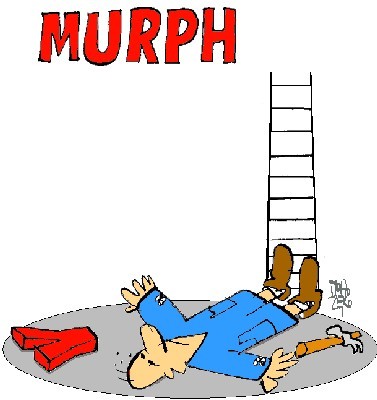
Who Is This Murphy Guy?

Suppose you are an entrepreneur who is seeking start-up funding for a terrific idea you have. You do your homework and put together a solid business plan. Market research shows a lot of upside. Then you pitch your idea to a group of investors and hear the following observations, “I’m concerned that it would be very easy for a competitor to take this idea and run with it faster than you will.” Or, “you are projecting revenues to grow at a 25% rate per quarter for the first three years. Do you seriously believe this can be accomplished?” And finally, “your burn rate seems pretty low – in my experience a rate double what you suggest would seem more appropriate.” What do these statements and questions represent? If you said “skepticism,” you are correct.

Skepticism can be a healthy thing for entrepreneurs and non-entrepreneurs alike. In 1987, Ronald Reagan made his famous “trust but verify” statement about a treaty with the then-Soviet Union. This is a great guidepost for us where skepticism is kept in a positive perspective. Part of advancing new ideas is to have them challenged. A lot of questions are to be expected, many of which may be doubting in nature. This is good – if our ideas can survive rigorous scrutiny and we can provide evidence that is sufficient to prove our case, everyone wins.

There’s a very fine line between the kind of skepticism that is all about looking for answers or proof, and that which questions veracity or integrity. When others become suspicious of our motives, we’ve entered dangerous territory for now we’re on the border of “cynicism.” Cynics suspect that others are motivated by self-interest and at times exhibit varying degrees of paranoia. When cynicism exists in an organization it’s like a cancer. The attitude of a cynic is negative. I believe that cynics are related to Murphy – you know, the Murphy of Murphy’s Law . . . anything that can go wrong will go wrong. Cynics are often denigrating, disapproving, apprehensive, sarcastic, and like to run other people down. You can see why cynics and their cynicism are so unproductive for any organization or institution.

Let’s juxtapose the skeptic and the cynic in our previous example of the start-up seeking funding. I already provided statements and questions that might have been made from a skeptical point of view. Now, here is what the cynic might say. “This idea is unoriginal and doesn’t stand a chance to succeed. Why are you pitching this to us? I’ll bet you’re going to take our money; buy a few computers; have a big party; shut down your company, and leave us holding the bag!” Not one positive thing was said there. And all of the various cynical tendencies were on full display – sarcasm, suspicion, bitterness, paranoia, and disapproval. Sure this may be a bit over-dramatized. But the illustration shows the stark contrast that is important to understand.

We need to maintain a certain dose of skepticism lest we suffer too large a degree of naïveté. Skepticism can be difficult for some entrepreneurs. We are optimists and have powerfully positive mindsets. There may be times when we aren’t interested in looking at the downside of our ideas. That’s why it’s critical that we have people on our team who exhibit a higher level of skepticism. And we must give them permission to prod and probe while expressing their skepticism in a constructive manner. Skeptics serve the entrepreneur well as a counterbalance to wild, pie-in-the-sky unrealistic notions. On the other hand, we must constantly be on the lookout for cynics and eliminate them when they surface.

Embracing healthy skepticism helps to build a better and more sustainable organization. Denying cynicism before it takes root is equally important to the long-term success of whatever it is that we are pursuing.

You can also listen to a weekly audio podcast of my blog. What you hear will be different than what you read in this blog. Subscribe on iTunes or wherever you get your podcasts. You can also click on this link – Click here to listen to Audio Episode 63 – Go Away – We’re Closed!

This blog is being written in tandem with my book, “An Entrepreneur’s Words to Live By,” available on Amazon.com in paperback and Kindle (My Book), as well as being available in all of the other major eBook formats.

“Don’t You Know Who I Am?!”

The actor, Alec Baldwin, purportedly was riding his bike the wrong way near Union Square in New York and was stopped by police officers. After uttering some profanities, he produced this gem, “Don’t you know who I am?” We’ve all heard this before. Someone isn’t getting his or her way and so they play the “Don’t you know who I am” card. This statement is reflective of the ultimate entitlement mentality. Entrepreneurs are often on the road to success – sometimes in a big way. This success may lead to wealth, fame and power. What it doesn’t produce is entitlement.

Let’s define entitlement a bit more clearly. There are certain circumstances where entitlement is perfectly legitimate. For example, suppose we pay through the nose to fly first class on an airline. There are perks that inure to our benefit when we pay extra for them. Similarly, if we pay a premium for a luxury automobile, there will likely be some special treatment that we receive at the dealership when we arrive for service. Again, we are entitled to this special treatment because we paid for it.

Now, contrast this with the guy who always parks his luxury car in a “no parking” zone. Or the woman in an expensive mink coat who cuts in line at the grocery store or the theater. Or in 2009 when a young woman ordered a hamburger in a fast food restaurant and upon asking her name for the order, she replied to the server, “You don’t recognize me? I’m Miley Cyrus!” I don’t know about you, but I cringe when I witness this kind of behavior. This type of entitlement mentality is not the legitimate kind.

As leaders we’re role models whether we like it or not. Our team members are watching every move we make. If we happen to be in the public eye, there are many more eyeballs and ears that are taking notice of everything we are doing and saying. Oh, and they are judging us AND our organization at the same time. It’s one thing to have a great deal of self-confidence and assertiveness – this is entirely necessary to succeed in today’s rough and tumble world of commerce. But the line is crossed when that self-confidence and assertiveness becomes boorish, arrogant and aggressive.

The whole issue is one of self-esteem. The way we see ourselves comes from within and not from the outer. It’s probably no secret that people who are shoving their fame, fortune or power in the face of others, are acting from a feeling of low self-esteem. Sometimes the resulting sense of misplaced entitlement leads to destructive actions such as heaving drinking, drug use, gambling, extramarital affairs and other sorts of outrageous behaviors.

There’s absolutely nothing wrong with driving a luxury automobile, wearing expensive jewelry and clothing, or being on a magazine cover. It’s how we feel about ourselves and how we treat others that matters most. Country singer Dolly Parton is one of the nicest and most humble mega-stars on the planet. Soccer star David Beckham is super polite, and actress Jennifer Lawrence is known for being very down-to-earth and easy to work with. There’s no doubt that all three are members of the rich and famous class. And yet they aren’t overcompensating for their insecurities (and they may not have any) by displaying an attitude of entitlement. They, and many others like them are gracious and put others first.

Our station in life is not a rung on a ladder. Instead, it’s simply a stepping stone that is part of a long and winding journey. Each of us is on a similar journey. When we offer a helping hand to others our lives are enriched.

You can also listen to a weekly audio podcast of my blog. What you hear will be different than what you read in this blog. Subscribe on iTunes or wherever you get your podcasts. You can also click on this link – Click here to listen to Audio Episode 62 – 2300 Feet and No Ropes!

This blog is being written in tandem with my book, “An Entrepreneur’s Words to Live By,” available on Amazon.com in paperback and Kindle (My Book), as well as being available in all of the other major eBook formats.