
Unknown's avatar

About anentrepreneurswords

R. Lee Harris grew up in Manhattan, Kansas and has lived in the Kansas City area since 1977. A 1975 graduate of Kansas State University, Harris began his career with Cohen-Esrey, LLC as an apartment manager two weeks after he graduated. Now president and CEO, he is involved in apartment management, development and investment; construction and tax credit syndication on a nationwide scale. Over the course of his career Harris has overseen the management of more than 27 million square feet of office building, shopping center and industrial space and nearly 60,000 multi-family units. He has started dozens of business enterprises over the past 40+ years. In 1991, Harris wrote a book entitled, The Customer Is King! published by Quality Press of Milwaukee. In 2012 he authored the book, An Entrepreneur's Words to Live By. He has mentored a number of business people over the years and has been a long-time participant in the Helzberg Entrepreneurial Mentoring Program. He and his wife Barb have two grown daughters and one grandson. They are active in their church, community and university.

Who Is Dan Meyer?

In 1961 Major League Baseball’s Philadelphia Phillies suffered a 23 game losing streak. The 2013-14 NBA Philadelphia 76ers endured a 26 game losing streak. In 1976-77 the Tampa Bay Buccaneers had the longest losing streak in NFL history at 26 games. Dan Meyer played both in the infield and the outfield for the 1983 Oakland Athletics and captured the MLB record for hitless at-bats in 48 attempts by a non-pitcher. Talk about slumps! A quick check of the dictionary offers the following definition of slump – “a period during which a person performs slowly, inefficiently, or ineffectively, especially a period during which an athlete or team fails to play or score as well as usual.”

We’ve all watched sports teams at amateur and professional levels encounter slumps. Ditto for businesses. And we’ve undoubtedly experienced periods in our own lives where we perform slowly, inefficiently or ineffectively. Feelings of hopelessness and victimization set in. Day after day we become more lethargic. It’s harder and hard to get out of bed. We’re defeated shortly after we arise. When things don’t turn out the way they should we say things like, “it figures – I just can’t win,” and an air of resignation sets in.

A slump is simply a state of mind. While I don’t have scientific proof, I believe we enter a slump as a result of negative thinking. We’re rocking along with everything going fine and something happens that has negative connotations. Maybe we were certain we were going to win a certain piece of business and then we don’t. Rather than shake it off and re-double our efforts with a positive attitude, we allow the loss to gnaw at us. It might be very subtle or even subconscious. But we let that little bit of negativity into our psyche and that, my friends, can be the beginning of a slump. Which is why I am such a staunch advocate for maintaining a positive frame of mind 100% of the time. Positivity is the best armor against a slump. When something doesn’t go right we need to see it as an opportunity to get right back on the horse and ride again . . . without hesitation. The negative creep in our consciousness will kill us if we don’t.

Suppose that somehow we find ourselves in a slump. How do we pull out of it? The same way we avoid falling into a slump in the first place. The first and most important step is to examine our attitude. Recognizing the negative thoughts and replacing them with positive ones is absolutely crucial. And we need to make sure we get every last one of them. Even a lingering doubt of any sort can be enough to keep the slump alive.

Once we return to a positive frame of mind we can take some additional steps to ensure that we’re back on track and the slump is behind us. Look for a small victory of some sort. No need to swing for the fences – just get a base hit. For example, we don’t need to immediately make that next big sale. Instead, simply get an appointment to meet with a prospective customer. Also, it’s a good time to review the basics and fundamentals of whatever it is that you do. This becomes a necessary grounding exercise. A baseball player who is struggling at the plate will often focus on the mechanics of his hitting. Perhaps he finds that a very minor change in technique makes all the difference. With a completely positive mindset and solid basics and fundamentals working in concert, the final step is going to a place of gratitude. We have so much for which to be grateful and must intentionally create a thanksgiving inventory. Focusing on gratitude will close the circle and put us back in the winning mode again.

Slumps occur because we let in a tiny bit of negativity. We can quickly end a slump by regaining our positive attitude; by focusing on the basics and fundamentals of what we do, and by being thankful for all of the good that is in our life.

You can also listen to a weekly audio podcast of my blog. What you hear will be different than what you read in this blog. Subscribe on iTunes or wherever you get your podcasts. You can also click on this link – Click here to listen to Audio Episode 1 – False Choices.

This blog is being written in tandem with my book, “An Entrepreneur’s Words to Live By,” available on Amazon.com in paperback and Kindle (My Book), as well as being available in all of the other major eBook formats.


Dan Meyer

Innie or Outie?

Are you an “innie or an outie?” And I’m not talking about belly buttons. Are you an introvert or an extrovert? Before you answer you should know that there are many common misconceptions about these terms. The famous Swiss psychiatrist, Carl Jung developed extensive research on this subject. In fact, Jung actually used the term “extravert” instead of “extrovert.” Over the years the word seemed to have morphed into the “extrovert” terminology we use today. So, when you hear these words, what do you think? An introvert is shy and an extrovert is outgoing? As with many things, this is an oversimplification. Think about how we recharge our batteries. Do you find that you gain renewed energy from being alone in solitude or by being around other people? Technically, introverts seek renewal alone and extroverts recharge through interaction with others. But enough with the technicalities. Let’s explore introversion and extroversion in the more traditional sense.

How can introverts and extroverts survive and thrive with each other? How can an introvert succeed when many situations call for a high degree of sociability and gregariousness? And how do extroverts avoid coming across as a bull in a china shop in situations that need reflection and finesse?

I know a person who has a position that requires considerable interaction with others in a public setting. This individual makes outstanding presentations to large groups of people but struggles mightily with one-on-one interaction. I and others question his genuineness and authenticity as a result of this challenge with his personality. People see him as a masterful “performer” on stage but are frustrated because the “act” doesn’t translate into personal charisma.

For those of us who might find it challenging to engage easily with others, here are some ideas. Step into it. Play offense instead of defense. We can put ourselves in situations where we have the opportunity for interaction. Maybe it’s at a conference or a gathering of some sort. We find someone who isn’t already talking to others and go introduce ourselves. Be strong. The handshake is firm and we make friendly eye contact. The person I mentioned in the preceding paragraph has a tendency to either avoid eye contact or look over my shoulder. Smile. Always smile. It helps us to put ourselves and others at ease. Relax. Don’t try too hard. We just need to be who we are – not someone else. And yes, we can be strong and relaxed at the same time. This actually projects confidence.

On the other end of the spectrum some of us may be somewhat supercharged with extroversion. In certain situations this can be overwhelming to others and can come across in a high pressure salesman manner. Of course we don’t want to be perceived this way. Many extroverts have a great deal of nervous energy and perhaps even a touch (or mega dose) of ADHD. This reflects in their speech patterns and mannerisms.

As extroverts we need to work to “dial it back” at times. Zip it. We may have a tendency to dominate conversations. Instead, we need to make a concerted effort to create a dialogue where we make sure that others have a chance to express themselves. Chill. Somehow we have to resist the urge to outwardly manifest all of the energy that is pent-up inside. Calm. We need to replace the pent-up energy with calmness. Don’t worry; our charisma is so strong that we won’t be seen as a shrinking violet. Smile. A friendly smile is disarming and sends positive vibes to others. As extroverts we may have a tendency to be too intense. Remembering to always smile will put others at ease.

Introverts and extroverts must make a mutual effort to co-exist and collaborate. When they succeed, they can do great things together.

This blog is being written in tandem with my book, “An Entrepreneur’s Words to Live By,” available on Amazon.com in paperback and Kindle (My Book), as well as being available in all of the other major eBook formats.

bull-china-shop

P+A+C=I

“. . . we shall fight in France, we shall fight on the seas and oceans, we shall fight with growing confidence and growing strength in the air, we shall defend our island, whatever the cost may be, we shall fight on the beaches, we shall fight on the landing grounds, we shall fight in the fields and in the streets, we shall fight in the hills; we shall never surrender.” “Let us therefore brace ourselves to our duties, and so bear ourselves, that if the British Empire and its Commonwealth last for a thousand years, men will still say, ‘This was their finest hour’.” Winston Churchill uttered these words during World War II and led Great Britain through one of its darkest periods in history.

“. . . I still have a dream. It is a dream deeply rooted in the American dream. I have a dream that one day this nation will rise up, live out the true meaning of its creed: We hold these truths to be self-evident, that all men are created equal.” On August 28, 1963, Dr. Martin Luther King made this proclamation at the Lincoln Memorial in Washington, DC, witnessed by 250,000 civil rights supporters.

Have you ever heard of Patrick Henry Hughes? He is an amazing story. Born without eyes and a congenital birth defect that prevented him from straightening his arms and legs, Patrick became an accomplished vocalist as well as playing the piano and trumpet. He even became a member of the University of Louisville Marching and Pep Bands, and a UP Premiere movie, “I Am Potential,” is based upon his life and success.

What is the common theme for these three individuals? Inarguably each is an inspiration. Churchill inspired his countrymen to stand strong during the difficult days when Britain was under siege. King inspired millions seeking equality in their everyday lives. Patrick Henry Hughes as served as an inspiration for everyone who has encountered a challenge – and haven’t we all?

As entrepreneurs we want to be inspirational leaders. We want to lead inspirational organizations. We want our mission and vision to be inspirational. But sometimes the notion of inspiration can be confusing and even elusive. Exactly how do we inspire? I’ve looked high and low and there’s no handbook. There are as many definitions as there are inspirational quotes – the quantities are massive. Here’s an equation that I’ve developed over the years that I believe stimulates inspiration.

Passion + Authenticity + Conviction = Inspiration

This formula can be measured by the likes of Winston Churchill, Martin Luther King, Jr. and Patrick Henry Hughes. Is there any question that each had incredible passion for their cause? And is there any doubt as to their authenticity? Think about it. How could anyone play-act the power and impact that each had on society? Finally, they never wavered. They never quit. They stood by their beliefs no matter what. When we genuinely have a deep and lasting positive passion; demonstrate it in authentic ways, and are steadfast in maintaining this passion, we can’t help but inspire others. People aren’t inspired by wishy-washy. People aren’t inspired by fake. And people aren’t inspired by quitters.

Inspirational intelligence exists in great leaders. By emulating the inspirational formula, Passion + Authenticity + Conviction, we too can motivate others to join with us in doing great things.

This blog is being written in tandem with my book, “An Entrepreneur’s Words to Live By,” available on Amazon.com in paperback and Kindle (My Book), as well as being available in all of the other major eBook formats.

Patrick-Henry-Hughes

The Zone of Doom

What do we dread most in our business and personal lives today? No, it’s not losing. When that happens, we simply pick ourselves up and go after it again. And it’s not being overwhelmed by our workload. We solve this with a few adjustments to time management and delegating to other team members. Our biggest “dread” is insidious and frustrating beyond belief. Here’s an example of what happens. We’re attempting to do business with someone. We’re past the cold calling stage and actually have been interacting with other party. We send an e-mail and wait a day or two. Then we call and leave a voicemail. Perhaps we even send a text. A week goes by with radio silence. We’re officially in the Zone of Doom.

The Zone of Doom is the black hole of non-responsiveness. Unfortunately it’s become an epidemic. With caller ID many people simply ignore calls from those of us with whom they do not wish to speak. Blowing off e-mails is even easier. I know I sound like an old geezer, but when I was growing up in the business world I quickly learned that protocol dictated the return of every phone call the same day or next morning. We didn’t have e-mail back then so letters and memos were the standard for written communications. The expectation was that the response be immediate. There never was any thought of not responding at all. In fact, when someone slipped and failed to provide a timely response, the word usually got back to corporate leadership and there was hell to pay.

The biggest challenge relayed to me by members of our team is that their interactions with so many people outside the company are one-way. Simply trying to reach people is so much harder than ever before. Long ago, I resolved not to fall into this category. I think I’m about 95% true to this resolution. I do return my phone calls in a timely fashion – though I will admit that there may be a cold call here or there from a salesperson that I miss. I believe most people will attest to the fact that I usually return all my e-mails the same day if not the same hour.

So how are we supposed to deal with the Zone of Doom?  How are we supposed to do business when people are so unresponsive? There’s no question that failure to respond is not acceptable. But we must ask ourselves what might be the root cause for our receiving the silent treatment? This goes beyond the fact that people are busy. It all boils down to priorities. Think about how we develop our own set of priorities. What goes at the top of the list and what goes at the bottom? I find that the things that are most important are those which are most impactful to my business and my life. It’s a pretty good bet that others set their priorities in the same manner. When I’m trying to reach someone else I try to bear in mind whether or not communicating with me will make that much difference to the other person. There’s the word . . . difference.

We must be able to differentiate ourselves when competing with someone else’s priorities. Is what we are attempting to communicate really that important to them? If not, then what can we do to push it up toward the top of the ladder. This is where relationship building becomes so important. I’ve written many times that relationships are all about service. I’ve found that the harder I work to establish and serve a relationship the more likely someone will reciprocate my attempt to communicate. You may be thinking, “How can I possibly build and serve relationships with everyone with whom I come into contact?” No one said it would be easy. Relationships take time to build and there’s no time to waste. Any and every little thing that can be done to help someone else builds that relationship. Many business people seek to establish relationships to benefit themselves. If we do it differently and make every attempt to help others, our efforts will be recognized as genuine and authentic.

We can avoid the Zone of Doom by building relationships for the purpose of serving others. And through our relationships, we move up the priority list of those we are serving.

This blog is being written in tandem with my book, “An Entrepreneur’s Words to Live By,” available on Amazon.com in paperback and Kindle (My Book), as well as being available in all of the other major eBook formats.

abyss

Thank You Fitbit!

I’m going to confess something in public right now. I’m obsessed. Ever since I got a Fitbit in August 2013, I’ve become more and more a slave to this device. I started with the basic unit and upgraded to the top-of-the-line Surge as soon as it came on the market. I created a spreadsheet on which I record my daily step count and miles walked (think I’m a little OCD?). Early on, when traveling if I found myself short of hitting my step goal, I would walk hotel hallways and stairwells until the Fitbit buzzed my achievement. More recently I continued to push for higher and higher daily step counts – 20,000, then 25,000, then 30,000. At this point in time I average 20,000 to 21,000 steps each day. I’ll park my car in the farthest reaches of the parking lot to get more steps. It’s comically absurd the lengths I’ll go to increase my step count.

Walking has been mostly a beneficial experience for me. Fortunately I picked something healthy over which to obsess. Along with eating properly, walking has enabled me to lose a lot of weight. It’s great to get outside in the fresh air and I tend to listen to a wide range of podcasts and some terrific music. I guess I’m glad that I didn’t choose to obsess over an ultra-expensive hobby or something riskier like sky diving or helicopter skiing.

However, the fact remains that walking is still an obsession for me. So I started to wonder how I might channel this persistent fixation. And I’ve finally decided that walking 20,000 steps each day is probably sufficient. I don’t need to try and push my average to 25,000 or even 30,000 – though I’ve actually contemplated both of these goals. I know that my personality is such that I will always obsess over something. It might as well be something even more productive than walking. Thus, I started a process to discover a new obsession.

Intentionally searching for an obsession is more than a bit bizarre. But I knew that I wanted to settle on something profound. Then I had an epiphany. One of our corporate core values is Customer Fulfillment – We Strive to Exceed Our Customers’ Expectations. Why not focus my obsessive energy on Customer Fulfillment? This notion began to resonate with me and I became excited over the possibilities. The challenge is to keep from having an artificial mindset about this. My obsession over walking is totally natural – can my obsession about Customer Fulfillment be just as natural? I resolved to make it so.

It is a fascinating experience to consciously and purposefully channel one obsession into another. I’ve only been doing it for a few months. But every time I walk, I find myself thinking about Customer Fulfillment. Ideas flow freely during these twice daily wanderings. Many notes are made on my phone to be fleshed out later. I’m now adding some podcasts with a customer-centric flair for my listening pleasure. Walking has become the trigger for the focus on this new obsession. I think this is the real key. If we want to channel an obsession into something productive, a trigger of some sort is needed. It also needs to become a daily practice. If I only walked three or four times each week the trigger effect would be less pronounced and I doubt that I would be able to transfer the walking obsession into that of Customer Fulfillment. I’m not going to stop walking, but now I ‘m inspired to walk for a different reason.

Obsessions can often be destructive. Fortunately there is a way to channel them into productive endeavors if we resolve to do so. Thank you Fitbit!

This blog is being written in tandem with my book, “An Entrepreneur’s Words to Live By,” available on Amazon.com in paperback and Kindle (My Book), as well as being available in all of the other major eBook formats.

fitbit

Cocoons and Garlic Necklaces

How often have you encountered situations where you conclude that luck must have played a part in the outcome? Perhaps you barely escaped being involved in a horrific traffic accident. Or you walked into a meeting with a prospective customer with whom you’d never spoken and won a major account just by “being in the right place at the right time.” Is someone who seemingly sails through life without struggle just lucky? What about fate? Is our destination already mapped for us? Are some people pre-ordained to succeed and others to fail? Could it be that we use “luck” and “fate” as rationale for something we don’t understand or can’t explain?

I’m going to go out on a limb here and profess that I believe luck and fate are mostly myths. Since no one can prove or disprove this statement, I think I’m pretty safe. Notice I didn’t completely rule out either concept . . . because I can’t be totally certain. But I do think that how we live our lives has a lot to do with what we might otherwise perceive as luck or fate. While this may sound a bit New Age, stick with me on this.

I am totally committed to the notion that positive energy exists and when we live a positive life in every way possible, good things come to us. Does this mean that a positive lifestyle provides protection from bad things happening to us? I don’t know. I suppose it’s possible but I prefer to look at . . . yes, the positive side of this. Here’s what I know for sure. When I’m thinking positive thoughts my heart rate is lower, my head is clearer and I’m more often “in the zone.” I’m much less resistive to new ideas and my creativity is off the charts.

Successful outcomes are a combination of many things. It helps to have talent, skill, intelligence, hard work, determination and perseverance. Everyone has talent. Unfortunately many people don’t dig deeply enough to discover their true talent – but it’s there. Skill can be learned and developed. Almost everyone can learn and develop a skill. Intelligence is innate, but even those individuals with average or below-average IQs can be very successful by learning how to think. Yes, there are many who are allergic to hard work, but everyone has the opportunity to work hard. With the right mindset, anyone can possess enormous amounts of determination. And of course we all can persevere if we choose to be patient. Too often, people are willing to give up because they aren’t determined and patient enough. Are people who consistently enjoy high levels of success just lucky, or have they discovered their talent, honed their skill, learned how to think critically, worked hard, been doggedly determined and are supremely patient?

Who needs luck when we can wrap a cocoon of energy from a positive mindset around our talent, skill, intelligence, hard work, determination and perseverance? The universe works in amazing ways and perhaps we resist negativity and bad outcomes by living inside this cocoon? Suppose we’re competing for a contract and we lose. Some might say that our woo-woo positive approach didn’t work. But I choose to see it differently. Instead, I get very excited when I don’t win because it means that something better is in store for me. In the moment that may be hard to see. But I’ve experienced this concept countless times. There have actually been instances when I’ve later learned that what we “lost” would not necessarily have been right for us in the first place. I remember vying to acquire an apartment property in a small town but did not win the bid. A few months later the major employer in that town pulled up stakes and left – occupancy at the apartment property we had wanted to buy was devastated.

Luck and fate are abstractions that can allow us to rationalize our success or failure. Living the most positive lifestyle possible eliminates the need for carrying a rabbit’s foot or wearing a garlic necklace to ward off evil spirits.

This blog is being written in tandem with my book, “An Entrepreneur’s Words to Live By,” available on Amazon.com in paperback and Kindle (My Book), as well as being available in all of the other major eBook formats.

garlic necklace

The Case of the Dirty Diaper Over the Cliff

Let me set the scene. We get a call from a customer and boy is he mad. He rants and raves about how he’s been wronged by one of our team members. “She was so incredibly rude to me!” he exclaims. “And she even laughed at me when I explained my issue.” Honestly, what is our first thought? It may be that we can’t believe our team member would act in this manner. We may also prepare ourselves to have a serious conversation with this team member and really lay down the law. Perhaps we are even ready to put a note in the personnel file about the incident. What happens next? We’re plenty steamed, so we track down our team member and lay out the situation in a somewhat accusatory fashion offering plenty of righteous indignation in the process. Except . . . it turns out that the customer was all wrong. What happened here? I call it the “The Case of the Dirty Diaper Tossed Over the Cliff.”

In this situation, we heard a complaint (the Dirty Diaper) and immediately jumped to a conclusion (the Cliff). We failed to gather solid evidence in a calm and reasonable fashion and instead rushed into an unpleasant encounter with our team member half-cocked. In this specific scenario, had we conducted a proper investigation we would have discovered that there was a witness – another customer – who observed the whole thing. And after talking to this customer, we learned that the accuser had an axe to grind with our team member and called her names and said ugly things to her. Not the other way around. Unfortunately we failed to give her the benefit of the doubt when we launched into our accusation which of course caused unnecessary tension.

In the “heat of battle” aka/confrontational situations – it’s easy to sympathize with the party that is upset. Perhaps our team has had the type of issues in the past that are being presented in the current situation. We instinctively may have a tendency to jump to erroneous conclusions and even worse, act upon them. The fallout from this approach can be devastating. Our team member felt that we weren’t supporting her and the feelings of trust she had for us were broken. Other team members learned of the incident and the trust with them was damaged as well. Ultimately the team member involved quit – all because this matter was so incredibly mishandled.

Maybe this has never happened to you. I truly hope that is the case. I’ve seen it occur in my own organization and I’ve even been the “accuser” in a bit of a milder way, but nonetheless I didn’t do my homework first. I’ve resolved to listen carefully to information that is being provided by the complainant and ask questions sufficient to fully understand this person’s point of view. I also try to glean as many facts as possible. Often there’s a lot of emotion involved and the “diaper” gets really dirty very fast. It’s critical to be adequately sympathetic without taking sides and try to focus on the facts. Then, rather than taking the “dirty diaper” and “throwing it off the cliff,” I try to factually determine the other side of the situation without accusation or condemnation.

There will be times when the facts presented by the two parties are vastly different. Let’s assume for a moment that there are no witnesses and there’s just no way to corroborate either version of the encounter. We have to be very careful passing judgment in such situations and determining that one party is right and the other is wrong. Instead, we offer our counsel with the intent to coach our team member, and we do what we can to placate the party who is aggrieved. In a sense, we need to operate as would a judge or jury. If the evidence is insufficient, it’s pretty hard to render a clear decision. Should a pattern develop with our team member where we learn of similar issues occurring on an ongoing basis, we may need to take stronger action based upon such a pattern.

Strong teams are built on trust. We must protect this trust by handling contentious issues in a calm and measured fashion; gathering evidence, and resisting the inclination to jump to conclusions.

This blog is being written in tandem with my book, “An Entrepreneur’s Words to Live By,” available on Amazon.com in paperback and Kindle (My Book), as well as being available in all of the other major eBook formats.
Father Changing Baby's Diaper --- Image by © Paul Barton/Corbis

Father Changing Baby’s Diaper — Image by © Paul Barton/Corbis

Mousetraps²

I don’t want our customers to be satisfied. Put another way, customer satisfaction is not our objective. I also don’t want our team members to be satisfied. There, I’ve said it. I’ll bet you’re thinking that there’s a punchline somewhere in all of this. And yes, there is. But let’s dig a bit deeper before getting to the bottom line.

When we serve others we certainly want them to be satisfied – right? This seems like a perfectly rational objective because we all know what happens when a customer or team member is dissatisfied. So, when a customer (or team member) makes a request, we do our best to satisfy that request. We generally believe that when someone is satisfied they are happy. Here’s an interesting dilemma. Suppose we’ve done everything we can to satisfy our customer; they tell us they are happy, but then they quit anyway. What’s up with that?

One of our companies is involved in managing apartment properties for our own account and for third-party clients as well. I can remember several times over the past many years that a long-time client told us he was perfectly satisfied with our service, only to make a change and hire another firm. We were assured that we’d done nothing wrong and other circumstances stimulated the change. In some cases the client was consolidating the management of all his properties with a national property management firm. In another instance we were told that the client had a relationship with another company and though he was satisfied with our performance, he thought he might do better with the other firm. Naturally there’s a strong level of disappointment when we hear that someone is satisfied and yet they are still making a change. What in the world are we to do?

OK, here comes the punchline. Customer satisfaction isn’t enough. Team member satisfaction isn’t enough. Customers and team members leave even when they are completely satisfied. Attempting to achieve customer and team member satisfaction is a siren song that will lure us into the rocks and sink our ship. Instead, we need to focus on fulfillment. Fulfillment is a much higher state than satisfaction. It’s a concept that’s similar to exceeding expectations but is even more than that. Trust me – you won’t get any help from the dictionary on this one. It says that to fulfill is to satisfy. I think the dictionary’s definition misses a very important nuance here.

Suppose an apartment resident calls and reports that her kitchen faucet is dripping. If our maintenance technician goes to her apartment and completes the repair, then he’s satisfied her request. However, if he goes and fixes the faucet, and then checks a number of other physical elements in her apartment and fixes other items that he finds, then we’re moving toward a level of fulfillment for the customer. Total fulfillment comes when there’s nothing else a customer could possibly want or need, even if he or she hasn’t articulated it. In other words, we’ve anticipated every possible scenario that could impact the customer and we’ve taken all the steps we could to resolve unforeseen issues and create an over-the-top experience. This was what was missing when we lost a client who told us he was satisfied. We had not gone above and beyond to create the over-the-top experience that achieved total fulfillment.

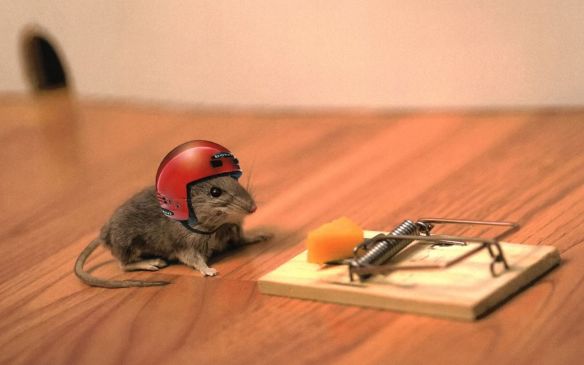
Customers and team members leave or quit all the time when they are satisfied. Usually it’s because they aren’t aware of a better alternative. But when that better mousetrap is presented to them it’s not hard to understand their motivation for making a change. Changing our focus from satisfaction to fulfillment increases the odds in our favor that we possess the better mousetrap.

Achieving fulfillment for our customers and team members requires a combination of commitment, innovation, understanding, vigilance, appreciation and gratitude. Fulfillment is the best mousetrap in today’s highly competitive entrepreneurial environment.

This blog is being written in tandem with my book, “An Entrepreneur’s Words to Live By,” available on Amazon.com in paperback and Kindle (My Book), as well as being available in all of the other major eBook formats.

mouse-trap-helmet

The “Disneyland” Story

We’ve explored the concept of Vision in this blog before. But I’d like to share a technique that has worked for me – perhaps you’ll find it valuable too. Simply put, vision is “what it looks like when we get there.” Remember when we were young and a family vacation to Disneyland was being planned? What was the focus? It wasn’t so much on the long journey to get there. Instead, we could see ourselves riding in the Tomorrowland Jets (long gone now) or in a Matterhorn Bobsled. We could taste the cotton candy and hear the whistle on the Mark Twain Riverboat. In other words, we had a vision in our minds-eye of what we were going to experience.

As entrepreneurs we have that same vision. The problem for most of us is that it remains trapped inside our heads. We struggle to articulate it to others. And so our team members punch the clock every day with no clear idea of “what it looks like when we get there.” It seems pretty clear to us, but they don’t have a clue.

I’ve been struggling with communicating my vision for many years. I often launch initiatives and undertake projects that all make sense within the framework of my vision – but to others it seems like a helter-skelter approach to something that is undefined. At times, members of our team have expressed frustration with the process and begged for a clearer picture. I’ve tried reducing my vision to writing, but a few bullet points later even I’ve been uninspired.

At the urging of a friend and former colleague I took another stab at it recently. But instead of trying to put it on paper in a concise one or two paragraph manner I went a different direction. I decided to tell a story. I mocked up a Wall Street Journal masthead and put myself in the shoes of a WSJ reporter writing a profile of my company – ten years in the future. I actually picked the name of a real reporter and the date on the masthead was really ten years out. And then I told the story in considerable detail. What unfolded were several aspirations; explanations of how the aspirations were to be achieved, and ensuing measures of success. I quoted real people. I talked about how our customers were going to feel. Our culture was highlighted and several strategies were outlined. One thousand seven hundred and seventy words later a clear picture emerged representing “what it looks like when we get there.”

I’ve started sharing the vision story with various teams – our Executive Leadership Team, Senior Managers Team, etc. My vision needs to become a shared vision and I’m eager and willing to tweak it so that it is inspiring to as many members of the team as possible. We’re beginning to work backwards from what it looks like ten years in the future, to identify the various strategies that will be needed to reach the vision. Clearly there’s a lot of work to be done – but finally; for the first time in more than 40 years, everyone has a clear picture of where we’re going.

If you’ve been having a tough time articulating your vision, I encourage you to write your own story. And if writing isn’t really your thing, sit down with someone who has the gift of prose and tell him or her the story from your heart. This person can serve as your translator and put on paper the story that you will share with your team. You’ll have several re-writes. You’ll add, delete, clarify, expand and fine tune. Just remember that the final product should be inspirational. It should be as big and bold as you desire. And anyone reading it should come away without any doubt about “what it looks like when we get there.”

We all have a Disneyland image of some sort for the organization to which we have committed so much of our lives. We can share it with others through a storytelling process that creates clarity and a call to action.

This blog is being written in tandem with my book, “An Entrepreneur’s Words to Live By,” available on Amazon.com in paperback and Kindle (My Book), as well as being available in all of the other major eBook formats.

Disneyland

A$$holes and Angels

Life is full of contrasts which span our personal and professional lives. Happy and sad. Victory and defeat. Sunny and rainy. Dogs and cats. A$$holes and angels. Wait a minute – a$$holes and angels! What the heck?

As humans we have a lot of issues. Sometimes we are able to deal with these issues and at other times we are not. When we are successful in meeting our challenges we tend to be more measured and pleasant. But when these challenges become seemingly insurmountable brick walls there is a chance that our personality changes – and not for the better. Feelings of insecurity and inferiority may manifest through biting and snide remarks, ugly facial expressions or downright hostility.

A guy walks into McDonald’s and orders lunch. He just was chewed out by a client and he’s not a happy camper. The person taking his order is a little slow or distracted and he snaps, “Your service is terrible.” Obviously he’s well on his way to winning friends and influencing people. Angelic behavior? Probably just the opposite. Little encounters like this happen all of the time. Unfortunately when unchecked, a pattern develops where lashing out in this manner can become a habit.

In an entrepreneurial organization rudeness and disrespect cause a great deal of tension. It produces negative energy, creates conflict and can destroy the chemistry of a team. Leaders who ignore it are giving implicit approval of the perpetrators. It’s one thing for there to be disagreements between team members. This can be a healthy process toward a successful end result. But when the disagreements turn uncivil and personal the healthy part of the process has come to an end.

I have a pretty high tolerance factor for dissent. I encourage my colleagues to offer different opinions and ideas. And I don’t mind a lively discussion that stimulates new ways of thinking. However, I’ve been told that there are times when others begin to feel uncomfortable because of the intensity of some conversations. The line may have been crossed where the comments have become too biting and even personal. So, I’m learning how to interrupt such situations and nip them in the bud before they digress into the world of the unproductive.

This all easily translates into one very simple premise. There is no place for a$$holes – anywhere in life. When unacceptable behavior is observed it needs to be stopped immediately. If there are several team members present it may be best to take a break in the meeting and consult with the offender in a one-on-one manner. There’s nothing gained by embarrassing an individual publicly. Everyone has a bad day once in a while and a kind and empathetic word may be all that is necessary to diffuse a brewing tempest and prevent it from escalating.

It’s much more troublesome when a member of the team has become a chronic a$$hole. Such a person may walk around with a permanent scowl on his or her face. Colleagues may go out of their way to avoid this individual. No one looks forward to meetings that include him or her, and encounters with this person often end with feelings of hurt, anger or humiliation. Chronic a$$holes must be dealt with swiftly and firmly. As soon as it becomes apparent that this person has chronic issues he or she must be advised that his/her behavior is unacceptable and will not be tolerated. When this person is a high performer it makes dealing with him/her that much more difficult. But for the sake of the team action must be taken including removal from the team as a last resort.

Life (and business) is tough enough without having to contend with a$$holes. Dispensing with such behavior as soon as possible will help restore the equilibrium of a team.

This blog is being written in tandem with my book, “An Entrepreneur’s Words to Live By,” available on Amazon.com in paperback and Kindle (My Book), as well as being available in all of the other major eBook formats.

gargoygle