
Unknown's avatar

About anentrepreneurswords

R. Lee Harris grew up in Manhattan, Kansas and has lived in the Kansas City area since 1977. A 1975 graduate of Kansas State University, Harris began his career with Cohen-Esrey, LLC as an apartment manager two weeks after he graduated. Now president and CEO, he is involved in apartment management, development and investment; construction and tax credit syndication on a nationwide scale. Over the course of his career Harris has overseen the management of more than 27 million square feet of office building, shopping center and industrial space and nearly 60,000 multi-family units. He has started dozens of business enterprises over the past 40+ years. In 1991, Harris wrote a book entitled, The Customer Is King! published by Quality Press of Milwaukee. In 2012 he authored the book, An Entrepreneur's Words to Live By. He has mentored a number of business people over the years and has been a long-time participant in the Helzberg Entrepreneurial Mentoring Program. He and his wife Barb have two grown daughters and one grandson. They are active in their church, community and university.

Pronouns

Do you remember English class? We learned about modifiers, adjectives, adverbs, nouns, verbs and dangling participles. Diagramming sentences was a daily occurrence and understanding predicates and prepositions wasn’t far behind. And how about the way we got down in the weeds with relative clauses and rolled in the mud with non-defining or non-essential clauses? But my all-time favorite exercise in phonology involved the schwa. Which brings us to pronouns.

Pronouns are a major element of entrepreneurship. As peculiar as this may sound you’ll soon understand how very true this statement is. The next paragraph is a montage of snippets from speeches given by a very famous entrepreneur who happens to be running for president. Move past any ideological dispute you may have with this individual – that’s not the point. Instead, pay attention to the language and in particular, the pronoun usage.

“I have lobbyists. I have lobbyists who can produce for me. I have so many websites. I have them all over the place. I hire people, they do a website. It costs me $3. I will be the greatest jobs president that God ever created. I’ll bring back jobs from China, from Mexico, from Japan, from so many places. I’ll bring back our jobs, and I’ll bring back our money. I’m using my own money. I’m not using the lobbyists. I’m not using donors. I don’t care. I’m really rich. I am a nice person. I give a lot of money away to charities and other things. I think I’m actually a very nice person. I’m proud of my net worth. I’ve done an amazing job. I’ve employed tens of thousands of people over my lifetime. I’m proud of my net worth. I would build a great wall, and nobody builds walls better than me, believe me, and I’ll build them very inexpensively. I will find the guy that’s going to take that military and make it really work. I will stop Iran from getting nuclear weapons.”

I’ve selected these quotes because they overdramatize the point I’m trying to make. Notice the manner in which pronouns are used. This particular entrepreneur speaks in what I call I, Me and My language. I, Me and My language can sound arrogant and insensitive, and likely reflects the way a person thinks. Gracious and humble people don’t speak this way. They realize that it takes a team filled with talented people to succeed.

There is an alternative language that can be spoken by entrepreneurs. It’s called the We, Our and Us language. It recognizes the collective efforts and contributions of many. I’ve been working to perfect this language for many years and it has made me very much aware of how easy it is to slip into I, Me and My. Whenever I write a memo or an e-mail, I always review it before sending to replace the references to I, me and my, with we, our and us. I have come to realize how this simple act is an acknowledgement of others. And the more I write this way, the more I tend to speak this way as well. Ultimately, writing and speaking leads to thinking in this language which completes the conversion.

The entrepreneurial pronouns of we, our and us help build strong and positive relationships with others. Spreading the credit through inclusive language generates more goodwill than any amount of money could buy.

This blog is being written in tandem with my book, “An Entrepreneur’s Words to Live By,” available on Amazon.com in paperback and Kindle (My Book), as well as being available in all of the other major eBook formats.

Team Trophy

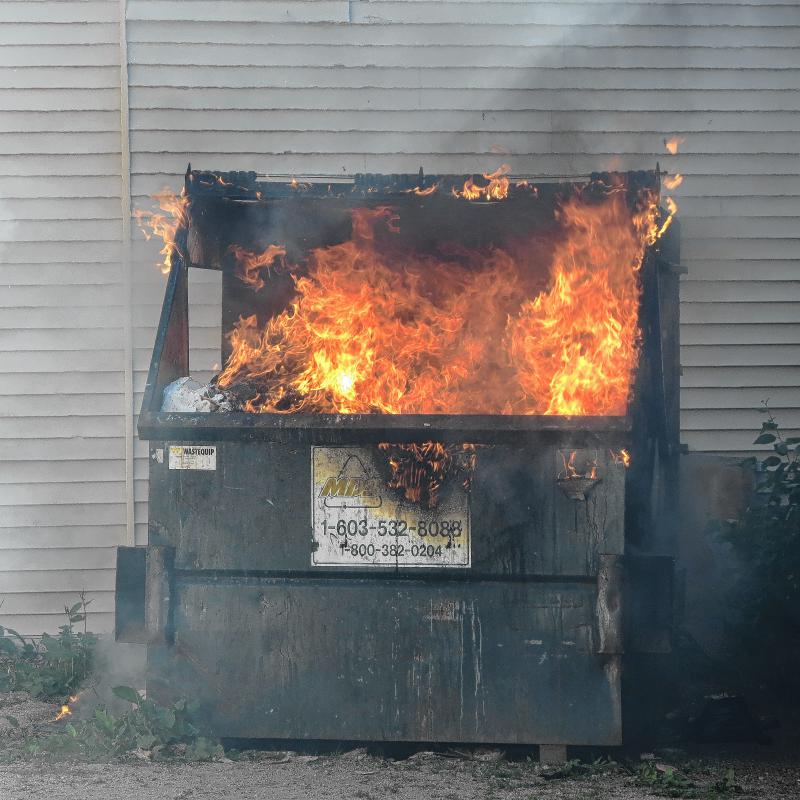
Dumpster Fires

Dumpster fires are tricky devils. They usually start out as nothing. Just a bunch of trash sitting in a big metal bin . . . and then someone flicks a cigarette butt or empties hot coals from a grill and the smoldering starts. Who knows what’s really inside the container? It could be aerosol cans, used motor oil, acetone, automotive batteries, paint thinner and a host of other accelerants. After smoldering for a while, the fire gets hotter and hotter until it becomes a raging inferno. If the dumpster is too close to a building, the entire structure could ignite and burn to the ground. Discovered early enough, a simple fire extinguisher could put out the blaze in a matter of seconds. But once it’s out of control the fire department may have a battle on its hands for hours.

There’s an obvious parallel between dumpster fires and the minor irritating problems that entrepreneurs encounter every day. We all experience situations that we tend to ignore. Perhaps there is a petty conflict between two members of our team. Maybe it’s a nagging customer service issue or a piece of equipment in the plant that isn’t functioning properly. We know the problem is there, but we simply choose not to address it wishing and hoping that it will just go away. After all, we have bigger crises to deal with. Right?

But we all know what eventually happens. The conflict between team members blows up big time and someone quits or has to be fired. Other team members are dragged into the drama which impacts productivity and damages our culture. The customer service issue results in the loss of a customer and perhaps a nasty post in the social media world hurting our brand in a much broader way. Now we’re in damage control mode involving multiple members of our team who are trying to restore our reputation. And that piece of equipment in the plant that wasn’t functioning properly? It finally breaks completely, shutting down the entire production line in the process. Oh, and one of our team members was injured when the machine finally died.

Each of these situations began as a small smoldering dumpster fire. Immediate attention (the fire extinguisher) would have resulted in a solution that put out the fire. The wider ranging consequences of inaction would have been avoided. This leads us to conclude that we need to look for small problems every day and intentionally take the necessary steps to fix them. I know that I have small festering issues that need my attention. But sometimes I just don’t want to face them at the moment. So I give myself a 24-hour pass and make sure they pop-up the next day on my task list. I’ve learned that it takes discipline to handle the small stuff or else I’ll eventually have to spend a whole lot more time and money untangling things later. I’ve found that the 24-hour pass approach works well for me. And I may even find myself thinking about what the solution will be before the end of my self-imposed deadline. Unfortunately there is no other trick to it other than “just do it.”

Small seemingly inconsequential problems can explode into dumpster fires that consume our lives. It’s better to take small incremental steps to solve the problems as they arise and then we won’t have to call the fire department because our house is burning down.

This blog is being written in tandem with my book, “An Entrepreneur’s Words to Live By,” available on Amazon.com in paperback and Kindle (My Book), as well as being available in all of the other major eBook formats.

dumpsterfire

Balls in the Air

Have you ever heard of Anthony Gatto? I hadn’t either. Gatto has been on the list of the world’s best jugglers every year since 2003 when the list was first compiled. He started juggling when he was almost four years old and is the only juggler ever featured on a Topps trading card. Among his amazing performances were juggling eight balls for one minute and 13 second; nine balls for 54 seconds; seven rings for 15 minutes and six seconds and 12 rings with 12 catches. All are world records. I’ve tried many times and can’t even master juggling two balls – much less eight. I did notice that Gatto doesn’t hold any records for juggling chainsaws – so he must be a pretty smart guy!

For entrepreneurs the obvious metaphor here involves the juggling act that we perform every day. But I want to talk about it in a bit of a different context. The question I want to pose is that of focus vs. diversification. What do I mean by this? I’ve said before that I don’t like to take risk, but I’ll manage risk all day long. This is a Grand Canyon-huge distinction. Taking risk for me is akin to gambling – and I’m not a gambler. Managing risk is a process and allows me to stack the odds in my favor. So what does focus vs. diversification have to do with managing risk?

There is a school of thought that says we should focus on what we do best. And we should hone our craft to the point that we then are the best at what we do. Several very successful companies are focused on a single product. Crocs, Spanx, Michelin, Roku and Gorilla Glue are all such companies. They have developed their product to the point that it’s in such high demand that there is no need to add to their product mix. Southwest Airlines has focused for decades on solely flying the Boeing 737 aircraft. The advantages for them are numerous including the manner in which they stock spare parts, train their mechanics and flight crews, route and position planes, etc.

I believe that there is an inherent risk to being so focused on a single product line. This risk includes business cycles where a particular product type might fall out of favor. Technological advances have been known to make many products/services obsolete. Remember Blockbuster Video? It was a high-flyer for a long time and was pretty much focused on a bricks and mortar delivery of videos. But it became so focused that it failed to realize that it needed to change its entire business model and product suite to adapt to rapidly changing consumer preferences. Now the company is out-of-business.

This brings me to the strategy of diversification. Our organization has always had multiple product lines. In the 1970s through the 1990s, we were primarily involved in the commercial real estate industry with leasing, brokerage and property management. And we handled office buildings, shopping centers, industrial facilities and apartment communities. In some years the leasing and brokerage business might be slow, but the property management business would be booming. Then there were times when the opposite occurred. Yet we were able to maintain fairly consistent revenues and margins throughout the various cycles we encountered.

Since 2000 we’ve diversified even more extensively including construction, maintenance service, building components distribution, tax credit syndication, apartment acquisitions, apartment development and venture capital investments (outside of the real estate world). We’ve organized into business units specializing in these areas with a managing director leading each. With this structure each leader is able to focus on being the best in class. The overall enterprise benefits from a highly diversified product/service offering balanced with a focus sufficient to excel. To accomplish this, a considerable investment was made in human resources to enable the focus and specialization. Our organization also wins with the vertical integration that has resulted. Multiple business units are able to participate in various internally generated projects as well as provide products and services to third parties.

Keeping a lot of balls in the air actually requires considerable focus. When we can do both successfully we are able to minimize the risks that we face as entrepreneurs.

This blog is being written in tandem with my book, “An Entrepreneur’s Words to Live By,” available on Amazon.com in paperback and Kindle (My Book), as well as being available in all of the other major eBook formats.

juggling

Gotcha Games

I purchased a couple of new beds for our home at a national mattress store. One was a fairly fancy model that is adjustable, vibrates and has other bells and whistles. I would normally pay for such a purchase outright, but the mattress store was offering free financing for a year. I thought, “what the heck, why not?” So I paid the monthly principal amounts over the course of 12 months like clockwork. Toward the end of this one year period I started looking for a payoff balance to show up on the monthly statement, but it never did. Then I received a statement showing a large amount of “deferred interest” that when calculated produced an exceptionally high interest rate.

In looking back at the previous month’s statement (four pages of legal-size paper), I found a single sentence in small print advising me to look elsewhere in the statement for an acceleration amount. I finally found the payoff figure – again in small print. Unfortunately I had missed the deadline by ten days and now owed over $3,000 in interest charges. I called the national bank that had purchased the paper from the mattress company and pointed out what my intentions had been from the outset and that the small print notice was deceptive and easily overlooked. I spoke with a supervisor and then a manager who ultimately cut my interest cost by 75%. I still contend that the interest should have been fully waived.

The national bank involved in this incident was clearly playing a “gotcha game.” There’s no doubt in my mind that they intentionally used fine print and required the customer to hunt through the bill to find the amount owed. This is despicable behavior and does nothing to help the cause of entrepreneurship. I am not a fan of a lot of government regulation, but it’s situations like this that trigger calls for more regulation in the first place.

As entrepreneurs we should look at our business practices to see if we too are playing the “gotcha game.” Are the documents we use with our customers very clear relative to what is owed as well as the terms and conditions for payment? Or are we using fine print, misdirection and incomprehensible language to obfuscate and confuse the customer? And if we’re doing this, what is our end game . . . to shake down the customer for extra dollars?

Companies that are winning in today’s environment are focused on culture, product and the customer. Profitability at any cost isn’t part of this calculus. Businesses that gouge their customers like the national bank with which I dealt, will ultimately suffer through new regulatory initiatives and/or customer abandonment. We entrepreneurs have a golden opportunity to identify competition that is perpetrating such behavior and differentiate ourselves in striking fashion. With the right messaging, winning customers from the bad actors should be relatively easy.

The integrity we maintain with our customers is one of the most valuable assets we possess. Playing the “gotcha game” can quickly turn that asset into a liability.

 This blog is being written in tandem with my book, “An Entrepreneur’s Words to Live By,” available on Amazon.com in paperback and Kindle (My Book), as well as being available in all of the other major eBook formats.

Fine Print

Shooting Star

Imagine a warm summer night, a meadow away from the city lights and a cloudless, moonless sky. A blanket is spread on the ground and you stretch out on your back and gaze at the heavens above. Trillions of pin dots twinkle back at you. Suddenly, as luck would have it, a streak of light crosses right in front of your eyes – a brief moment of intense action in an otherwise passive setting. Yes, a meteor is truly a sight to behold and provides a metaphorical warning to us as entrepreneurs.

The romanticism of a shooting star quickly gives way to the realization that we have just witnessed a piece of interplanetary debris burning up in the earth’s atmosphere. The operative words here are “burning up.” In entrepreneurial parlance, we’re talking about “burning out.” We all know what burnout is, so I don’t need to describe its symptoms. In fact, we’ve all probably experienced burnout in some form over the course of our careers. More important are two central questions. How do we prevent burnout in the first place? And how do we get out of burnout if it already holds us captive?

Preventing burnout in the first place is actually easier than figuring out how to get out of it once we’re in it. Consider this example. Jeff is focused on his software training business in laser-like fashion. He eats, sleeps and breathes software training and hasn’t had a vacation in six years. The business is growing in a very profitable fashion, but Jeff worries every day that if he takes his eye off the ball, his competition could easily overtake him and he’d begin losing money. He justifies his herculean efforts as the right way to provide for his family (but he’s missed eight of his son’s last ten soccer games). By contrast, Amy has a competing software training business. She is passionate about her company which is growing like Jeff’s and is also profitable. Amy has learned through time management techniques and following a carefully thought plan, how to be incredibly productive while she’s at work. She serves on a non-profit board, exercises and meditates every day, volunteers at a local homeless shelter, plays tennis and takes a ten-day vacation every six months. It’s pretty obvious which entrepreneur is a prime candidate for burnout. Because she has embraced a life balance, Amy is more creative and innovative. When Jeff finally hits the wall Amy will blow on by him because she has learned how to build a strong team to which she can delegate.

Extracting ourselves from the clutches of burnout is a real challenge. The first step is to go back to the basics and determine if our vision and mission are the same now as they were when we were filled with passion at the outset of our endeavor. Do they need to be tweaked? What made us passionate about what we started doing in the first place? Are our core values intact? Reconnecting with our passion is critical and can only happen when we become grounded in our vision, mission and values. Without this re-set we cannot know for certain if the passion is truly alive.

Next, we need to make the choice to move toward a more balanced approach to life. Nothing prevents us from adopting Amy’s M.O. Experts say that it takes three weeks to form a habit. Every day we must become intentional about identifying and implementing the different elements that will compose our newly balanced life. Getting out of ourselves and doing good things for others is one of the best ways to break out of the burnout cycle.

Finding a balance in life is the best preventive medicine for warding off burnout . . . and for getting out of it. While shooting stars are spectacular to watch there’s no need to be one.

Shooting stars

980 by 600

I saw a video clip the other day of the Haohan Qiao Bridge that stretches 980 feet between two cliffs in China’s Shiniuizhai National Geological Park. It’s a suspension footbridge that is extremely unique in one particular sense . . . it’s made of glass. As you walk (or crawl) across, you see through the glass floor and look straight down 600 feet to the canyon below. We’re told that the glass is 25 times stronger than ordinary glass and if it breaks it is so dense that a person won’t fall through.

What’s interesting about this bridge is the fact that it’s bold, it’s big AND it’s safe (we’ll assume for the moment that what we’re being told about the bridge’s safety is correct). This bridge is the perfect metaphor for what we’re trying to accomplish as entrepreneurs. There’s nothing wrong with small-ball, but after playing this way for a number of years we sometimes yearn to take that big leap across the canyon. Doing so requires that we push beyond our comfort zone and summon a fearlessness that we may not have previously experienced.

What prevents us from taking big and bold action? Often it’s a question of safety. We’ve invested much in the way of blood, sweat and tears to get to where we are today and we don’t want to risk our bank account, our 401(k), our home, our health, our reputation and yes, the possibility of failure. The risk of failure is likely the Number One reason we don’t take those big and bold steps. The rest of the risks can be successfully managed. We use them as “why not” reasons, but ultimately it all boils down to the chance that we might fail.

What does failure look like to you? Many of us are programmed to abhor failure. In school, getting an F was something to dread. Our parents were disappointed. We thought we looked stupid in the eyes of our classmates. There was real shame associated with this letter grade. Throughout our lives we have been conditioned to avoid failure at all costs. And so we say things like, “I don’t want to go all-in on my business idea because I can’t afford to put my family at risk.” But at the root of it, we are afraid to get that paper back from the teacher with a red F in the upper right hand corner.

I’ve said many times that failure is simply an unfinished experiment in the laboratory of life. Failed experiments can sometimes be the only way we eventually get it right. I’ve started numerous business ventures that failed. In one case we raised investor money to fund a particular concept but could not get the traction we were looking for. Within a few months we realized that we were going to fail and so we gave everyone’s money back and shut down the venture. The goodwill from the early recognition of our failure and the act of returning the investment capital enabled us to build even stronger relationships with those investors who have invested in subsequent ventures. Long ago I realized that there is nothing to be ashamed about when we fail, and maintain our integrity in doing so. I just haven’t figured out how to go big and bold without the risk of failure somewhere in the equation.

Here’s the bottom line. Step One – think big and then think bigger. Step Two – focus on how to mitigate the risks that could be associated with failing when launching that big (bigger) idea. Step Three – release the ego and realize that failure doesn’t diminish us as individuals. Step Four – create a solid implementation plan. Step Five – GO FOR IT!

Going big and bold is a process to be managed. But it also means that we have to get out of our own way to deny the insecurities and perceptions of failure that prevent us from moving forward.

 This blog is being written in tandem with my book, “An Entrepreneur’s Words to Live By,” available on Amazon.com in paperback and Kindle (My Book), as well as being available in all of the other major eBook formats.

glass bridge.

Keep the Line Moving

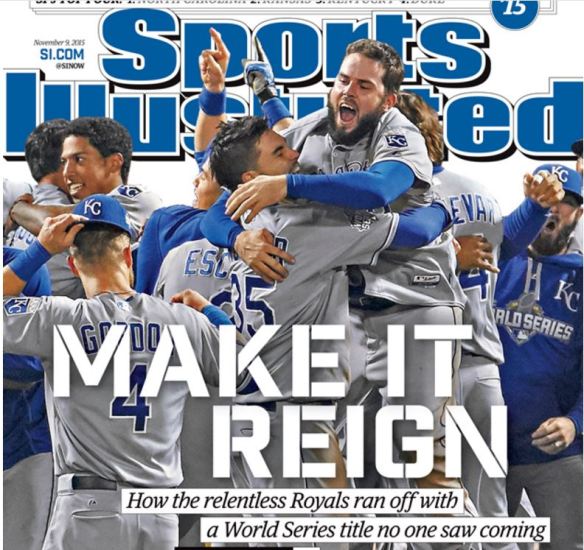
In November 2014, I wrote a blog about the Kansas City Royals major league baseball team and its losing effort in the World Series. A year later I’m pleased to once again write about the Kansas City Royals and the World Series . . . but this time the outcome is different because the Royals won the Series in five games. There’s a real symmetry with the parallels between how the Royals won and how entrepreneurs can win.

The 2015 Kansas City Royals was not a team of superstars. They were not a team of power hitters swinging for the fences and hitting the ball out of the park. In fact, Kansas City only hit two home runs during the World Series, and one was inside-the-park. The Royals won for a combination of reasons. First, all of the players bought into the culture and the plan that was conceived during spring training to win the championship. The players were aggressive at the plate and simply aspired to hit the ball and put it in play. They were intentional about trying to make contact with the ball and send it through the gaps. Once a player was on base the mantra became “keep the line moving.” In other words, the key to producing runs was to generate singles, doubles, walks – whatever it took for the next player to get on base and advance runners across home plate.

Kansas City players and coaches spent considerable time doing research on their opponents. But it didn’t stop there. They also analyzed data on the umpires to understand how strike zones were being maintained. They watched how certain infielders threw the ball to first base; how quickly outfielders got the ball back into the infield and the tendencies of pitchers with their windup motions. The Royals used this information to decide when to stretch singles into doubles – or when Eric Hosmer decided to make a mad dash from third base to home on a ball hit to the third baseman in Game 5. This was a team that hustled. This was a team where it was obvious that all of the players were having fun and enjoyed playing the game. Probably the most amazing trait of the Kansas City Royals was their ability to come back from being behind in the later innings of a game and win. Seven times in the postseason they came from multiple runs behind to win, and outscored their opponents 55 – 11 after the sixth inning. Every player believed that no matter what the odds, they would win and they literally willed it so.

Each of our entrepreneurial endeavors would be well served to use the 2015 Royals as a model. Do we have superstars in our midst who require the feeding of big egos? Do they sulk or create drama when things don’t go their way? Are we focused on hitting the big time, or do we work hard to apply the basics and fundamentals that produce the singles (and sometimes a double) in our everyday business lives? Have we developed a winning culture within our organization that values the contribution of every team member? Christian Colón, a Royals backup infielder, hadn’t played a single game in the post season. And yet he was asked to bat in the 12th inning of the final Game 5 against the Mets. Down in the count with two strikes he proceeded to hit the go-ahead run that led to the championship. Manager Ned Yost trusted Colón to bat as a backup just as he trusted every starting player on the team.

Are we sticklers for diving in and digging up data, then translating it into the myriad of ways that will help us win? Is our team all about hustle and having fun? Do our team members have resilience and a comeback mindset? When the chips are down do they give up or do they truly believe that they can cobble together whatever it takes to put a W on the scoreboard? Sports often offer a plethora of wonderful metaphors that correlate with the business world. But the winning ways of the 2015 Kansas City Royals may be the ultimate example in this respect.

“Keep the line moving” is both an aspirational and an inspirational business concept. It certainly worked for the Royals and is a winning notion for us as entrepreneurs.

This blog is being written in tandem with my book, “An Entrepreneur’s Words to Live By,” available on Amazon.com in paperback and Kindle (My Book), as well as being available in all of the other major eBook formats.
Royals World Series

Lost Art

Harrison Ford starred in the classic movie, Raiders of the Lost Ark. Bill Murray and Scarlett Johansson starred in Lost in Translation. Richard Dreyfuss played the lead in Lost in Yonkers. The television show Lost in Space ran from 1965-68. And entrepreneurs star every day in the Lost Art of Negotiation. Why is negotiation a lost art? I believe that too many of us see negotiating as a competition.

Google gives 90,500,000 results for the word negotiation so there’s no shortage of material about the subject. But I don’t want to focus on negotiating techniques – that’s not the point of this blog. Instead, I’d like to offer some ideas that may be helpful in making the negotiating process more productive.

If we start with the premise in a negotiation that we want to win, then it becomes a competition where someone (not us) is going to lose. From here we harden into our “positions” and the tension begins. There is a better way. First, we need to see a negotiation as an opportunity to solve a problem. It’s actually a dual problem – one for us and one for another party. Trying to solve just our problem may be far more difficult than figuring out how to solve for both parties. What do we do when we solve a problem? We start by clearly defining all elements of the problem. Then we catalog all of the possible solutions. Our innovation and creativity come into play at this point.

In the process of attacking the problem we establish our bedrock principles. For example we may resolve that no matter what, we will always be respectful. Perhaps we commit to avoid getting hung up on personalities. Or we may decide that regardless of how dirty the other party may play, our approach will continually reflect total integrity. Ultimately our analysis leads us to the bottom line for the most critical factors to the outcome we believe will best solve the problem for both parties.

Recently I was coaching a business owner about the potential sale of her company. I asked her what her bottom line number was and she gave me a figure. Then I asked her if negotiations led to a value that was $50,000 less than her bottom line number, would she sell. She replied in the affirmative. So we went back and forth with the $50,000 question until we finally reached an amount that she absolutely positively would not accept. The takeaway for her was that the initial figure she thought was her bottom line number actually wasn’t.

As we engage in a negotiation we listen to and understand what the other party is telling us. This information is then overlaid onto the problem we have identified and our array of solutions is applied. We avoid confrontation by working from a set of facts; seek agreement wherever possible, and constantly narrow the scope of issues.

Being in the commercial real estate business I’ve been in continuous negotiations in one form or another for more than 40 years. You can read all the books you want and watch all the videos in the world on negotiating strategies. And if you pay attention to them you can easily end up getting too cutesy. I have found that a pretty straightforward approach has been extremely successful for me. I don’t try to outthink the other party or construct a series of chess-like moves. Instead, I know what my bottom line is and I know the principles that I want to maintain. If I have to violate my principles to get to my bottom line I’ll withdraw. And I’ve learned that transparency and respect have been more valuable than anything else.

Entering a negotiation as a creative opportunity to solve a problem for both parties puts us on the same path. Bedrock principles and a clear understanding of our bottom line is then the recipe for a positive outcome.

 This blog is being written in tandem with my book, “An Entrepreneur’s Words to Live By,” available on Amazon.com in paperback and Kindle (My Book), as well as being available in all of the other major eBook formats.

negotiations

Curveballs and Changeups

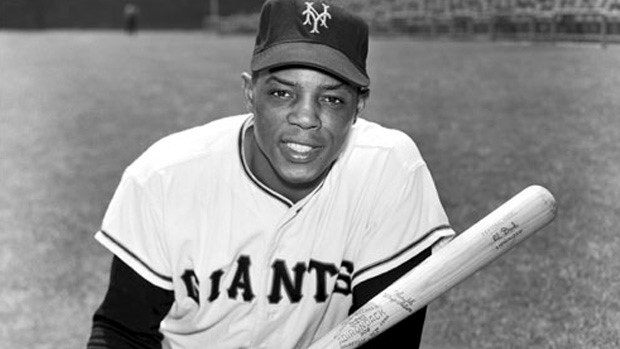
Major league baseball pitchers throw some amazing pitches. Their repertoire includes the breaking ball, changeup, forkball, screwball, slider, curveball, knuckleball, four-seam fastball, split-finger fastball, cutter, sinker, two-seam fastball and probably some other customized versions of all of the above. These pitches range in speed from 70+ to over 100 miles-per-hour. How a batter can even see a pitch that is screaming in at speeds above 90 and dancing all over the place is an incredible feat. And the fact that such pitches can be hit for home runs is even more stupefying. How do they do it?

Major league batters expect to adapt. They know that they are going to see a wide array of pitches that are surgically placed in different locations in the general area of home plate. Thus, every at-bat requires them to adapt to a host of variables. Top-flight big leaguers have an uncanny knack for successfully adapting their vision and their swing to hit the ball and get on base. They go to the plate knowing with absolute certainty that they must be able to adapt or they will strike out, fly out or ground out.

As entrepreneurs we would be well-served to study successful major league baseball players and observe how they adapt. Sometimes they shorten their swing. At other times they become supremely patient. They may try and push the ball to the opposite field; they may bunt, and they might also time their swing in order to pull the ball. All of this happens within a split second.

We entrepreneurs often work hard to create elaborate strategies and backfill with a host of tactics. We plan and we create extensive systems and processes. All are absolutely necessary to succeed. But sometimes we forget that we must expect to adapt. There is nothing negative about holding this expectation. The game plan provides a roadmap for us to follow, but it doesn’t account for every possible instance where we may need to be flexible. Over the years I’ve tried to muscle my way through a plan that I was convinced was the only way to go. Most of the time it led to failure or at least results that were less than stellar. I realize that I was being resistant to adaptation.

What I wish I had understood at the time is that the need to adapt can offer some incredible opportunities. And my resistance caused me to miss those opportunities. It’s easy to say, “OK, I have a plan and undoubtedly something will knock me off-course.” What goes unsaid is the thought that, “Then I’ll do whatever it takes to get back on-course.” But what if we had a mindset of expecting the need to adapt and actually turning it into a desire?” Think about all of the wonderful inventions that have occurred in the past. If you’ve ever read the story of Steve Jobs, you’ll know that he was a master of adaptation. Through his flexible nature he embraced the chance to make changes to the iPhone and the end result was, “WOW!” It’s well-documented that the initial vision for this technology would not have been nearly as phenomenally functional as what was eventually developed.

When we rejoice at the prospects of adapting our ideas, our creativity increases exponentially. Then we are positioned to achieve greatness in whatever we choose to do.

 This blog is being written in tandem with my book, “An Entrepreneur’s Words to Live By,” available on Amazon.com in paperback and Kindle (My Book), as well as being available in all of the other major eBook formats.
willie mays

Defaulting

What’s the first thing that comes to mind when you see these statements?

  • The dog ran away.
  • We didn’t get the Smith contract.
  • Our star salesperson just gave notice.
  • It may rain and keep us from teeing off at 4:00.
  • Your daughter just wrecked the car.

Your initial reaction to each of this less-than-stellar-pieces-of-news is your default thoughts. As humans, it’s natural for us to have an emotional response to many of the things we hear throughout the day. There may be moments of displeasure, irritation, dread, fear and even panic. We also have emotional responses to the positive things we are told or read. Many people experience highs and lows each day in this regard. And yet, it takes considerable energy to swing from one end of the spectrum to the other.

Wouldn’t it be wonderful if we could re-pattern our default thinking on the downside? Well, we can but there are a couple of requisites. First, we must truly desire to change our default thinking, for without a compelling reason we’ll fall back into the default mode in short order. Second, we must be willing to take the steps necessary to make this change.

For me, the desire to change my default thinking centered on my understanding of positive and negative energy flows. I’ve written many times about the fact that negative energy creates a blockage for creativity and our ability to solve problems. Also, negative energy just plain doesn’t feel good. It’s kind of like burning the roof of my mouth on a piece of hot food – the sensation isn’t very pleasant. I realized that metaphorically burning the roof of my mouth several times each day just didn’t make any sense.

This led me to accept that I needed to take actionable steps to effect change. What worked for me was to intentionally spend a day taking inventory of the various negative reactions that I held. I wrote them down for further analysis at the end of the day. I didn’t try to change any of my thoughts during that day – I simply tried to be as normal with my thought process as possible. Upon review, I was able to see thought patterns emerging and could then identify alternative reactions for the future when faced with similar challenges.

I’m at the point now where I may still have a fleeting burst of negativity when I encounter a situation that’s not favorable. But I quickly recognize it and replace it with a much more positive reaction. For example, suppose I learned that a particular investor I was counting on had decided not to invest in one of our deals. The initial quick reaction might be, “Well, I certainly didn’t see that coming. We’re now under the gun to find the money.” This might be accompanied by a surge of adrenaline. But literally within seconds, I’m able to shift my thinking to, “But it’s OK because I have three other investors who have said they want to be in our deals. I know I’ll get one of them to sign on.” And a feeling of calm occurs at that point.

Quickly shifting out of default thinking in negative situations puts us on the road to solving problems and avoiding the emotional lows that we may experience. There is no question that our lives are richer and fuller when we maintain positive thoughts.

 This blog is being written in tandem with my book, “An Entrepreneur’s Words to Live By,” available on Amazon.com in paperback and Kindle (My Book), as well as being available in all of the other major eBook formats.

positive-thinking