
Unknown's avatar

About anentrepreneurswords

R. Lee Harris grew up in Manhattan, Kansas and has lived in the Kansas City area since 1977. A 1975 graduate of Kansas State University, Harris began his career with Cohen-Esrey, LLC as an apartment manager two weeks after he graduated. Now president and CEO, he is involved in apartment management, development and investment; construction and tax credit syndication on a nationwide scale. Over the course of his career Harris has overseen the management of more than 27 million square feet of office building, shopping center and industrial space and nearly 60,000 multi-family units. He has started dozens of business enterprises over the past 40+ years. In 1991, Harris wrote a book entitled, The Customer Is King! published by Quality Press of Milwaukee. In 2012 he authored the book, An Entrepreneur's Words to Live By. He has mentored a number of business people over the years and has been a long-time participant in the Helzberg Entrepreneurial Mentoring Program. He and his wife Barb have two grown daughters and one grandson. They are active in their church, community and university.

Sleepless in Seattle

I’m going to briefly describe a scenario to see if it sounds at all familiar to you. Here goes. Your day was particularly stressful and things didn’t go the way you wanted. A fairly major and troublesome issue is unresolved and needs fixing immediately. You go to bed with the weight of your day still front and center. While you toss and turn your mind churns with thoughts from the day. Twenty minutes go by. You stare at the ceiling. Fifty minutes have passed and you might have faded in and out but you don’t know for sure. At some point during the night you awaken, realizing your dreams are becoming beyond weird. Then that troublesome issue starts its nocturnal carousing. I have a sneaking suspicion that a lot of heads are nodding right now.

We all have obviously experienced what I described above. There are a number of emotions driving this response including anxiety, fear, frustration, anger and guilt. Isn’t it interesting that it’s usually the negative stuff that keeps us awake at night? Think about it. We generally don’t stay awake because we are feeling euphoria, happiness, joy, peace or gratitude. When we’re “Sleepless in Seattle” it’s a sure bet that we won’t get a good night’s sleep and wake up refreshed the next morning. So what to do?

I have self-developed a technique that works very well for me and perhaps it will be helpful for you as well. I call it the three Rs – Relax, Release and Replace. Relax may sound trite, but it’s absolutely necessary. OK, you say, how am I supposed to relax when I’m all balled up inside? Start with a bedtime routine. Try and go to bed at the same time every night. Watch what you eat and drink within two or three hours of going to bed. Practice meditating to clear your mind. When you go to bed, be very aware of your breathing. See that it becomes slow, measured and deep.

Now that you are in somewhat of a relaxed state it’s time to Release. Recently I woke up in the middle of the night as I usually do to take a pill and make the journey to the bathroom. Normally I go right back to sleep, but this particular night my mind went into overdrive. The issue stemmed from a nasty surprise in one of my businesses that could have proven to be very expensive. In the past I might have allowed my thoughts to spin out of control and ultimately begin envisioning the worst possible scenarios. But this time I said to myself, “Lee, you are not going to solve this tonight. It will still be there in the morning and you will need a fresh perspective which you won’t have if you stay awake for the next four hours.” Then I smiled and went back to sleep because I knew this to be the truth.

Finally it’s time for the last step . . . Replace. Once you’ve released the thoughts that are keeping you awake, replace them with positive thoughts. One of my favorite places in the whole world is on the side of a fairly steep hill on a Caribbean island overlooking the ocean with a clear blue sky and the sun’s light flooding every inch of the experience. It’s not hard for me to bring this vision into my consciousness which makes me feel very warm and safe. Falling asleep at that point is a breeze.

Lying awake and churning a problem – large or small – generally accomplishes nothing. Creative solutions are inspired by healthy sleep and a clear head. Consistently using the Three Rs technique puts us on a successful path toward accomplishing this.

This blog is being written in tandem with my book, “An Entrepreneur’s Words to Live By,” available on Amazon.com in paperback and Kindle (My Book), as well as being available in all of the other major eBook formats.


sleepless

Own It

When things go wrong there’s a pretty strong chance that human nature will cause a very specific reaction. And what do you suppose that reaction will often be? Yes, someone will be blamed. “It’s his fault” is simply another way of playing the victim card. As entrepreneurs we should resist allowing ourselves to be drawn into the blame mentality.

As children we often would blame our siblings for our own transgressions. Fortunately (though unfortunately at the time) my parents didn’t buy into my efforts to shift responsibility away from myself. A withering look from my mother was all it took for the blame to shift right back where it belonged. Perhaps it was this grounding effect that taught me to be accountable for my actions – right or wrong.

We damage our credibility as leaders when we blame others. When I’m speaking with someone from another company about something that went wrong, I lose respect for that person if he or she doesn’t take responsibility in the “organizational we” sense. Let me explain. I’ve gotten calls before about a glitch in our customer service. It would have been very easy to say something like, “Mary Manager failed to do her job and I’ll see that she is disciplined.” Instead, I want everyone in our organization to know that I have their backs. When I get those calls I say, “I’m sorry your customer experience was unsatisfactory. Clearly we should have done better. We’ll see that the matter is rectified as soon as possible.” If Mary Manager really caused the problem we’ll make sure to privately counsel with her and make sure she has the proper tools and perspective to avoid a repeat of the mistake. But internally and externally we won’t point our finger at her.

As entrepreneurs and leaders, we need to own our mistakes and be comfortable doing so. Recently I failed to properly communicate in a situation that caused some heartburn for a client. Upon realizing my error, I quickly sent an e-mail falling on my sword and taking full responsibility for my inadequate communications. Then I called him and apologized personally. I have a philosophy that mistakes are experiments in the laboratory of life. If we are properly prepared we usually don’t make them. But when we do, we admit and amend. Quickly acknowledging a mistake; apologizing for it, and taking the necessary steps to remedy it actually builds customer loyalty. It also builds loyalty with team members.

Refusing to play the blame game demonstrates real leadership and engenders respect. We can model this for others when we accept responsibility for our own deficiencies and do so in a gracious manner.

This blog is being written in tandem with my book, “An Entrepreneur’s Words to Live By,” available on Amazon.com in paperback and Kindle (My Book), as well as being available in all of the other major eBook formats.

dog

The Royal Treatment

I’ll bet there are a million books that have been written about customer service. I even wrote one that was published in 1991 called The Customer Is King! How has customer service been for you lately? Have all of the books that have been written over the last 20-some odd years done any good? Is customer service any better today than in the past?

There is a way to ensure that we receive top-quality service with each and every encounter (well almost). It’s been working for me flawlessly for many years and I can assure you that it will work for you as well. Yes, we’re the customer and we should be treated like royalty – right? Well, what if we treat the service provider like royalty too? I have made true friends with many individuals who provide service to me. And the word “friends” is important here. I treat them like I would treat a friend.

I always try and know the name of the person serving me. That’s the best way to start a friendship. And I use their name throughout the service experience – not in a patronizing or schmaltzy way, but in a natural conversational manner. I look them in the eye and smile. At some point in the encounter I may ask them something about themselves. Why? Because I really want to know more about them. I’ll joke and tease with them because that’s my personality. If someone provides excellent service, I make sure and tell him or her what a terrific job he/she did. And I also make sure and tell the manager the same thing. I may also shake hands with the service provider, especially if he’s a man. If the circumstances are appropriate I make certain that I tip generously, rounding up to the nearest dollar. At Christmas, I give $100 in cash to a couple of servers who regularly serve me at my favorite restaurants. In one case I know that my gift made a significant difference in what he was able to do for his family during the holidays.

We eat regularly at a local restaurant and have often been served by a 50-something woman. She wasn’t easy to warm-up, but when she did crack a smile it was radiant. At one point I told her how beautiful her smile was and I thought she was going to cry. I talked to her about her daughter and her mother and learned more about her life experiences. Today she is extraordinarily warm and outgoing with us. She goes to great lengths to make sure our service is outstanding. The effort I expend is nominal and I’m completely genuine about my interest in those providing service to me.

If something about the product or service isn’t quite right I don’t hesitate to talk to the service provider or the manager about it. I always do so in a friendly and respectful way. Throwing a tantrum and acting like a jerk doesn’t do anything to build friendships or treat everyone like royalty. More often than not the situation is corrected and though I never expect or request it, my bill is reduced or I receive a gift coupon.

Treating service providers like royalty is rare these days. Usually they simply blend into the background. When I interview someone for a job, I like to do so over a meal so I can see how well the person treats the wait staff. If her or she is gracious and acknowledges the server there’s a reasonable chance that the interviewee has a good customer service perspective. Numerous prospective team members have not been hired because they didn’t even show common courtesy to the server.

We have every right to expect excellent customer service. And we’ll receive it if we treat our service provider like a king or queen. It’s human nature to return kindness with kindness.

This blog is being written in tandem with my book, “An Entrepreneur’s Words to Live By,” available on Amazon.com in paperback and Kindle (My Book), as well as being available in all of the other major eBook formats.
royalty

Who Needs King Midas?

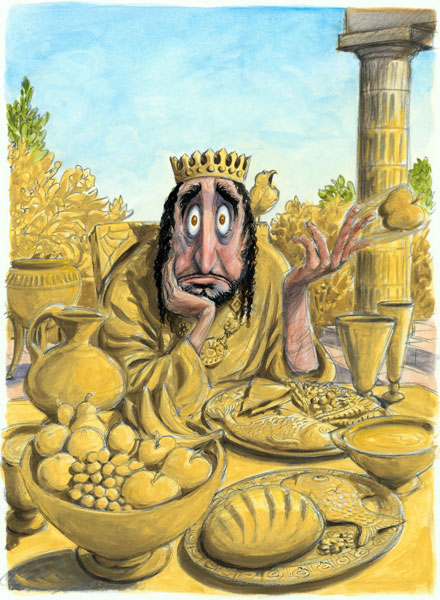
We all know the story of King Midas. The satyr Silenus became drunk and wandered into King Midas’ rose garden where he passed out. Midas found him and treated him kindly whereupon Silenus offered Midas a wish. The king asked that everything he touched would turn to gold. The wish was granted and thereafter everything that Midas touched turned to gold . . . including his daughter. Sadly, Midas died of starvation because even the food he touched turned to gold. Did Midas actually prosper through all of this?

Prosperity and abundance take many forms. This blog is specifically about financial prosperity. As entrepreneurs we have an opportunity to take stock about our attitude toward prosperity. Early in my career I was focused on the Almighty Dollar. Everything was about money for me. And the harder I chased it, the more elusive it became. It seemed as though I could see prosperity, but it was always just barely beyond my outstretched fingertips. What a frustrating period this was for me!

It’s easy now for me to see why I wasn’t prosperous. Very simply, I had the wrong attitude. I have a surefire, 100% guaranteed method that will ensure that you will enjoy financial prosperity beyond your wildest dreams. And unlike a lot of snake oil salesmen that are peddling their methods, I’m going to pass it along to you absolutely free! Here’s what worked for me.

First, I stopped focusing on money and instead found my Passion. I’ve written before about a concept that Simon Sinek discusses in his book entitled, Start with Why. When we understand WHY we exist and then align everything in our lives with our WHY we begin to live our passion. If we start with our WHY, our HOW and our WHAT will emerge effortlessly.

Second, I embraced Tithing. I give away at least 10% of every dime that comes into my life. We tithe to that which feeds our soul. This might be to a church or some other individual or cause that truly makes a spiritual difference in our lives – and I’m not talking about just religion here. Tithing enables me to see the Law of Attraction at work every single day for I know that when I give away my treasure without condition, I attract much more Good into my life.

Third, I have No Fear of lack or limitation whatsoever. When I write a large tithing check I never wonder for one second if I should give less or keep the money in my bank account until my balance is a little larger. No matter what happens – no matter how tough or bleak things may be in the moment, I always know that good things will come my way – and they always do!

Finally I do my darnedest to maintain Positive Mindset at all times. Negative thoughts are toxic and poisonous to positive energy. And positive energy is necessary to deliver prosperity. Fortunately this isn’t too hard to do as I live my passion every day.

Financial prosperity comes about when we intentionally create the environment for it to grow and flourish. When we do this who needs King Midas?

This blog is being written in tandem with my book, “An Entrepreneur’s Words to Live By,” available on Amazon.com in paperback and Kindle (My Book), as well as being available in all of the other major eBook formats.

King Midas

The Enemy

As entrepreneurs we place a great deal of value on flexibility, creativity and efficiency. We thrive on developing new ideas and managing risk. Our fires are stoked when we find ourselves in situations where we must be quick and nimble. We succeed because we are positive, optimistic and passionate, and because we persevere. So what could possibly rain on our parade?

Bureaucracy is the enemy of entrepreneurship and innovation. It doesn’t matter if it’s government bureaucracy or corporate bureaucracy – both are stifling and unrelenting. We entrepreneurs are in a constant struggle with bureaucracy and our frustration grows by the day. Bureaucracies are inflexible, inefficient and slothful. While entrepreneurship is a dream catcher, bureaucracies are dream-killers. So what is an entrepreneur to do?

Government bureaucracy is a subject unto itself. Entrepreneurs can do two things to combat government bureaucracies. One is to figure out how to maneuver and work-around them. I’ve made the mistake of trying to fight government bureaucracy in the past and it was always a losing battle – primarily because they have no accountability. Rather than fight, we can choose to become innovative involving not only our business initiatives, but also in the way we interact with a government bureaucracy. And of course the other thing we can do is support political candidates who believe in streamlining and/or eliminating bureaucracies.

Corporate bureaucracy is almost as maddening as the government variety. They generally exist as a result of the implementation of systems and processes that are cobbled together over an extended period of time. Many corporate bureaucracies are never intended to be so. They simply evolve. In the absence of a well-defined strategy a vacuum exists. Business people tend to do a lot of “firefighting,” constantly reacting to issues that are presented on a daily basis. The sum total of this reactionary approach to doing business; the vacuum that is present with the absence of a strategy, and the hodge-podge of solutions that are produced, equals a greater and greater entrenched bureaucracy. Conversely, a well-thought corporate vision wrapped in strong strategy and precision tactics, does not allow this vacuum to see the light of day.

To ensure that innovation and entrepreneurship flourish we must focus on creating a roadmap that is clearly defined for everyone on our team. When we see “firefighting” beginning to occur this is our danger signal that bureaucracy will ensue. This is our opportunity to step back and re-examine our vision and our strategy. It’s a time when we can tweak and modify our operations to be totally aligned with our entrepreneurial spirit.

For the sake of our customers, our team members and everyone who comes into contact with our enterprise, it should be our goal to avoid the establishment of bureaucracy at all costs. When we succeed, we’ll enjoy an abundance of happy customers, happy team members and prosperity at all levels.

This blog is being written in tandem with my book, “An Entrepreneur’s Words to Live By,” available on Amazon.com in paperback and Kindle (My Book), as well as being available in all of the other major eBook formats.

firefighting

The Jinx Factor

I was talking with a friend recently who was sharing information about an opportunity that was materializing for him. But he didn’t want to get too much into the details because in his words, he didn’t want to “jinx it.” The next day as I was taking my daily walk I started thinking about his comment. I know I’ve used the same phrase a few times, though I don’t really believe in jinxes. I’ll bet you have too. Then my thoughts expanded to go beyond the simple “jinx factor”.

Have you ever been in a place where everything seems to be going perfectly and then the following thought creeps into your mind . . . “what is going to go wrong?” Of course at the conscious level this is all about whether or not we deserve our good fortune. We’re so used to struggling and toiling that sometimes when the journey becomes smoother we can’t believe it will last and are conditioning ourselves for the next shoe to drop. I suppose this could be deemed the “jinx factor.”

I have come to a few realizations in this regard. Our mind is the most powerful organism in the universe. And we can create self-fulfilling prophesies. If we think something bad is about to interrupt our bliss, then we’ll probably find a way to make it happen. Another realization is the fact that whatever we attract in the way of a negative experience usually won’t be the result of something external. There are days when I drive the speed limit on a certain route and every stoplight turns red. Am I jinxed on those days? I think not. There are times when I think a business deal is done and then something over which I have no influence comes out of nowhere and blows it up. Did I somehow jinx the deal? I think not. External factors that are totally uncontrollable just happen. Did negative energy or bad karma draw them to us somehow? I doubt it. It’s that which we control with our mind and our being that matters.

This leads us to the final point of this discussion. Even joking that we “don’t want to jinx” something is an affirmation and affirmations have power. Instead of worrying about jinxes, we are better served visualizing and affirming favorable outcomes. Doing so aligns us with the positive energy that we need to impact that which we control in the desired manner. When we find that nagging thought entering our consciousness that says, “what is going to go wrong?” we recognize it, chase it away and replace it with an affirmation or a visualization of success.

Jinxes make for interesting novels or television programs but don’t exist in reality. On the other hand, the power of our mind is very real and can attract that which we affirm. Maintaining a positive focus on what we desire allows us to live without the fear that some outer force will deny us our good. In the infamous words of Groucho Marx, “A black cat crossing your path signifies that the animal is going somewhere.”

black cat

At the Core

The other day a consultant-friend of mine took me through an exercise that I had performed a number of years ago but had since forgotten. The subject was personal core values and the exercise was a simple method to identify them. I will confess that introspection is not one of my strong suits. I tend to blow and go and not spend a lot of time reflecting upon what I’ve done or why I’ve done it. In the past I’ve considered this a waste of precious time – my philosophy has been that life is too short and every second should be spent moving forward.

What my friend helped me understand is that people in my organization want to know what I stand for. I have always thought my actions speak louder than my words, but sometimes the words help add clarity and context. Whether we really think about it or not, we all have a set of core values. Here’s the exercise in a nutshell.

Write down on a piece of paper the name of ten people you admire most. They can be living or dead and may even be fictional characters. My list included parents, presidents, scientists and a couple of everyday people. Next, make a list of reasons why you admire those people on your list. Perhaps a particular person is extremely loving. Another is very passionate. Still another might be wise and insightful. The people on your list could have two, three or even four characteristics that resonate with you. Write them all on your list.

Ultimately you are looking for repetitive patterns of characteristics among the collection of people whom you admire. Out of ten names, you might find that seven of them share a similar trait that is important to you.  Four might have still another characteristic and so on. You are looking for three to five traits or characteristics with which you identify. Obviously the people we admire serve as a mirror for our own core values. My exercise revealed core values of integrity, optimism/positivity, perseverance, creativity/innovation and calmness. The calmness value threw me for a moment because most people who know me probably think I’m anything but calm. But I realized that the calmness I value may be less of demeanor and more of mind and spirit. In order to juggle a million balls at once, my mind must remain calm to create a sense of order that leads to accomplishment.

If you haven’t spent time recently thinking about your own core values, try this simple yet powerful exercise. Not only is it a lot of fun but it will be revealing for you. And once you clearly understand your core values you can strive to live them on a daily basis.

This blog is being written in tandem with my book, “An Entrepreneur’s Words to Live By,” available on Amazon.com in paperback and Kindle (My Book), as well as being available in all of the other major eBook formats.

applecores

Do You Read Me?

Question: I’ve heard the term “reading people” and I think I know what it is but I’m not sure how to do it. Do you have any tips on how to go about doing this?

Answer: Learning how to read people is a critical skill for everyone. It doesn’t matter if it’s the business world, government, academia or any other walk of life, understanding the reactions of others will help us improve our relationships – guaranteed.

The first step toward learning how to read people is to push ourselves out of the picture. All of our focus and powers of observation must be directed at the person with whom we are interacting. If we’re thinking about what we’re going to say next, or our mind is wandering, we may very well miss the subtle signals that the other person is sending. Often our desire to engage in conversation may also cause us to be oblivious to how the other person is really feeling.

I have a theory that successful poker players may be more skilled at reading their opponents than utilizing whatever strategy they may be deploying. Start with the use of our auditory senses. How articulate is the other person? What is his/her cadence like? Are the conversational pauses appropriate in duration? Are there increases in the voice pitch? The manner in which a person speaks reveals whether he or she is nervous, happy, sad, lying and a host of other emotions.

What visual cues do we see? Can the other person maintain eye contact? Is the person slouching or sitting or standing in an erect manner? How genuine is his or her smile? Does this person fidget or shake a foot? Some people play with their ear lobes or hide their mouths behind their hands. What kind of hand gestures do we see?

Reading people requires that we finely tune our powers of observation. Think about how well we really pay attention. What color are the other person’s eyes? Which side does he or she part their hair? How was this person attired? Was this person wearing rings, earrings or other jewelry? If you are like me, you aren’t as keenly aware of the other person so as to notice these details. This is something I’ve been working on lately and I can tell you that it has helped me pay closer attention to all aspects of whomever I am interacting.

Ultimately the objective in reading people is not to manipulate them but to make a connection. When a connection is made a relationship can be built. And I would much rather build a strong and lasting relationship with someone than use my ability to read them for purposes of gaining an advantage of some sort. If someone is in distress, I want to empathize with them. If someone is in a euphoric state, I want to celebrate with them. If someone is anxious, I want to help calm them. Above all, I want to support them and can do this if I understand them.

We can become better leaders, better colleagues, better acquaintance or better friends when we look below the surface and understand how another person is feeling. Reading people for this purpose is truly a noble calling.

This blog is being written in tandem with my book, “An Entrepreneur’s Words to Live By,” available on Amazon.com in paperback and Kindle (My Book), as well as being available in all of the other major eBook formats.

inspector clouseau

Sliced Bread

Question: I’ve been working for the past two years on bringing my dream idea to fruition. And it seems like it’s two steps forward and three steps backwards. When do I know it’s time to throw in the towel?

Answer: This question really resonates with me. Over the course of the past 40 years I can’t tell you how many dream ideas I’ve pushed, prodded, cajoled, coaxed and dragged, trying to get them across the finish line. Fortunately I’ve succeeded more often than I’ve failed, but there definitely have been a number that succumbed along the way.

Something I learned may surprise you. I’ve discovered that becoming emotionally invested in an idea can be dangerous. You may rightly ask, “How can we work to realize our dream without emotion and passion?” And here’s where the distinction comes for me. I am very passionate about the process of creating an idea and taking the steps necessary to implement it successfully. But I try and avoid becoming emotionally attached to the idea itself. By doing so, I can pursue an idea up to the point that it appears to be no longer viable and then discard it, moving on to the next idea.

Here’s what happens when we take a “this is my baby” approach to nurturing an idea. The process of birthing the idea takes on an emotional dimension that can blind us to things that we may not want to see. As a result we may not maintain our objectivity and might even miss some critical signals that would otherwise steer us in a different direction. We tend to have tunnel vision, believing that our idea is the best thing in the world since sliced bread. Yet others may not see what we think we see. So we start trying to sell people on our idea . . . rather than helping them buy it. When we don’t get the response we’re looking for we may begin to put pressure on ourselves to push the idea over the top. Then the frustration builds to the point that we’re ready to scream. By now our creative flow of energy has been blocked by our frustration and there is no way we’re going to succeed.

What works for me is to remove the emotion from the idea and replace it with a process. This process includes milestones and metrics that help me determine if I’m making progress in developing an idea. I’m also more receptive to pivots that may be necessary – that is, changes in direction that I need to take to ensure that the idea succeeds or is enhanced. More than anything, it’s liberating to know when an idea needs to be thrown on the scrap heap. I can now do this with ease, knowing that I did what was reasonable to make it work and recognized when it wasn’t meant to be.

Becoming emotionally invested in our dreams may actually hinder our success. Having passion for the process of realizing a dream will help us relax and maintain our creative flow.

This blog is being written in tandem with my book, “An Entrepreneur’s Words to Live By,” available on Amazon.com in paperback and Kindle (My Book), as well as being available in all of the other major eBook formats.

sliced bread

Hello, Hello?

Question: I’m having trouble getting someone to answer my business e-mails. I’ve thought about sending a text message but wonder if it’s appropriate. Should I do this?

Answer: I would do something else first. Pick up the phone and call the person. I’ve written about this subject before but I believe the message is worth repeating. For some reason we aren’t calling each other as much anymore. This trend is especially prevalent with the millennial generation.

So what is happening to some of the basic forms of communications these days? I still receive a letter occasionally – usually in the form of a PDF document sent to me electronically. Ninety-nine percent of the snail mail I receive is junk that gets tossed. We send massive numbers of e-mails. Text messages are as commonplace as waking up in the morning. We Tweet and we re-Tweet. We send private messages via Facebook and can e-mail through LinkedIn. In other words, it’s easier for us to be in touch 24/7 than ever before. But are we truly in “touch?”

My phone hardly rings anymore. In the mid-80s my company had two full-time receptionists who processed thousands of calls each day. They wrote message slips that we used for returning our calls. Voicemail was not yet fully developed. Today some companies don’t even have a live person answer the phone. An automated attendant handles the function in a very sterile and antiseptic manner. We tried that for a while and realized how much we didn’t like it. Now a live person answers our phone.

I’ve become a champion of Alexander Graham Bell’s invention. It’s not that I have a problem with e-mail or text messages, but I miss the human-to-human personal interaction. All of the modern electronic methods of communications are one-dimensional and lack the ability to convey true feelings. Oh, and what we say (or don’t say) in an e-mail or a text can easily be misconstrued.

Not only have I become a champion of the phone, I’m also a big fan of videoconferencing. When you and I talk, or better yet, when we see each other and talk, the dynamic changes considerably. We can hear voice inflection and read facial expressions and body language. I constantly hear people complain about their e-mails being ignored. We’re at the point where ignoring e-mails may even be excusable when the guilty party throws up his/her hands and says, “I’m sorry. I get 200 e-mails a day and can’t possibly keep up!” Maybe we can all relate. There’s something different about the phone however. Perhaps the etiquette standards are higher. Of course there are people who blow off phone calls too, but I find the percentage to be lower than those ignoring e-mails.

We can improve our chances of building lasting relationships and communicating more effectively when we make that simple phone call. Give me a call sometime. I’d love to chat.

This blog is being written in tandem with my book, “An Entrepreneur’s Words to Live By,” available on Amazon.com in paperback and Kindle (My Book), as well as being available in all of the other major eBook formats.

phone talk