
Unknown's avatar

About anentrepreneurswords

R. Lee Harris grew up in Manhattan, Kansas and has lived in the Kansas City area since 1977. A 1975 graduate of Kansas State University, Harris began his career with Cohen-Esrey, LLC as an apartment manager two weeks after he graduated. Now president and CEO, he is involved in apartment management, development and investment; construction and tax credit syndication on a nationwide scale. Over the course of his career Harris has overseen the management of more than 27 million square feet of office building, shopping center and industrial space and nearly 60,000 multi-family units. He has started dozens of business enterprises over the past 40+ years. In 1991, Harris wrote a book entitled, The Customer Is King! published by Quality Press of Milwaukee. In 2012 he authored the book, An Entrepreneur's Words to Live By. He has mentored a number of business people over the years and has been a long-time participant in the Helzberg Entrepreneurial Mentoring Program. He and his wife Barb have two grown daughters and one grandson. They are active in their church, community and university.

It Only Cost a Buck

Question: Recently I read an online customer review about my business and it was pretty mediocre. We delivered the service we were supposed to. Why would someone give us such average marks?

Answer: Maybe the service was mediocre. It’s my theory that people generally expect average which is a pretty low bar. That’s also why it’s so easy to wow customers with a little bit extra. There just aren’t a lot of companies that consistently deliver the wow factor.

While vacationing recently I had the opportunity to eat in the same restaurant while driving to our destination and again when driving back. Apparently the general policy at this restaurant is for the server to leave the ticket at the end of the meal and the customer pays at the cash register. During my first visit, our server saw me take out my credit card and asked me if she could take the ticket and my credit card and handle the payment without my having to go to the register. This was a small but friendly touch that resulted in my rounding up the bill to the nearest five-dollar amount and calculating her tip on that basis. My visit on the return trip was, well . . . average. Our server was friendly enough but when the time came to settle up, I put my credit card on the table with the ticket and it sat there. She came back twice to clear dishes but never made a move to pick up the credit card. I finally paid at the register and guess what I did? I rounded down to the nearest five-dollar amount to calculate her tip. It only cost her a buck, but imagine what that could add up to over the course of a year.

In my second encounter the server didn’t do anything wrong. In fact she was undoubtedly following restaurant policy. Thus she met my expectations. But it wouldn’t have taken much for her to exceed my expectations as her colleague had done a couple of weeks earlier. This minor incident highlights the fact that it doesn’t take much in this average society of ours to really stand out. As entrepreneurs we’re always looking for ways to differentiate ourselves and our businesses. We don’t need to get fancy about it. Just understand what average is and find simple and friendly ways to beat average.

The same lesson applies to life in general. Do we want to have average relationships? In my book, life to a great extent is about the people that pass through it. I’d like to think that the people in my life get more than “average” from me. Having the mindset of always giving a little extra effort will make this so.

This blog is being written in tandem with my book, “An Entrepreneur’s Words to Live By,” available on Amazon.com in paperback and Kindle (My Book), as well as being available in all of the other major eBook formats.


dollar bill

I Still Hate Eggplant and Rhubarb

Question: I attended an event recently and talked for quite a while with another individual. He was completely boring and didn’t have much to say beyond work stuff. It made me wonder if I too might be one-dimensional. How do I make sure I’m not?

Answer: Your self-awareness is an encouraging sign that you are on the right track. We entrepreneurs can have a tendency to be so focused on our work that we assume everyone else must be interested in this aspect of our lives. The first step in making certain we aren’t one-dimensional is to take a personal inventory. During the past 30-days, make note of all of the activities in which we have participated that are not work-related. If we’ve attended sporting events, the symphony, met friends for dinner, read a book or two, watched a documentary and volunteered at the local food bank, we are probably in pretty good shape.

If you find that you need a bit more variety in your life make a “bucket list.” This isn’t necessarily a bucket list of things you want to do before you die (though it can be), but is simply a list of things that you think might be interesting if you would ever stop eating, breathing and sleeping your work so much.

The hardest part about this is moving out of the work-focus mindset. To move forward and try new things we need to give ourselves permission to do so. That new product idea will still be ready for us to flesh out tomorrow if we take a cooking class tonight. We’ll still have time to complete the spreadsheet that needs to be created for next week’s presentation if we take a piano lesson or spend some time at the gym. Try new things. Meet new people. Twenty years ago there is no way that I would have envisioned doing the things I am now outside of my profession. And in so doing, it’s opened a whole new world for me that has made me a much better entrepreneur. Why? Because adding more dimension to my life has stimulated my creativity and kept me fresh. I’m more receptive to new concepts and I find it fascinating to talk to other people about many things other than business.

If you choose to walk down this path don’t despair if at first it’s a slow go. You’ve become accustomed to doing things a certain way and you can’t broaden your horizons overnight. But your enthusiasm will grow and I guarantee you’ll be a better entrepreneur and a better person overall.

The best antidote to being one-dimensional is an open mind. The world is full of opportunity beyond our own little backyard. There are so many new and wonderful things to experience. That said, I still hate eggplant and rhubarb.

This blog is being written in tandem with my book, “An Entrepreneur’s Words to Live By,” available on Amazon.com in paperback and Kindle (My Book), as well as being available in all of the other major eBook formats.

NCI_03

Three Little Words

Question: I’m in the middle of a dispute with a colleague. I know she’s wrong and I’m right. But now I’m beginning to wonder. I’m concerned that this dispute is damaging my relationship with her. How do I work my way out of this mess?

Answer: There are three underused words in the English language that would probably solve all of this . . . I am sorry. Why don’t we say we’re sorry more often? For some reason, we believe that apologizing somehow causes us to lose something in a relationship. In fact, just the opposite occurs. I’ve been one of those people who always had to be right about everything. And after a lot of self-analysis I realized that this may have been driven to an extent by some sort of insecurity or lack of confidence.

Here’s an obvious statement; apologies must be real. How many times have we heard a politician or other public figure make this kind of an apology, “I’m sorry if my comments offended some in the community.” Saying one is sorry if someone else is offended can be subject to interpretation. Is the speaker sorry that someone took what he said the wrong way? Or is he sorry for what he actually said? If the apology was sincere, the speaker would say, “I’m sorry for what I said because I was wrong.” There’s no doubt that this person is truly remorseful about what he said.

I’ve gotten better at making heartfelt apologies. I’m not completely there yet, but my progress is incremental. I’ve found that I am catching myself before I try to defend a word or deed that may or may not be correct. The old me would argue to the end of the day that I was right. Not so much now. Several months ago I had what I thought was a playful moment with my wife. I had been teasing her throughout the evening and was oblivious to how frazzled she was at the end of the day. I made the mistake of turning the light off on her before she got into bed causing her to stumble around in the dark. She blew her top at me – something that very rarely ever happens. The old me would have snapped back at her that she was being overly sensitive and that I wouldn’t tease her if I didn’t love her so much. Instead, I made a choice at that moment. I simply said, “Honey, I’m being totally childish and insensitive. I’m completely wrong and I’m sorry.” The situation was defused and there were no hard feelings. I’ve also stopped turning the light off on her before she gets into bed.

Being able to say “I’m sorry” is not an act of weakness but an act of honesty. Sincere apologies build relationships and are an indication that we value another person. Rarely will we find three little words that have as much power as “I am sorry.”

This blog is being written in tandem with my book, “An Entrepreneur’s Words to Live By,” available on Amazon.com in paperback and Kindle (My Book), as well as being available in all of the other major eBook formats.

Apology

The “F” Word

Question: Recently I’ve been unsuccessful with several things in my life including a relationship, a business initiative and with an attempt to buy a house. How do I stop feeling like such a loser?

Answer: You are referring to a concept that most of us call failure. And you can take comfort in knowing that all of us encounter it periodically. Everyone. How each of us deals with failure is another matter. In my book, An Entrepreneur’s Words to Live By, I wrote a chapter in which I say that “Mistakes are simply unfinished experiments in the laboratory of life.” I believe that the same statement can be made about failure.

If we look at failure as a finite experience it can be profoundly negative. But if we see failure as merely a step in a process, then there is hope. And hope is generally a positive emotion. It all boils down to how we choose to view what the world might typically deem a failure. The process of failure is actually a process of elimination . . . what works and what doesn’t. We tend to get caught up in the emotions surrounding failure and may be unable to see the good that can come from it. These emotions run the gamut from frustration, embarrassment and inadequacy to anger, despair and blame.

We owe Thomas A. Edison a huge debt of gratitude (as well as a number of other inventors over the centuries). He made 1,000 unsuccessful attempts to invent the light bulb but when asked about this by a reporter, he responded, “I didn’t fail 1,000 times. The light bulb was an invention with 1,000 steps.” Imagine the emotional control he must have had. But rather than giving up and accepting each “step” as a failure, he learned how to make little tweaks that eventually led to success.

Perhaps if we look at our failures in a more scientific manner – as part of a discovery process – we can overcome the negative emotion that often is associated with apparent setbacks. This along with a good dose of perseverance, resilience, a positive mindset and coupled with an expectation of good results, can propel us to the success we seek. This is a powerful recipe that all boils down to how we choose to think.

When we choose to learn from our experiences the “steps” toward success are infinitely good. As entrepreneurs and human beings we can then embrace this process as part of the richness and fullness of life.

This blog is being written in tandem with my book, “An Entrepreneur’s Words to Live By,” available on Amazon.com in paperback and Kindle (My Book), as well as being available in all of the other major eBook formats.
Test Score

And So It Is

Question: When the world seems to be crumbling around them, some people seem to be able to stay positive no matter what. How do they do it?

Answer: This isn’t as hard as it may seem. I’ve said it before; we all make choices. When the sledding gets tough we can wring our hands in despair and play the victim card. Or we can maintain a positive outlook and move through the difficult situation. The choice is ours and only ours. Personally I find that it takes less energy to stay on an even keel all of the time than it does to ride the emotional roller coaster.

Staying positive doesn’t happen overnight. It takes a lot of practice. The first step is to truly understand the physiology of positive thinking. Dr. Richard J. Davidson, director of the University of Wisconsin’s Laboratory for Affective Neuroscience, reports that “activation of brain regions associated with negative emotions appears to weaken people’s immune response to the flu vaccine.” There are many other physiological benefits that have been proven to occur with positive thinking. Thus, we have to make a concerted effort to stay positive in order to protect and enhance our health. If we begin to feel a bout of negative emotions and thinking coming on, we must consciously remind ourselves that we must break this cycle in order to stay healthy.

There’s another thing that we can do to practice positivity. Some call it self-talk. I call it positive affirmations. Positive affirmations are statements that are meaningful to us – kind of a positive pep talk. We need to say them often and with gusto. We say them throughout the day when we’re feeling good and also when we may encounter the opportunity to move into negative thinking. For prosperity we might say, “My life is filled with unlimited abundance!” For health we might affirm, “I am healthy and whole in mind and body!” For relationships our statement might be, “I am harmonious with each and every person in my life!” At first it may seem a bit weird to be saying words like this. Why? Because the world may see this as a bit woo-woo. But that’s OK because I absolutely guarantee that it works.

Try saying positive affirmations in groups of ten, at least ten times each day. Eventually you’ll give a great deal of feeling to the affirmations and they in turn will become ingrained in your psyche. You will absolutely believe what you are affirming. Then, when a negative thought creeps into your mind, you’ll gently release it and replace it with a positive affirmation.

We are blessed by the fact that we have the power to make our own choices. And one of the most powerful choices we can make is to always remain positive about our lives. We affirm a positive thought . . . and so it is.

This blog is being written in tandem with my book, “An Entrepreneur’s Words to Live By,” available on Amazon.com in paperback and Kindle (My Book), as well as being available in all of the other major eBook formats.

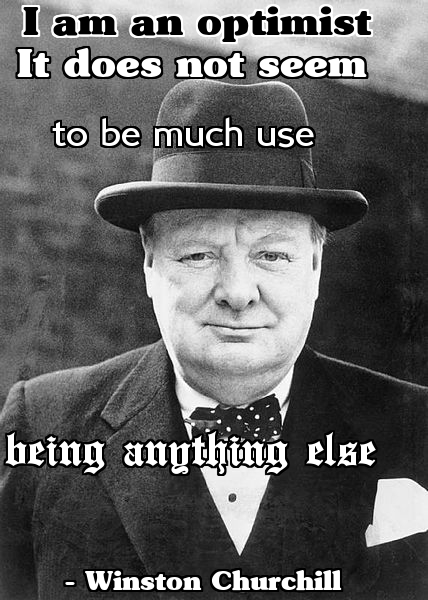
Winston Churchill

All Present and Accounted For

Question: I hate to admit this but there are times when I’m physically with my family, but I’m not really there. Instead I’m thinking about something happening in my business. How can I focus more?

Answer: Whoa! If this were 20-years ago I’d feel like I was looking in the mirror! I’m proud to say that when my kids were growing up I made all of their school plays, piano recitals, soccer games and the other activities in which they participated. But for certain, I wasn’t always present in the moment. Did they notice that I was only there with a physical presence but not necessarily mentally? Probably not? But I knew then and I know now.

There’s a story I like to tell about a trip I took to Disneyland as a five-year old boy (no, Disneyworld didn’t even exist). I don’t have many memories of being five, but this one I remember like it was yesterday. We arrived at the park and passed by a car ride where the cars were on rails, but you had to steer and use an accelerator. I started bugging my parents to let me go on that ride, but they said I was too young. I’m sure we went on many wonderful rides, but I was obsessed with that car ride and let my parents know every few minutes. By the end of the day I had worn them down and they finally relented. Back then, there were no height restrictions regarding rides so I excitedly sat down in the car and my mom sat in another nearby car. When the ride started I had no idea what to do. At five, I didn’t have much experience steering anything other than a tricycle and I was clueless about the accelerator. So I just sat there until one of the attendants came out onto the track; stood on the running board; told me to step on the accelerator, and he steered me around the track.

Obviously this experience has stuck with me my entire life. And it also taught me a valuable lesson. I don’t remember any of the fun things we did that day – all because I was living in the future, obsessing about the car ride. As it turned out, the car ride was a major disappointment so I was 0 and 2 in the win-loss department. I didn’t live in the moment and have fun, and what I was focusing on turned out to be a bust to boot.

Multi-tasking can be a wonderful thing but it requires a balance. While the kids were growing up, I would have been better off living in the moment and savoring every precious second that they were young. Yes, I was there, but not always in the savoring mode. And here’s the kicker. I don’t believe that anything I was thinking about while watching a school play had a real meaningful impact on my career. I’m now living this premise: if it won’t make a significant impact on the future, I’ll deal with “it” later rather than allowing a distraction from what I need to focus on right now.

Living in the now will prevent regrets in the future. Thus, we can shape the future by savoring that which we are living right here and now.

This blog is being written in tandem with my book, “An Entrepreneur’s Words to Live By,” available on Amazon.com in paperback and Kindle (My Book), as well as being available in all of the other major eBook formats.

Disneyland Car Ride

Stick a Hose In Their Mouth

Question: The other day I was making a purchase and I asked the salesperson about another product sold by one of his competitors. He was very disparaging about this competitor. How should talk about a competitor be handled?

Answer: I have come to the point of believing that only if we have competition will we be better. This is true in business and in life in general. Everyone wants to win but does beating up a competitor when talking to a customer really put us in a winning mode and make us better?

When a salesperson makes derogatory comments about another company or its products that indicates that he or she isn’t confident enough in his or her own company’s product to help the customer buy it. Instead, the salesperson must resort to tearing down the other company and its product. I’ve been in this situation many times as a customer. And I can tell you that my reaction was not positive. In fact it is such a turnoff that I may not even purchase the product that the offending salesperson is trying to sell.

If you are an entrepreneur, how do you feel when you read or hear about one of your competitors landing a big contract or succeeding in some other way? Are you angry or are you happy for them? How do you view your competitors? Are they the “enemy” to be beaten into submission? For me, life is too short to constantly be engaged in hand-to-hand combat with the competition. I choose to see people trying to earn a living or even live a passion. I see people working hard to perfect their product or service. Those who view competition and competitors in an adversarial manner also see the world as a zero-sum game. They define the market as finite and believe that success for a competitor means that they are losing something that otherwise might have been theirs. With few exceptions this is a not a pathway to success.

A different mindset could produce much better results. Ray Kroc, founder of the McDonald’s restaurant chain is quoted as saying, “If any of my competitors were drowning, I’d stick a hose in their mouth.” Rather than focus on and react to the competition, it’s much better to focus on the way we serve our customers; develop new and innovative ways to improve our products and services, and improve the way we operate our businesses. We embrace competition to push us to do better and be better. We learn from the things our competitors do better. And we also observe their weaknesses and use this knowledge to avoid the same mistakes.

Healthy competition can be transformed into cooperation and collaboration. When this happens we experience a state of co-opetition. Everyone wins when this state is reached.

This blog is being written in tandem with my book, “An Entrepreneur’s Words to Live By,” available on Amazon.com in paperback and Kindle (My Book), as well as being available in all of the other major eBook formats.

garden hose

A Self-Fulfilling Prophecy

Question: I can’t seem to get ahead financially. I save a little bit and the next thing I know something unexpected drains the bank account. This is really discouraging.

Answer: How many books and articles have been written about the subject of prosperity? The subject has been extensively dissected and there’s no doubt you will find some great techniques that may help you with your personal financial affairs. But that’s not what I want to explore with you.

I’d like to offer a concept called Intentional Abundance. I strongly believe that prosperity is a state of mind. It’s not externally generated and we’re not at the mercy of others when it comes to realizing our prosperity. When combined with various prosperity techniques, Intentional Abundance creates the mindset that is necessary to bring to bear the results that we seek. So what exactly is Intentional Abundance? Simply put, it means that we absolutely positively know with every fiber of our being that prosperity will be ours! Even when it may seem that abundance is a fleeting concept, if we remain steadfast with our belief that prosperity is ours to claim, it will ultimately be the truth.

Part of Intentional Abundance is the realization that prosperity is totally within our control. When we think, “Oh my, I don’t have enough money to pay the electric bill right now,” we’re affirming lack and limitation. Our minds are so powerful that this sort of affirmation can become a self-fulfilling prophecy. Instead, we must know that there’s no doubt about it that somehow we’ll find a way to pay the electric bill. I’ve been living my life this way for years. And here’s what’s so amazing. By having no worries or doubts, my prosperity flows from so many sources and at greater levels that one might call it Unexpected Abundance. Except that it’s not. In fact it’s Intentional Abundance.

We can all live a life of Intentional Abundance if we choose to. This mindset requires us to train our minds not to accept thoughts of lack, limitation, doubt and worry. Every time we feel such thoughts creeping into our consciousness, we must release them and replace them with positive thoughts of prosperity and abundance. Eventually the negative thoughts will no longer exist.

Intentional Abundance is a mindset of eager expectation. When we fully embrace it our financial needs will always be met above and beyond our wildest dreams.

This blog is being written in tandem with my book, “An Entrepreneur’s Words to Live By,” available on Amazon.com in paperback and Kindle (My Book), as well as being available in all of the other major eBook formats.

Prosperity

Big Mo

Question: Some people seem to be on a roll with everything going their way. How can I get some of that?

Answer: What you are suggesting is like a sports team. The team begins to win some games and the next thing you know they’ve put together a pretty impressive winning streak. Did you know that the 1916 New York Giants baseball team won 26 games in a row? The college basketball UCLA Bruins recorded 88 consecutive wins between 1971 and 1974. And at 17 – 0 the 1972 Miami Dolphins was the only NFL team to win the Super Bowl with a perfect season.

What did these teams have in common? They were able to use their talent optimally. They executed the basics and fundamentals of the sport they were playing. They had a solid game plan. They were well-coached. They had confidence and faith in their abilities. And they absolutely positively believed that they would win. What a powerful combination of factors! Blended together they created momentum.

We’ve all seen momentum in our business and personal lives. A company creates a winning product and can do no wrong. It captures an ever increasing percentage of market share and then garners a lot of favorable press. This in turn creates more demand for its product and feeds the momentum. But how do we build momentum for ourselves and our businesses? What if we don’t have that magical product or service that gets all the buzz?

We can create our own momentum following the same pattern as the great sports teams that put together incredible winning streaks. It’s incumbent upon us to assemble a team that has top flight talent. Are there team members who don’t have the talent we need? If so, it will be difficult to gain momentum. Do we pay attention to the basics and fundamentals of our business? Is our customer service second-to-none? Is our product the best that we can build? Do we have a sound business strategy? Our game plan must be well-thought and proven to work successfully. How can we create a winning streak if we don’t have such a strategy in place? Is our team well-coached? Do we micro-manage our teammates? Are people held accountable? All of these elements will build momentum. But there’s one thing that will push us over the top and sustain that momentum. Do we have confidence in our abilities? Do we really truly believe that we will win? Individuals and teams that continuously win have an everyday belief that they will always win. And if they do suffer a loss, they get right back in the winning groove the next day.

The most powerful aspect of momentum is faith. It’s the humble belief that we have the ability to win and nothing can shake that belief. There’s never a shadow of a doubt in our being that we will succeed. Believe in momentum and it will be so.

This blog is being written in tandem with my book, “An Entrepreneur’s Words to Live By,” available on Amazon.com in paperback and Kindle (My Book), as well as being available in all of the other major eBook formats.

locomotives

That Queasy Feeling

Question: As an entrepreneur, I consider myself to be a pretty easygoing person. But there are times and situations where my interaction with others can become pretty intense. How can I avoid these situations?

Answer: You can’t avoid them but you can change the way you feel about them. What you have described is confrontation. Many entrepreneurs don’t deal well with conflict and confrontation and attempt to avoid them at all costs. Often this makes the problem worse. By avoiding dealing with a particular situation that could result in a perceived confrontation, we may be giving tacit approval to bad behavior on the part of someone else. Or we may not be resolving a particular situation that could become poisonous for our organization. This doesn’t just apply to the business world, but to life in general.

Why do we try so hard to avoid conflict? Are we afraid of hurting someone else’s feelings? Are we concerned about our own image? Does it make us anxious when we’re in the middle of a disagreement? Is there a chance that a relationship could be damaged? It’s true that all of these things could happen . . . if we believe they might. But what if we changed our attitude and didn’t view them as truths?

Suppose instead, that we look at a potential conflict or confrontation as an opportunity to accomplish several things. Perhaps it’s an opportunity to truly understand someone else’s point of view. Maybe it’s a chance to learn of a new idea or a new way to accomplish something. It could also be an opportunity to strengthen a relationship. Conflict will occur only if we believe that it will and allow it to be so. The key to the preceding statement is keeping an open mind.

I’ve encountered plenty of confrontational situations over the years and in many cases I dug in my heels and probably caused the conflict to intensify. More recently I’ve taken a different approach. Over time, I’ve found that it has gotten easier to open my mind and truly listen to someone else rather than being loaded for bear. That doesn’t mean that there aren’t intense conversations however. For example, if someone isn’t performing to expectations, this can’t be ignored. In these situations I’ve taken more of a mentoring or coaching approach rather than just having harsh words with the other person. Instead, I’ll start by asking them if they believe they are meeting the expectations. Often they’ll admit that they aren’t and we can move quickly into the coaching process. If they don’t make such an admission, it’s my duty to show them where they are falling short and make recommendations for improvement. Notice my wording here. At no time do I feel as though I’m in conflict with the other person.

We can avoid confrontation by changing our mindset. If we think a situation will be confrontational, it will be. But if we view the situation as a positive opportunity to have an open mind and reach an agreement with another person; or if we can turn an intense conversation into a coaching opportunity, then we can avoid that queasy feeling altogether.

This blog is being written in tandem with my book, “An Entrepreneur’s Words to Live By,” available on Amazon.com in paperback and Kindle (My Book), as well as being available in all of the other major eBook formats.

queasy feeling