
The Entrepreneur’s Trap

There is a trap that is well known to most human beings. This trap ensnares the young and the old; the rich and the poor; the healthy and the sick – it does not discriminate. The trap is that of seeing something negative and believing that it is so. You may think that this is black and white. Either something is negative or it’s not. Ah, but that’s the epitome of the trap. In fact, it’s not black or white.

For entrepreneurs this trap is especially dangerous. As we toil to grow our enterprise, we constantly encounter situations that could easily be perceived as negative. Let’s look at a hypothetical example. Eddie the Entrepreneur has watched his team work tirelessly to grow revenue. But the process has been slow, and Eddie is struggling to juggle his bills and keep vendors at bay. Scaling his company is happening but he’s quickly running out of cash. Eddie exhorts his team to pick up the pace and generate more revenue more quickly. Secretly, he thinks that his days are numbered and he’s going to have to face the inevitable and close the doors. Eddie sees what appears to be a negative situation and believes it. What do you suppose will happen next? Yes, Eddie’s belief becomes a self-fulfilling prophesy, and his company goes out of business.

Then there’s the story of Ingrid the Impresario. Her situation is like that of Eddie. Her company is making headway, but revenue isn’t keeping pace with expenses. She hates the calls she receives daily from bill collectors. But Ingrid is not going to be beaten. Rather than see a negative appearance and believe it, she is resolved to look beyond it. She realizes that she needs to act immediately before it’s too late. Ingrid asks her vice-presidents of sales, operations, and manufacturing to spend a day with her off-site. During that day, they identify a small pivot that will drastically cut costs, pump sales, and give them a much longer runway to reach consistent profitability. Rather than continue to try and “muscle through” they deftly make this tweak and quickly see the results they were seeking.

The difference in these examples is profound. In Eddie’s case he saw his business failing and became resigned to that negative appearance – he believed it. Conversely, Ingrid realized that adjustments were needed in her business – and she believed it. What Ingrid saw was not what others might have seen – a negative situation. Instead, she saw an opportunity to make changes that put her company on the path to success and looked beyond the negative appearance.

The ability to look beyond negative appearances is a superpower for entrepreneurs. Doing so takes discipline and a generally positive outlook on everything. I’ve often wondered why human nature seems to default to fear and negativity. I’ve concluded that we while tend to be afraid of the unknown, it’s relatively easy to believe that we will fail. We hear the statistics about how many companies die an early death. We read story after story detailing the failure of retailers, restaurants, start-ups of all types . . . and the list goes on. It takes a supreme effort not to succumb to the constant drumbeat of negativity.

I learned long ago to ignore the admonitions and warnings of others who lacked a clear understanding of that with which I was involved. Instead, I choose to view every situation and circumstance as an opportunity to inject a healthy dose of creativity. Of course, I’m not naïve enough to ignore reality. But I look for ways to push the boundaries of reality to my advantage. We’ve abandoned business ideas (and businesses!) that did not work. But that was done in clinical fashion after first exploring all our options and determining that we could better spend our time and capital in a more productive and profitable manner. We weren’t resigned to the “inevitable” failure. Instead, we were coldly calculating in our assessments and made choices that were in our best interests. After more than 49 years in business, I’ve never yet seen the sky fall. We’ve had setbacks and hit speed bumps. But by steadfastly looking for opportunity in every situation, we always find a way.

Seeing beyond negative appearances is an entrepreneur’s superpower. Following this approach opens infinite possibilities to prosper and succeed in ways we may not even imagine.

This blog is being written in tandem with my book, “An Entrepreneur’s Words to Live By,” available on Amazon.com in paperback and Kindle (My Book), as well as being available in all of the other major eBook formats.

The “Opportunities to Fail” Entrepreneur

Some years back we developed an exercise that can be beneficial for every entrepreneur. We all want to manage risk – not take risk. I’ve said it before that taking risk is akin to rolling the dice. Managing risk is an intentional process to minimize or eliminate risk to the greatest extent possible. To this end we created a process called Opportunities to Fail.

Some might say that “Opportunities to Fail” sounds negative and ought to be called something else. But it is named this way on purpose. Why? Because we believe that whether we succeed, or fail is almost totally within our control. Thus, we have the opportunity to succeed or to fail – it’s up to us as entrepreneurs which we choose.

Let’s say that we are considering launching a new division, a new product or service, or embarking upon some other endeavor for which there are numerous risks. The Opportunities to Fail exercise begins with assembling all the stakeholders from the team and beginning a series of brainstorming sessions. The first such session is that of identifying all the different risks that are inherent surrounding whatever we are preparing to do. For this purpose, we developed a simple Excel spreadsheet on which we log the risks. To each, we assign a numerical value on a scale of one to 10 – both in terms of Probability and Impact. We arbitrarily determined that we would weigh Impact 25% higher. So, if a particular risk is assigned a 10 for Probability it means that there’s a high likelihood of this risk being realized. And if that same risk is also a 10 for Impact, it means that if the risk is realized, it could have a very detrimental effect. Thus, the Probability score is 10 and the Impact score is 12.5 (due to the 25% extra weighting) for a total score of 22.5.

Remember that during the first exercise we are only identifying the various risks and assigning Probability and Impact scores – we’re not solving anything yet. Usually, this inventory process takes a couple of hours and there may be as many as 25, 30 or even more risks. When someone says, “An asteroid could drop out of the sky and destroy us,” it’s probably time to wrap it up. We then re-order the risks in the spreadsheet from the highest numerical value to the lowest and circulate it to the stakeholders for a few days of contemplation. Everyone is empowered to offer additional risks during this time frame with their thoughts on scoring.

The second meeting of the group will take place within three or four days of the first and is devoted to risk mitigation. We look at the highest scoring risks and discuss ways that we will prevent the risk from coming to fruition. In addition, wherever possible we also add a contingency plan should somehow the risk “leaks through” our mitigation program. This way if a high-risk item bites us, it doesn’t kill us. We have found that there’s a natural breakpoint in the list. Perhaps there are 17 risks that rank at 14 or higher, and then there’s a gap with the next grouping of risks starting at a score of eight. We generally don’t worry too much about low-scoring risks as their Probability is usually low, and even if they happen, the Impact is minimal. Instead, we spend our time ensuring that we have robust mitigation and contingency plans for the most dangerous risks.

At the end of the second meeting, we ask this simple question – “Are we totally comfortable moving ahead with this endeavor?” If there is still fear and trepidation, then it means that we haven’t sufficiently mitigated one or more of the risks. Or it could mean that there is something nagging in the back of the minds of our team that still needs to be put on the table. It’s at this point that we engage in additional discussion and mitigate further until we have total buy-in; we modify our endeavor to the point that everyone is comfortable, or we determine that should not move forward at all. The ultimate objective is to either move ahead knowing that we aren’t going to fail, or not to move forward at all.

A few days later a third meeting of stakeholders occurs. Each member of the group reaffirms his or her belief that we have adequately mitigated the risks and should proceed. Then we brainstorm for ways to Exploit the Opportunity. This is a lot of fun. We spend our time looking for ways that we can enhance the opportunity and make it even bigger and better than we initially envisioned – without adding new risks. Utilizing the Opportunities to Fail exercise is a liberating experience. It puts us in a position to manage risk rather than take risk and allows us to choose success.

This blog is being written in tandem with my book, “An Entrepreneur’s Words to Live By,” available on Amazon.com in paperback and Kindle (My Book), as well as being available in all of the other major eBook formats.

The Entrepreneur’s Personal SWOT

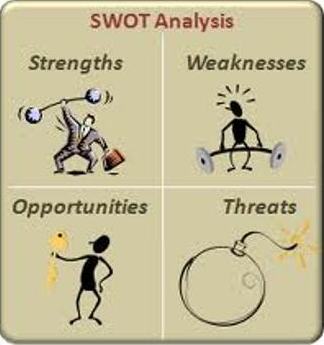
Almost every entrepreneur has heard about the acronym, SWOT. It stands for Strengths, Weaknesses, Opportunities and Threats. Typically, the SWOT analysis is used as a corporate assessment. We gauge each of these areas relative to our own businesses and then create strategies to respond accordingly. But there is another application of the SWOT analysis that I have rarely (maybe never) heard utilized. And that is to perform a personal SWOT analysis. As the entrepreneur, it is a good practice to self-perform the SWOT. But it would also be enlightening to have a peer or trusted colleague do the same to gain an additional perspective.

We start this process by analyzing our personal Strengths. Are we strong leaders – if so, how is this demonstrated? Are we persevering? Do we have exemplary resilience in the face of adversity? Perhaps we have a strong innovative flair. Could we safely say that we are calm, patient, kind or generous? We should identify and assess the strengths that matter most.

Seeing our Weaknesses may not be so easy especially if we aren’t an introspective type. This may require help from that trusted colleague or a peer who is not afraid to tell it like it is. Do we have a temper? Does our ego ever get in the way? Do we always treat others with respect? Are we perceived to be of high integrity? Do we give up too easily? Maybe we tend to lose focus.

Analyzing our Opportunities is an exercise in determining whether our glass is half empty or half full. Think about what we personally have the potential to do. Could we become more philanthropic? Is there a mentoring or coaching opportunity in our future? Do we begin speaking at industry conferences? Perhaps we could develop a new product or service. Ultimately this is about how we can become more fulfilled as human beings as well as becoming even more valuable to our enterprise.

Finally, we must look at our Threats. Could our lifestyle be a threat to our health? Is there a lurking situation that could degrade our financial security? Does our mindset work for or against us? When we evaluate Threats in a corporate sense, we generally are contemplating external pressures that we may think are beyond our control. As we consider Threats from a personal standpoint, we find that most will be of an internal nature. We can be our best friend or our worst enemy.

Once we complete an honest and realistic personal SWOT assessment, we need to take the next step of creating strategies that bolster our Strengths; resolve our Weaknesses; take full advantage of our Opportunities and eliminate our Threats. The ensuing plan can become the centerpiece for leading a balanced work and personal life. And revisiting it often will ensure its implementation.

A personal SWOT analysis can be an invigorating and exhilarating process. When done in concert with a SWOT for a company, the results can be a powerful catalyst for positive change in both the entrepreneur and his or her enterprise.

This blog is being written in tandem with my book, “An Entrepreneur’s Words to Live By,” available on Amazon.com in paperback and Kindle (My Book), as well as being available in all of the other major eBook formats.

The Opportunity-Juggling Entrepreneur

Are you a juggler? Or do you like to focus on one thing at a time? This is the classic conundrum for an entrepreneur. True confession. My personality is such that I could become easily bored if forced to focus on only one thing. I flourish when I am juggling 67 balls and trying to keep every single one of them in the air. There are times when juggling is not only useful but necessary. And there are times when intense focus is mandatory. Mind you, I can focus like a laser when I absolutely must. But I do not really like to do this day-in and day-out.

In the start-up world, venture capitalists often advise entrepreneurial founders to focus on a single product or service. This is generally sound advice. Too often, founders “flit” all over the place with a million ideas and are masters of none. I understand this. At the earliest stages of the corporate lifecycle, we are searching to find the right product; the right features; and the right market. As a result, we may tend to cast a wide net over many products, many features, and many markets, looking for the right combination in the process. And so, the juggling act begins.

There is a fine line between juggling to fine-tune a product or service and juggling a panoply of unrelated ideas that we think are opportunities. One of our business units is focused on acquiring market-rate apartment properties across the country. This product set has been painstakingly refined and our team is very disciplined within the parameters that have been established. This strategy calls for purchasing properties of 200 to 600-units, built in the 1980s to 2000s, and located in larger markets in the Midwest, Southeast and Southwest. I am very supportive of this approach. A couple years ago I suggested that we purchase some smaller properties in the same markets for a different group of investors wishing to write smaller equity checks. Fortunately, our team knows my proclivities and accommodated my suggestion. I think they would prefer to maintain their focus on the larger properties. But they understand that this second product set provides some diversification as well as some operating efficiencies. Needless to say, this additional strategy has caused a certain amount of juggling to accomplish.

Many of the great companies have started with a single product. Amazon sold only books in the early days. One could order hard copy books and eventually digital books that could be read on Amazon’s e-reader, the Kindle. It was years before Amazon began juggling in the sale of other products. Apple did the same thing with a personal computer. Again, it was years before they started selling MP3 players, phones, and other electronic devices. Somewhere along the line these companies had to begin juggling in a more robust manner. What was the inflection point? If you are an entrepreneur, have you found the inflection point where juggling more opportunities is appropriate and perhaps even necessary?

Working within a team structure is critical to discovering the right time to begin juggling more and more opportunities. Debating and discussing a multitude of ideas is healthy and will lead to the right decision. One thing I appreciate about our team is the fact that while willing to juggle, they will say “no” to opportunities they do not believe are productive. They test each idea and opportunity against our corporate vision and mission. This is the most important factor of all. Earlier in my career I grabbed at everything. That was before our vision and mission was clear. It is much easier now to juggle while still remaining focused when understanding which opportunities are truly a fit.

As entrepreneurs we are destined to juggle. But we must know when to be singularly focused and when to look at many ideas and opportunities. Using a team approach to make these decisions and testing each idea and opportunity against the corporate vision and mission is the ticket to success.

This blog is being written in tandem with my book, “An Entrepreneur’s Words to Live By,” available on Amazon.com in paperback and Kindle (My Book), as well as being available in all of the other major eBook formats.

Advice from a Boomer to a Millennial – Part 2

A few years ago, I wrote a blog offering advice from a Baby Boomer entrepreneur to Millennials. Now, I have some additional thoughts to share.

  1. Create your own opportunities. Nothing should stop you from creating and pursuing your own opportunities. They are not going to be handed to you, so do not have an expectation that someone is going to tap you on the shoulder and say, “Here is an opportunity that I think would be perfect for you.” I was very fortunate early in my career to work for an entrepreneur who allowed me free rein. I had certain roles and accountabilities that I was expected to perform. But after that, I was free to dream and take the steps necessary to make those dreams a reality. It was important that the opportunities I created did not conflict with our organization’s values and goals. I made more mistakes than I can count, but none were so serious that they would have sunk the ship. Too many people today seem to be in a “waiting mode.” Rather than dreaming big dreams and making them a reality, they think that someone else is going to give them direction and structure. Believe me when I tell you that this mindset will only end up in frustration and resentment the longer it persists.
  2. Work for/with honorable people. Another fortunate aspect to my career was the fact that the entrepreneur for whom I worked was an honorable man. He was tough and old-school with many of his leadership traits and tendencies, but he was as honest and fair as the day is long. I had job offers along the way but always thought, “I am able to create my own opportunities and work for a person of integrity. What more could I want?” The grass-is-greener syndrome that many people face was never a factor for me. Now that I lead our collection of companies it warms my heart to know that one of our five core values is Integrity and we have created an entire organization with hundreds of honorable people.
  3. Make your own happiness. We have all heard it said that happiness comes from within. This is 100% true. How many times have you (or a colleague) said that when your compensation reaches a certain level or you have a specific amount of money in the bank, that you (or a colleague) can relax a bit and be happier? There is no question that material wealth can make life easier. But easier does not necessarily translate into happiness. When we make our own happiness, we are channeling our passion in ways that are satisfying to us. Passion and happiness go hand in hand. Find your passion and chances are you will be a happy person.
  4. What the heck is boredom? This one stumps me. I have never been bored a minute in my life. And yet I hear adults talk about being bored all the time. As a kid life was full of wonder and excitement. I grew up in a time long before video games, the Internet and 24-hour stimulation. If any of us kids ever thought about being bored, our parents would read our minds and make us go pull weeds in the yard or scrub out garbage cans. My grandkids talk about being bored which is amazing considering all the toys and tools to which they have access. Boredom comes from being too one-dimensional. If we are curious about all things in life, there is never a chance to be bored because we are always learning something new. I will never forget Saturday afternoons as an eight-year-old grabbing the World Book Encyclopedia annual update and reading about so many different things. If you tend to become bored, consider creating a bucket list of things you would like to learn and do, and then get to it. This does not have to be the “Climb Mt. Everest” type of aspirational bucket list but could be as simple as learning to play the piano or reading a book in a genre that you would not ordinarily consider. Simply put, boredom is a complete and total waste of life.
  5. Live a positive life. We all have a choice to make. Do we maintain a positive mindset or a negative one? Other people do not dictate our mindset. To me, the choice has been a total no-brainer. If I can be positive and happy or negative and miserable, what choice is there really? Life is far too short to wallow in despair and negativity. If there is only one piece of advice that I can give you, it is to always, always, always stay positive and look for the silver linings in everything, for they are there.

Here is wishing you the ability to create your own opportunities, work for and with honorable people, make your own happiness, never be bored, and live a positive life. YOLO!

This blog is being written in tandem with my book, “An Entrepreneur’s Words to Live By,” available on Amazon.com in paperback and Kindle (My Book), as well as being available in all of the other major eBook formats.

The Personal Acronym

Almost every entrepreneur has heard about the acronym, SWOT. It stands for Strengths, Weaknesses, Opportunities and Threats. Typically the SWOT analysis is used as a corporate assessment. We gauge each of these areas relative to our own businesses and then create strategies to respond accordingly. But there is another application of the SWOT analysis that I’ve rarely (maybe never) heard utilized. And that is to perform a personal SWOT analysis. As the entrepreneur, it is a good practice to self-perform the SWOT. But it would also be enlightening to have a peer or trusted colleague do the same to gain an additional perspective.

We start this process by analyzing our personal Strengths. Are we strong leaders – if so, how is this demonstrated? Are we persevering? Do we have exemplary resilience in the face of adversity? Perhaps we have a strong innovative flair. Could we safely say that we are calm, patient, kind or generous? We should identify and assess the strengths that matter most.

Seeing our Weaknesses may not be so easy especially if we aren’t an introspective type. This may require help from that trusted colleague or a peer who isn’t afraid to tell it like it is. Do we have a temper? Does our ego ever get in the way? Do we always treat others with respect? Are we perceived to be of high integrity? Do we give up too easily? Maybe we have a tendency to lose focus.

Analyzing our Opportunities is an exercise in determining whether our glass is half empty or half full. Think about what we personally have the potential to do. Could we become more philanthropic? Is there a mentoring or coaching opportunity in our future? Do we begin speaking at industry conferences? Perhaps we could develop a new product or service. Ultimately this is about how we can become more fulfilled as human beings as well as becoming even more valuable to our enterprise.

Finally we must look at our Threats. Could our lifestyle be a threat to our health? Is there a lurking situation that could degrade our financial security? Does our mindset work for or against us? When we evaluate Threats in a corporate sense we generally are contemplating external pressures that we may think are beyond our control. As we consider Threats from a personal standpoint we find that most will be of an internal nature. We can be our best friend or our worst enemy.

Once we complete an honest and realistic personal SWOT assessment, we need to take the next step of creating strategies that bolster our Strengths; resolve our Weaknesses; take full advantage of our Opportunities, and eliminate our Threats. The ensuing plan can become the centerpiece for leading a balanced work and personal life. And revisiting it often will ensure its implementation.

A personal SWOT analysis can be an invigorating and exhilarating process. When done in concert with a SWOT for a company, the results can be a powerful catalyst for positive change in both the entrepreneur and his or her enterprise.

This blog is being written in tandem with my book, “An Entrepreneur’s Words to Live By,” available on Amazon.com in paperback and Kindle (My Book), as well as being available in all of the other major eBook formats.

SWOT-Analysis

Knock-Knock . . .

Knock-knock. Who’s there? Problem. Problem who? This childhood riddle is emblematic of a common perspective that many of our daily encounters present problems for us. But are they really problems? I’m sure that an argument can be made that anything a bit perplexing or where a less-than-favorable outcome is realized, could be considered a problem. But why do we choose to believe this so often? Some of us by nature are problem-solvers (I’ve been known to fall in this category) and so we may see situations as problems to be solved. But I submit that there is a different way to look at this.

For the last many years, I’ve become more and more inclined to be an “opportunity-seeker.” And what a difference it makes to see things as less problematic and more opportunistic. Obviously this is a subtle shift in mindset – does it really matter what we call it? I believe that it does because of how we tend to react internally to problems versus opportunities. Some of our natural feelings when facing a problem may be dread, fear, surprise, fatigue, victimization, overload, resignation, procrastination and apathy. All of these feelings are cloaked in negativity. Of course there are positive ways to view problems and many of us may do so; but I’ll bet that the natural tendency is to focus more on the negative perspective.

On the other hand, becoming an “opportunity-seeker” is a proactive and positive manner in which to move through challenging situations. Notice my language here. I didn’t talk about “facing” a problem. I didn’t talk about a “resolution.” Instead I used the words “move through challenging situations.” This sounds effortless but it’s not. However, the process of “moving through challenging situations” does not have to be filled with our own emotional downside drama. And there’s one component to being an “opportunity-seeker” that makes it all worthwhile in my view. We get to unleash our creativity.

Creativity is one of the most positive energies that we can experience. It’s much more expansive than just figuring out how to fix something. Metaphorically speaking, creativity enables us to make things bigger and better. I’m sure you’ve felt the frustration of trying to put together a puzzle where you simply can’t find the right piece. We just want to “fix” the situation by finding the missing piece and moving on – right? Contrast this with taking a pile of Lego® pieces and building an object right out of our minds-eye. That’s the difference between being a problem-solver and an opportunity seeker. Some situations will always require finding the right piece to the puzzle no matter how creative we want to be. But we can find a way to harness our creativity in every situation. In the literal case of the puzzle, perhaps we can become more imaginative in the way we sift through the pieces to find the right one. Or maybe we make a game out of it.

When we choose to stop seeing challenging situations as problems we cease limiting ourselves to being only problem-solvers. Moving through challenging situations by looking for opportunities to be creative opens the way for feelings of joy, accomplishment, euphoria, happiness and satisfaction. Knock-knock. Who’s there? Opportunity!

This blog is being written in tandem with my book, “An Entrepreneur’s Words to Live By,” available on Amazon.com in paperback and Kindle (My Book), as well as being available in all of the other major eBook formats.

flyingcar

The Eeyore Effect

Once upon a time there was a donkey; a very sour, pessimistic, woe-is-me, black-cloud-hanging-over-his-head donkey. Do you ever feel like this Winnie the Pooh character, Eeyore? What sort of a load are you carrying? As entrepreneurs we may often feel like that load is very heavy. As a result, our productivity is stunted and our emotional state is negatively impacted.

Feeling the weight of the world can be triggered by so many things. And feeling the weight of the world can have a compounding effect and further escalate our woes. Perhaps we are experiencing a health challenge of some sort. What happens to our functionality when we don’t feel good? Our focus isn’t as sharp and we may be more prone to making mistakes. Realizing this, we try even harder to focus; end up having tunnel vision, and miss something important happening outside of our line of sight.

Maybe we’re having a relationship issue. A member of our team is causing severe problems in the office, and is making outrageous, false and highly personal statements that are very hurtful. We find ourselves dwelling on what is being said about us and become distracted to the point that we miss the signals of dissatisfaction from one of our clients. By the time we realize what is happening, things are spinning out of control and we become even more beaten down.

Entrepreneurship is all about solving problems. We make a clear choice about how we are going to deal with what may be perceived as “the load we carry.” We are most effective when we don’t accept the problems as our own. How can we say that we aren’t going to accept a situation that is ours and only ours? The previously mentioned health challenge isn’t someone else’s problem, is it? True enough. But the key word here is accept. We can view a challenge as a load that we must shoulder, or we can look at it as a problem we must solve. If our mindset is that a problem is a load to carry, then it’s likely that we’ll see all of our problems as loads to carry. If each problem represents a 50-pound weight, three problems are the equivalent of carrying 150-pounds on our back.

Rather than carry our challenges as weights on our back, we can choose to embrace them as opportunities to demonstrate our creativity; our resolve; our discipline, and our skill. In so doing, we refuse to “accept” our challenges as problems. We refuse to carry a load of any sort. Our mindset is that of clinical detachment. How many times have you seen someone appear to juggle a multitude of issues in an apparently effortless manner? And even more impressive is that while doing so they always maintain a sunny disposition. This ability is more than just resilience. It’s not allowing the load to be placed on our back in the first place.

We must draw a line in the sand with respect to whether or not we will allow our challenges to result in problems that accumulate as weights on our back. Seeing our challenges as golden opportunities is a sure-fire winning formula.

This blog is being written in tandem with my book, “An Entrepreneur’s Words to Live By,” available on Amazon.com in paperback and Kindle (My Book), as well as being available in all of the other major eBook formats.

eeyore

Perceptive Passion.

Question: Why is it that many entrepreneurs seem so animated about what they do?

Answer: There’s no doubt – entrepreneurs are a different breed of cat. Successful entrepreneurs somehow seem to live in a “zone.” Things always seem to go right for them. It’s almost like they have a sixth sense about everything. How does this happen?

It’s all about perspective. Some people see what they do for a living as a job. Others see it as a career. Successful entrepreneurs live it as a passion. Their vocation may have started out as a job and progressed into the career phase. But somewhere along the line something clicked and it became a passion. I remember when I graduated from college and went to work for the firm that I’m still with. My first position was a job and I hated it. But I was intrigued enough to stick with it and before long it became a career. I knew it was what I wanted to do for a long, long time. This was followed by years of toil, angst and stress – certainly not the most fun period of my life. Then it was as if the clouds parted and the sun began to shine.

For me the difference was the realization that I was actually living the dream I always had. My creativity level was off the charts and I was truly having a lot of fun. I never sought the passion I was feeling, but gradually it was just there. Today I understand that it was all about mindset. Had I willfully focused on changing my perspective I might have succeeded in reaching the passion stage much sooner. I’m lucky that the gradual shift in my mindset occurred. I wonder how many would-be entrepreneurs never achieve this gradual shift.

Intentionally changing your perspective is the key to moving past job and career and into a state of passion about what you love to do. This means understanding that everything you experience can build toward the good you desire. Look for the silver linings. Look for opportunities. Dwelling on what may seem negative is a passion killer. Use these situations as a challenge to learn perseverance and problem-solving. And this will lead to the silver linings and opportunities.