
Unknown's avatar

About anentrepreneurswords

R. Lee Harris grew up in Manhattan, Kansas and has lived in the Kansas City area since 1977. A 1975 graduate of Kansas State University, Harris began his career with Cohen-Esrey, LLC as an apartment manager two weeks after he graduated. Now president and CEO, he is involved in apartment management, development and investment; construction and tax credit syndication on a nationwide scale. Over the course of his career Harris has overseen the management of more than 27 million square feet of office building, shopping center and industrial space and nearly 60,000 multi-family units. He has started dozens of business enterprises over the past 40+ years. In 1991, Harris wrote a book entitled, The Customer Is King! published by Quality Press of Milwaukee. In 2012 he authored the book, An Entrepreneur's Words to Live By. He has mentored a number of business people over the years and has been a long-time participant in the Helzberg Entrepreneurial Mentoring Program. He and his wife Barb have two grown daughters and one grandson. They are active in their church, community and university.

The When Affliction

The minister in church one Sunday talked about his anticipation of future events and it got me to thinking about the subject in a different way. How many times have you heard someone say, “I’ll be happy when . . .” or “I’ll have plenty of money when . . .” or “I’ll have more fun when . . .”?

As a classic Type A entrepreneur I tend to focus on the future. Oh, I do live in the now, but I am constantly thinking about the next steps in building my businesses. But it goes beyond that. If I am going on a trip in a few days I’m thinking about what all will be involved in the travel process. I’m thinking about what I’ll do when I get to my destination. Once I’m on my trip and have reached my destination, I think about where we’ll eat dinner or an event that we’ll attend. I don’t think that it’s necessarily a bad thing to be planning ahead though I can easily flip over into the realm of obsession with planning. What’s more problematic is when the thinking ahead becomes the “When Affliction.”

The When Affliction manifests in several ways. It can occur when we are so focused on thinking about something that is to happen in the future that we don’t pay close enough attention to something critical that is happening right now. This is the perfect environment for mistakes to be made. The other day while driving I was so engrossed in thinking about an upcoming meeting that I nearly caused a wreck. I was changing lanes, turned on my blinker and quickly looked over my shoulder. There was a car in the other lane – I know I saw it – but it didn’t register as I pulled over anyway. Horns blared and my heart leapt into my throat. My focus on the moment was blinded by my focus on the future.

The When Affliction can have us so wrapped up in getting past the next milestone that we are unable to truly appreciate what we are experiencing in the process of getting there. So here’s a question. How many magical moments do we miss with the When Affliction? I remember my youngest daughter’s wedding. It was a splendid affair and one where I was truly present every second of the day. I simply allowed myself to be swept up in the pomp and pageantry that is often woven into such an event. Not once was I contemplating a future action. And I am able to treasure the memories because I really was a part of making them. There are so many other things I don’t remember about what has happened in my life because I was looking forward so much of the time.

It’s OK to plan ahead. If we simply allow ourselves to float along the river of life without regard for the snags and rapids in front of us, our boat could easily be swamped. The key is to find the right balance between thinking ahead and maintaining a “now presence.” To accomplish this, I have discovered a game that I play with myself. Let’s say that someone is coming to my office to meet with me. Before the meeting I identify several things that I want to notice during this meeting. What color are the clothes this person is wearing? What color are his or her eyes? Is the person right handed or left handed? Sharpening my observation skills in this manner helps me focus on the other person and the moment, thereby avoiding the When Affliction.

We intuitively know that tomorrow never comes because there always is another tomorrow. Thus we can avoid becoming obsessed with the future if we limit our planning to that which really matters.

This blog is being written in tandem with my book, “An Entrepreneur’s Words to Live By,” available on Amazon.com in paperback and Kindle (My Book), as well as being available in all of the other major eBook formats.


Huckleberry Finn

Celebritude!

As I write this it’s just days before the end of the year. It’s a time of rest and reflection. It’s a time of excitement for the New Year ahead. And it’s a time for celebration and gratitude – Celebritude! What is Celebritude?

Celebritude is a celebration of gratitude. Think about all for which we can be grateful. It’s not very hard, is it? Hopefully we’ve been acknowledging our gratitude throughout the year. After all, we know that maintaining an attitude of gratitude is part of the giving and receiving equation that enriches our lives. But we can do more in the gratitude department by creating “Celebritude.”

Celebritude is a time to think about those who have been particularly instrumental in supporting us and helping to make our lives better. Was there a teacher who inspired us during our early years? Perhaps there was a mentor somewhere along the way. How about a friend who lent a sympathetic ear during tough times? Maybe a colleague encouraged us to step up and do something we never thought we could do. And of course there may be a spouse or significant other who always believed in us.

To create Celebritude we must intentionally inventory those seminal figures that have helped shape our lives in positive ways. Then we take the opportunity to celebrate them and all that they have meant to us. There are many ways to do this. For example we could write a heartfelt letter to that teacher expressing our appreciation for his or her inspiration so many years ago. We might make a charitable contribution in the name of the mentor we appreciate so much. Dinner at a nice restaurant for that fabulous friend who has been so encouraging could be a perfect expression of gratitude. A nice gift might be appropriate for that colleague who challenged us to stretch ourselves and be better. And maybe we could take a special trip to say thank you to the spouse or significant other who has stood by our side through thick and thin.

When we create Celebritude we amp-up the gratitude process. It grounds us in the knowing that others have lifted us up and helped to propel us forward throughout our lives. By celebrating our gratitude for these wonderful souls we open a major channel of positive energy that benefits others as well as ourselves. And we can continue to live in Celebritude by paying it forward. Now, we can become that significant benefactor in someone else’s life by providing inspiration, support, mentorship, challenges and love.

The creation of Celebritude can be life changing for us and for others. Truly celebrating our gratitude brings a new level of momentum to the positive energy in which we thrive.

This blog is being written in tandem with my book, “An Entrepreneur’s Words to Live By,” available on Amazon.com in paperback and Kindle (My Book), as well as being available in all of the other major eBook formats.
Celebration

Bridge Building

Recently I was in a meeting with a group of entrepreneurs. One of them has been struggling to get traction with his entrepreneurial venture. His stress level was quite high and he indicated that he was under severe financial pressure. And to cap it off, his spouse was suffering with some anxiety issues that rendered her unable to care for their children at times. This all was adding up to a perfect storm of events that was creating considerable negative energy in his life.

This individual wants his entrepreneurial idea to work in the worst way. Obviously that is adding to the pressure. But he must clear up the various issues he’s dealing with in order to achieve the success that he desires. I suggested that he initially do only three things. First he needs to put his idea on the shelf for the time being – simply let it go. This doesn’t mean that he abandons it permanently but simply takes a breather with it. Second, I told him he needs to get a job so that he can provide for his family and relieve the financial pressure he is experiencing. I recommended that he live as frugally as possible and try and save some money that can be utilized when he resumes the pursuit of his entrepreneurial venture. Finally, I advised him to make a consistent practice of meditation – finding a quiet time each day to clear his mind and work on deep breathing. The purpose here is for him to become centered and release his negative energy.

Another entrepreneurial friend had been trying for quite some time to raise money for her venture and was having no success. She was extremely frustrated and was very emotionally invested in her idea. I had been following her situation for quite some time and suggested that she move on and do something else. She went home and took everything related to the idea; put those items in a clear plastic tub and stashed them in her attic. She had completely released her idea at that point. Within days she received a call from another investor asking her to reconsider. She revived her idea at that point by pivoting and re-tooling her concept. Today she is well on her way to raising the necessary funds for her revamped business concept.

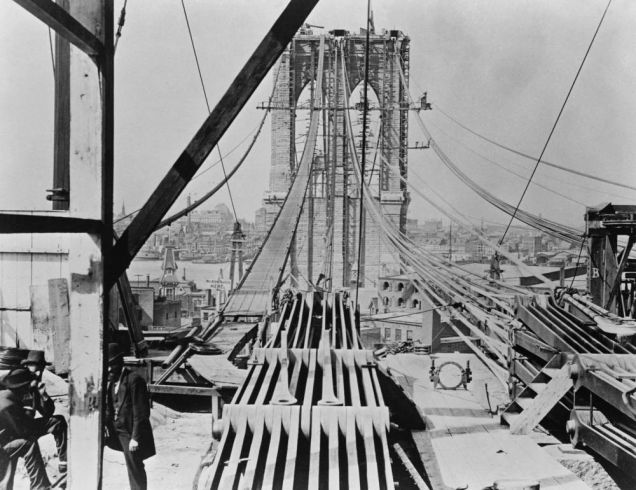
I liken the steps I recommended to my friends as bridge building. When we are pursuing success it doesn’t just happen instantly. There often are obstacles that we must face, some of which can create significant adversity. Sometimes our instinct is to continue “fighting the fight.” By trying to muscle through, we constrict our flow of positive energy and end up wallowing in our circumstances. And when this happens we remain stuck on the wrong side of the river.

To cross the river we must build a bridge. That requires that we take the necessary steps to restore positive energy and an optimistic outlook. One of the hardest things for an entrepreneur to do is to let go of his or her idea – even if it’s just momentary. But we know that when we continue to try and hammer, hammer and hammer – we’re not actually building the bridge. Instead we’re just stuck in the mud.

The entrepreneurial journey will periodically require the building of bridges to reach our success. To build the bridge we need to pause for a moment and identify forward-moving actions that will eventually ensure that we succeed.

This blog is being written in tandem with my book, “An Entrepreneur’s Words to Live By,” available on Amazon.com in paperback and Kindle (My Book), as well as being available in all of the other major eBook formats.

Bridge Building

The Eeyore Effect

Once upon a time there was a donkey; a very sour, pessimistic, woe-is-me, black-cloud-hanging-over-his-head donkey. Do you ever feel like this Winnie the Pooh character, Eeyore? What sort of a load are you carrying? As entrepreneurs we may often feel like that load is very heavy. As a result, our productivity is stunted and our emotional state is negatively impacted.

Feeling the weight of the world can be triggered by so many things. And feeling the weight of the world can have a compounding effect and further escalate our woes. Perhaps we are experiencing a health challenge of some sort. What happens to our functionality when we don’t feel good? Our focus isn’t as sharp and we may be more prone to making mistakes. Realizing this, we try even harder to focus; end up having tunnel vision, and miss something important happening outside of our line of sight.

Maybe we’re having a relationship issue. A member of our team is causing severe problems in the office, and is making outrageous, false and highly personal statements that are very hurtful. We find ourselves dwelling on what is being said about us and become distracted to the point that we miss the signals of dissatisfaction from one of our clients. By the time we realize what is happening, things are spinning out of control and we become even more beaten down.

Entrepreneurship is all about solving problems. We make a clear choice about how we are going to deal with what may be perceived as “the load we carry.” We are most effective when we don’t accept the problems as our own. How can we say that we aren’t going to accept a situation that is ours and only ours? The previously mentioned health challenge isn’t someone else’s problem, is it? True enough. But the key word here is accept. We can view a challenge as a load that we must shoulder, or we can look at it as a problem we must solve. If our mindset is that a problem is a load to carry, then it’s likely that we’ll see all of our problems as loads to carry. If each problem represents a 50-pound weight, three problems are the equivalent of carrying 150-pounds on our back.

Rather than carry our challenges as weights on our back, we can choose to embrace them as opportunities to demonstrate our creativity; our resolve; our discipline, and our skill. In so doing, we refuse to “accept” our challenges as problems. We refuse to carry a load of any sort. Our mindset is that of clinical detachment. How many times have you seen someone appear to juggle a multitude of issues in an apparently effortless manner? And even more impressive is that while doing so they always maintain a sunny disposition. This ability is more than just resilience. It’s not allowing the load to be placed on our back in the first place.

We must draw a line in the sand with respect to whether or not we will allow our challenges to result in problems that accumulate as weights on our back. Seeing our challenges as golden opportunities is a sure-fire winning formula.

This blog is being written in tandem with my book, “An Entrepreneur’s Words to Live By,” available on Amazon.com in paperback and Kindle (My Book), as well as being available in all of the other major eBook formats.

eeyore

The E Factor

Here’s a simple test. Do you wake up in the morning and can’t wait to tackle the day ahead? Does your brain function in overdrive with an idea a minute? Are you ever bored? Are you able to stay in “the zone” from a productivity standpoint for long periods of time? Do you experience endorphin rushes at times other than when you are exercising? Are you almost always in an upbeat mood no matter what? If you answered “yes” to all of these questions except for being bored (and answered it “no”) then you are experiencing the “E” Factor.

The E Factor is a major ingredient in the recipe for the success of an entrepreneur (and everyone else for that matter). The E Factor is . . . Exhilaration! Exhilaration is the energizing excitement that puts an exclamation point on our lives. There’s no drudgery in Exhilaration. There’s no exhaustion in Exhilaration. There’s no negativity in Exhilaration. There’s nothing boring about Exhilaration. Exhilaration is all about positivity, optimism, the glass is overflowing (as opposed to half full), fireworks-on-the-4th-of-July, the sun is always shining and everything WOW!

From personal experience I can tell you that my life is so much richer and fuller as a result of reaching and staying in a state of Exhilaration. The little setbacks along the way that might throw others for a loop are mere speed bumps for me. My existence goes far beyond my vocation and has become totally holistic in nature. I know this may sound corny, but I truly am in love with life and life is in love with me.

How do we reach and stay in a state of Exhilaration? There are three steps that have worked for me. First we must make serious choices about how we think. If you read my blogs regularly, you know that I constantly talk about how much of a difference our mindset can make. We all know this for the most part, but it’s not always easy to remember. Maintaining a positive state of mind is absolutely and totally critical to the E Factor. We must recognize when we are starting to veer into negative thinking; stop and release the negative thought, and replace it with a positive thought. I have found that a positive affirmation said over and over is a perfect replacement for a negative thought.

Second, we deserve to live our passion. I realize that sometimes there needs to be a ramp-up process to reach this passion. My passion isn’t just what I do for a living. My passion is the way I live. It’s filled with many things for which I have a passion including my relationships, my philanthropy, my health, my creativity, my faith and many more elements. I’ve said numerous times that passion is what allows us to see in color. Just because we may not be totally passionate about our careers at the moment doesn’t mean that there aren’t many other aspects to our lives for which we can have passion. And with respect to our careers – we should have a step-by-step plan that provides the light at the end of the tunnel for when our career does become our passion.

Finally, we must practice intense gratitude. Being grateful for what we have and what we receive keeps the energy channel open for us to receive more good in our lives. When I think back over the years about all the wonderful people who have done wonderful things for me, my gratitude needle explodes off the meter. Saying thank you isn’t enough. Doing good things for other people is an expression of our gratitude that recognizes what others have done for us. It’s a bit of a pay-it-forward mentality.

We can live in a state of Exhilaration if we choose to do so. It’s as simple as that. And to achieve the E Factor we must be positive, passionate and grateful. Enjoy the fireworks show!

This blog is being written in tandem with my book, “An Entrepreneur’s Words to Live By,” available on Amazon.com in paperback and Kindle (My Book), as well as being available in all of the other major eBook formats.
fireworks

Yin and Yang

Plans are only good intentions unless they immediately degenerate into hard work – Peter Drucker (management consultant, author and educator).

Good intentions aren’t enough. People have good intentions when they set a goal to do something, but then they miss a deadline or other milestone – Harvey Mackay (businessman, author and syndicated columnist).

Good intentions never change anything. They only become a deeper and deeper rut – Joyce Meyer (author and speaker).

I have low tolerance for people who complain about things but never do anything to change them. This led me to conclude that the single largest pool of untapped natural resources in the world is human good intentions that are never translated into action – Cindy Gallop (advertising consultant).

Each and every one of us has intentions; and most likely they are good intentions. But there must be another component to “intention” for there to be success. This component is a counterweight of sorts. It’s the yang to the yin. Without commitment good intentions never come to fruition. We’ve talked before about execution and how specifically we act. But before we can take action we must install the middle step of commitment. If we have good intentions and try to take action without commitment, we’re likely to fail.

Commitment embodies obligation, responsibility and dedication. Let’s suppose that I set an intention to exercise every day for at least thirty minutes. So far so good. Then I plunge into exercise activities the next morning and the morning after that. Wow – now we’re cooking! But wait, the third morning I struggle to get out of bed and decide to skip the exercise routine; besides, I have an early breakfast meeting that would probably have shortened the amount of time I could spend on the treadmill anyway. Then the next morning I have another excuse and so on. What was missing here? Why didn’t I follow-through on my good intentions? Very simply, I lacked commitment.

Understanding how to link intentions and sustainable action through commitment may seem elusive. There are two foundational elements to commitment. The first is what I call an “A ha” moment. This is when something in our mind clicks – where all the pieces fall into place – and our intentions make perfect sense. I’m not really going to commit to an ongoing exercise program until there’s a meaningful reason for me to do so. Of course I know that I want to be healthier, but that’s not enough. Why do I want to be healthier? My “A ha” moment came when I realized that my oldest grandson needed me to be in his life for the long haul. At that point, being healthier had a much more important purpose to which I was willing to commit. Often it’s easier to make a commitment when someone else needs us to be committed.

The second foundational element to commitment is that of accountability. Sure, we can be accountable to ourselves, but unless we have tremendous self-discipline this isn’t always easy. If we feel an obligation to others for some reason, then we can be accountable to them for that which we commit. In my case the reason I’m committed to an exercise program is to be alive and supportive of my oldest grandson. And thus I’m accountable to him for this commitment. If for some reason I don’t feel in the mood to exercise, I see his innocent young face in my mind’s eye and it isn’t hard to kick into gear and follow-through with the necessary actions.

Intention and commitment are necessary before we can take action. Making a commitment to another person and being accountable to that person helps to ensure that we follow-through and translate our intentions and commitment into action.

This blog is being written in tandem with my book, “An Entrepreneur’s Words to Live By,” available on Amazon.com in paperback and Kindle (My Book), as well as being available in all of the other major eBook formats.

yinyang

Not-My-Job-itis

I stopped at the grocery store the other day to pick up a few small items. I didn’t need a cart – only a small hand-held basket, but there were none at the front door as there usually are. I found a store employee who was wiping off a self-checkout monitor and asked her where I might find a basket. She walked with me past several of the checkout stands until she found a basket that I could use. This woman was very friendly and helpful which left a positive impression with me.

The day before my grocery visit I was on an aircraft preparing to fly back to my hometown. In the row next to me were two seats without seat cushions. After a short delay a maintenance person for the airline arrived and installed new seatbelts for each seat. Then he left. The seat cushions still were not re-installed. After another delay, a supervisor showed up and surveyed the situation. Then yet another airline employee came and cleaned the seat bases and then repositioned the seat cushions.

Both examples cited seem relatively innocuous except for one thing. In each case the employees had a serious case of Not-My-Job-itis. The grocery store employee did not bother to tell a manager that there were no baskets at the front door. She was helpful in finding a basket for me, but apparently it wasn’t her job to see that the lack of baskets didn’t become a problem for the next customer (and when we left the store there still weren’t any baskets to be seen). In the airline situation the maintenance technician wasn’t able to clean the seat base – this evidently was someone else’s job. How easy it would have been for the technician to have installed the seatbelts, cleaned the seat base and repositioned the seat cushions.

Not-My-Job-itis causes inconvenience for customers. It causes inefficiency for the company which may indirectly result in higher prices for the customer. In an entrepreneurial environment Not-My-Job-itis is toxic and undermines the culture we are trying to create. One large company that seems to get it is Southwest Airlines. At the end of each flight I watch the flight attendants don latex gloves and move from row to row cleaning out seat pockets and preparing for the next flight. I’ve even seen pilots do this as well. Many old-line large companies are afflicted with Not-My-Job-itis as a result of union work rules. Non-union companies should avoid this malady at all costs.

As entrepreneurs we need to set an example for our team members. Whenever possible, we should pitch in and help our team with whatever functions need to be performed. When I walk through our corporate office and see a piece of trash on the floor, I bend over and pick it up. I see others do this as well. When I visit one of our apartment properties during a snowstorm, I won’t hesitate to grab a snow shovel or a broom to help clean the sidewalk. As the CEO is this my job? You bet it is! My job is to meet the needs of our customers and to be a role model for our team. If I’m not “too good” to shovel snow, then no one in our organization should be either.

The benefits of eliminating Not-My-Job-itis are many. And there is no downside to it. Our customers are the winners when we teach others that we are never too important to provide assistance wherever it may be needed.

This blog is being written in tandem with my book, “An Entrepreneur’s Words to Live By,” available on Amazon.com in paperback and Kindle (My Book), as well as being available in all of the other major eBook formats.

broom

Fortune Telling

How would you like to be clairvoyant? Think about how amazing it would be to see into the future. Maybe you could even take your act to Vegas or have a television program of your own. Well, I’m here to tell you that you can develop a strong sense of clairvoyance. And as an entrepreneur it will serve you well in your business endeavors and in your life.

What I’m really talking about is the ability to think several steps ahead – I call it logical sequencing. I have a theory that our thoughts and actions have a natural rhythm and follow a pattern of some kind. Understanding this rhythm or pattern enables us to predict what will follow in each step of the process. Assume the following simplistic example. A mother sees the cookie jar on a shelf in the kitchen and she also sees her small son looking at the cookie jar. She immediately concludes that her son is going to want a cookie. Based upon her past experience with the lad, this is a reasonable conclusion and he does not disappoint. He looks around and notices his mother is not in the room. He also knows that he just asked for a cookie a few minutes ago and was told he could not have one. The determined child is enterprising and drags a chair to the counter but realizes that he still can’t reach the shelf. Then he sees a large ball on floor and puts it on the chair presumably to provide an added boost to the cookie jar. You know the rest of the story.

The mother obviously knew that this scenario was not going to end well. We’ll also assume that she intervened to avoid a trip to the emergency room because she could predict the outcome with great certainty. Yes, this is an overly simplistic scenario, but it demonstrates the point I’m making. Now, let’s translate that into a more complex business situation.

Assume that we own a small manufacturing operation with 20 employees. We’ve had a problem with shrinkage – the copper that we use in our manufacturing process is disappearing. Our general manager has decided to crack down and conduct random frisks of employees at the end of each shift. He requires each employee to sign a consent form agreeing to this procedure. Will this solve the problem? Maybe. Could it cause other problems? Most likely. A logical sequencing approach might have allowed for a different solution that would not cause problems.

In our hypothetical example the general manager was simply reacting out of frustration to a serious issue. Instead, he would have been better served to create a decision tree. He would have realized that if he took Step A, he might expect Result A to ensue, which could then cascade to Result B and Result C. Result A might have been all of the employees feeling that they are being unfairly accused of being dishonest. Result B might have been a growing resentment by the employees of the GM, and Result C might have been five of the employees quitting because they don’t want to work for a company that doesn’t trust them.

By using a logical sequencing process and creating a decision tree, we can anticipate the politics of a situation; how people are likely to feel about certain actions, and what the impact of our decisions might be. As entrepreneurs we may make such decisions in a reactive or expeditious manner without fully exploring how the various ramifications may unfold. As you read this you may be thinking, “Master of the Obvious!” But you would be amazed at how many decisions are made in society today where little or no thought is given to the ultimate outcome.

When we adopt a calm and measured approach to making decisions and taking action, we have a greater chance to succeed. Using logical sequencing to predict outcomes can greatly support this process.

This blog is being written in tandem with my book, “An Entrepreneur’s Words to Live By,” available on Amazon.com in paperback and Kindle (My Book), as well as being available in all of the other major eBook formats.

fortuneteller

WUONPS

Have you ever found yourself in what I call a “wired-up overwhelmed near-panic spiral – WUONPS?” You wake up at 3:30 AM with this gnawing feeling – you’re not worried about anything in particular, but that feeling is there. You can’t go back to sleep so you get up and make some coffee. You surf the internet while drinking three cups of coffee. Then you hit the drive-through at Starbucks on the way to work and get a Triple Frappasomething with an extra double shot of cappuccino. It’s been consumed before you reach the first stoplight. By the time you arrive at the office the feeling is welling up. With few more cups of coffee, a glance at 75 new e-mails and a minor crisis dropped in your lap, you’ve now reached the pinnacle of WUONPS. Oh, and it’s only 8:11 AM. What to do?

The first step is to recognize the state that we’re in. The quicker we can do this the faster we can move toward resolution. When we push on without stepping back our feelings cascade and we end up in a spiral. In aviation parlance, we’re now in full-fledged crash and burn mode. When we recognize that we’re headed into WUONPS we need to stop what we’re doing IMMEDIATELY. Then we need to go and find a quiet place for decompression.

Once in our quiet place it’s important to sit with our feet flat on the floor and hands in our lap with our eyes closed. We take a deep breath and let it out slowly. We do it again and again. Focusing on our breathing is a sure-fire method of calming ourselves. Deep breathing delivers increased amounts of oxygen to the brain. Livestrong.com says this: “Breathing slowly and mindfully activates the hypothalamus, connected to the pituitary gland in the brain, to send out neurohormones and trigger a relaxation response in the body. The hypothalamus links the nervous system to the endocrine system, which secretes the hormones that regulate all activities throughout the body.” Scientific explanation or not, this process definitely works.

Once we have begun to “unwire” through deep breathing, we might undertake the ROY G BIV exercise. ROY G BIV is an acronym for the seven colors of the rainbow – red, orange, yellow, green, blue, indigo and violet. In our mind’s eye we see each of the colors of the rainbow traveling from the center of the earth through the bottom of our feet, up our leg, across our midsection, down the other leg and back to the center of the earth. We do this slowly and intentionally with each color of the rainbow. The purpose of ROY G BIV is to ground ourselves. I know that when I’ve been in a state of WUONPS, I have a weird free-floating out-of-control feeling. ROY G BIV eliminates this feeling.

After spending ten or fifteen minutes deep breathing and grounding ourselves we are now ready to move back into the day. But first we should review our goals and objectives for the day. We spend a few moments with our “To Do” list and make sure we are clear on what we intend to accomplish for the rest of the day. Then we move forward with a new purpose and a new attitude. And . . . we avoid any additional caffeine for the rest of the day. We can also eliminate WUONPS altogether if we exercise regularly (daily for me); limit our consumption of caffeine, and maintain a daily practice of meditation or quiet time.

Recognizing WUONPS is critical. Breaking the spiral with deep breathing and ROY G BIV is paramount. Recommitting to the day with a clear understanding of what we intend to accomplish puts us back on the calm and productive path we desire.

This blog is being written in tandem with my book, “An Entrepreneur’s Words to Live By,” available on Amazon.com in paperback and Kindle (My Book), as well as being available in all of the other major eBook formats.

Cheetah_3

Worldly Serious Lessons

Indulge me with this blog posting. The 2014 World Series has just concluded and was one of the most exciting I’ve ever seen. It truly kept us on the edge of our seats until the last out in the bottom of the ninth inning with a Kansas City runner on third base who could have tied the game. Even though my Kansas City Royals did not prevail there are some excellent baseball metaphors that translate into some wonderful entrepreneurial lessons.

The MVP of the World Series was the Giants ace pitcher, Madison Bumgarner. Even though I’m a Royals fan I marveled at this cool, calm and collected 25-year old phenom. He pitched in three games during the Series and limited the Royals to nine hits, one run and one walk in 21 innings. Folks, this is called differentiation. There is no doubt that Bumgarner was the difference maker in the World Series for San Francisco. As entrepreneurs we increase our odds for success the more significantly we can differentiate our products or services.

The 2014 Kansas City Royals are a young team. There are no superstars in this bunch. The Royals didn’t even win their division, making the playoffs instead as a Wild Card entrant. They beat the Oakland Athletics in the Wild Card game; then swept the Los Angeles Angels and Baltimore Orioles to win the American League pennant. A lack of superstars also meant a lack of big egos and prima donnas. The result was a group of young men bonding together as a real team. This was most evident when one of the top hitters took it upon himself to lay down a sacrifice bunt to advance a runner when the Giants least expected it, rather than trying to hit it out of the park. Entrepreneurs succeed more often when we function in a true team fashion rather than as lone wolves.

While I’m gushing about my Royals, let me add another dimension about this team. It was evident that these guys were having fun. Game after game we saw scenes of players laughing, joking and genuinely enjoying themselves. Some of the players Tweeted where they were going to party after the games and bought thousands of dollars of drinks for their fans. What is the point of being an entrepreneur if we can’t have fun doing what we do? I’ve talked to a number of entrepreneurs who appear to be successful but are miserable. This is a dangerous “crash-and-burn” formula.

Finally, it was fascinating to observe the focus displayed by Giants and Royals players alike. When the focus was lost there were strikeouts, errors and walks. When the focus was maintained it was a thing of beauty. There were spectacular catches all over the field. Tough pitches were turned into base hits. Base running was exquisite. In the entrepreneurial world we know the importance of focus. If we “scatter our fire” we strike out more often than not. But when we focus, we create a special energy that serves to deliver the results we want.

Baseball is a sport. Entrepreneurs play for keeps. At the intersection of the two is differentiation, functioning as a true team, having fun and maintaining focus. Play ball!

This blog is being written in tandem with my book, “An Entrepreneur’s Words to Live By,” available on Amazon.com in paperback and Kindle (My Book), as well as being available in all of the other major eBook formats.

baseball