
Tunnel Vision

During the days when I was flying an airplane, I learned a very important entrepreneurial lesson. I’d be approaching a large airport and the situation became very busy. I had Approach Control giving me vectors and altitudes which required regular attention to the instrument panel. I had a landing checklist to review. If there were passengers, I needed to make sure they were buckled in and loose objects were secure in the cockpit. I also had to dial in the radio frequency for the airport tower to be ready for the hand-off from Air Traffic Control. Whew! With all this activity it was easy to forget to do one very critical thing – and that was to get my head up and look outside the airplane. Pretty obvious, right? You have no idea how even the most experienced pilots can make this mistake. We’re focused on everything else – and yes, we are looking straight out in front of us to line up with the runway. But there are other objects in the sky – aircraft that might be unaware of our presence, radio towers, drones, birds, etc. I quickly came to understand (under the penalty of death) that I needed to avoid Tunnel Vision at all costs.

What does Tunnel Vision look like in the entrepreneurial world? Here’s a hypothetical example. Jeff owns a three-year old company that provides IT services to small and medium-sized businesses. He has 27 members on his team and his top line has been growing at 60% annually. Needless to say, Jeff is crazy busy right now. He’s up at the crack of dawn and after a quick workout he heads to the office. Many nights he’s not home until after 9:00. At work he’s consumed with an endless stream of team members who catch him for a wide variety of reasons. He attends meeting after meeting. E-mails pile up and phone messages go unanswered. During the few moments Jeff has to breathe he wonders why time is flying by so fast and why it seems that he has accomplished so little.

You probably already know the rest of the story. Jeff and his team are so consumed with trying to keep up with their meteoric growth that a competitor sneaks in and steals some of their best clients. Instead of focusing on the customer, Jeff and his company have fallen victim to Tunnel Vision – and what they are seeing are systems, processes, recruiting, hiring, training, HR issues, accounts receivable, accounts payable – everything except the customer.

There are several ways we can be vigilant about keeping Tunnel Vision at bay. First, we need to make certain that every member of the organization has well defined written Roles and Accountabilities – let’s call them R&As. The R&As need to be of sufficient detail to identify all of the areas on which each of us should be focused. It’s kind of like a position description on steroids. Next, we should regularly review our R&A. I recommend that this be done at least once each week. Perhaps we have an “accountability buddy” with whom we review our respective R&As. I have gotten into the habit of doing this at least weekly and can see how easy it is to fall into a rut by just paying attention to one or two specific roles, sometimes to the exclusion of others. Part of this review is determining what I’m going to do during the coming week that involves each of my R&As. This helps keep me from falling into the ruts in the road.

As leaders, we must model how to avoid Tunnel Vision. After doing this for ourselves, we then need to encourage others to follow the same process. Often when Tunnel Vision is prevalent, I hear the same refrain – “there’s just not enough time in the day!” What this means is that we have lost control of our schedule and are allowing ourselves to be pushed and pulled by others. Tunnel Vision is inevitable when this is happening. Regaining control of our schedules is paramount and can be accomplished by planning what we are going to do rather than reacting. Ultimately, this planning initiates the R&A review and subsequent determination of our actions to be juggled in all areas.

Tunnel Vision can have fatal consequences for an organization. It can be avoided by reviewing Roles and Accountabilities at least once a week, and planning action steps that impact all areas for which we are accountable.

You can also listen to a weekly audio podcast of my blog. What you hear will be different than what you read in this blog. Subscribe on iTunes or wherever you get your podcasts. You can also click on this link – Click here to listen to Audio Episode 87 – Ted’s Song.

This blog is being written in tandem with my book, “An Entrepreneur’s Words to Live By,” available on Amazon.com in paperback and Kindle (My Book), as well as being available in all of the other major eBook formats.


The Art of Self-Discipline

I have my parents to thank for my level of discipline. I think perhaps I’m naturally wired for discipline, but there’s no doubt that the conscripted nature of their approach was very influential. As a young boy, every morning for nine years, I would get up and practice the piano at 5:30 AM on weekdays. I practiced the clarinet every weekday as well. I (dutifully) mowed the lawn, shoveled the snow, cleaned up the dog poop in the backyard, did my homework and practiced basketball. There was no choice. It was either get with the program or I’m sure there would have been even more horrific chores for me to do around the house. So I complied – I didn’t want to find out what the consequences would have been otherwise. So, today, whether it’s diet, exercise, investments or daily routines, I’m blessed with more than enough discipline. But I’m well aware that I may not be normal in this respect.

Discipline is a critical ingredient to an entrepreneur’s recipe for success. Without it we lose the “stick-to-itness” that is needed to follow through on a project or focus on a long-term strategy. The beneficial implementation of various systems and processes is dependent upon a level of discipline. It’s obvious to every adult that adopting a disciplined approach to multiple facets of our lives is essential.

So what do we do if we are less inclined in the discipline department? First, we decide where to pick our battles. I’m a neat freak – my wife, not so much. My shoes are organized in cubbies in my closet and every time I take off a pair they go directly into the cubby in which they belong. My wife’s shoes may be on the floor in front of the love seat where she sits in our den. In fact there may be more than one pair there. She has cubbies in her closet too, but they are packed full and she has dozens of pairs strewn about haphazardly on the closet floor. Naturally this used to bug me being the ultra-disciplined obsessive compulsive individual that I am. But I’ve learned that it’s not that big of a deal. And I’ve actually taken a page from her playbook and decided that there are some things on which I can lighten up in my daily routine. The point is that we don’t have to be disciplined about everything. Thus, we give ourselves permission to be less so with the things that don’t really matter.

Next, we identify those areas where we definitely need to be more disciplined. This applies to both our personal and professional lives. This starts with envisioning what it looks like when we get there. In other words, we paint the grand picture of success for whatever endeavor we are pursuing. Let’s take an easy example – weight loss. We see in our mind’s eye what we look like when we are 25 pounds lighter. We visualize a new wardrobe, how much easier it is to climb stairs, how wonderful the compliments are from our friends and overall how much healthier and vibrant we are. This visualization exercise needs to be performed daily until we have the desire to fulfill it. This process is necessary to build commitment. Without commitment discipline may be fleeting – look at gym attendance in February (or even half way through January).

Once we visualize our outcome and become fully committed, we next determine the steps that must be taken to achieve our outcome. Perhaps we want to become more disciplined about being aware of current affairs in our industry. Just jumping in and starting to read more trade publications, doesn’t ensure that we’ll have the discipline to continue this on a long-term basis. Instead we decide which information channels will be most productive. We determine a specific time of day we want to set aside for this initiative, and we also pick the environment most conducive to making this happen. In my case, it would be the easy chair in my den at home between the hours of 7:00 and 8:00 PM. I may read a couple of print and numerous online publications that are proven to have the content I’m seeking. There are some endeavors requiring discipline that need to be broken into bite-sized pieces or require a build-up of some sort. I walk about 10 to 12 miles each day but I didn’t start out that way. My initial Fitbit goal was 10,000 steps. Then it became 20,000 and now it’s 30,000.

Developing self-discipline is a process that starts with identifying what actually requires such discipline, followed by a visualization of the outcome we desire which builds to a commitment to follow-through. Then we map out the steps we’ll be taking – but always, always we keep visualizing our end goal.

You can also listen to a weekly audio podcast of my blog. What you hear will be different than what you read in this blog. Subscribe on iTunes or wherever you get your podcasts. You can also click on this link – Click here to listen to Audio Episode 86 – Alligator Food

This blog is being written in tandem with my book, “An Entrepreneur’s Words to Live By,” available on Amazon.com in paperback and Kindle (My Book), as well as being available in all of the other major eBook formats.

FOMO

We live in an age of acronyms. I guess they are a form of shorthand. LOL, YOLO, DIY, IMHO, SMH, MTFBWY, FUTAB and ROTFL. If you guessed them all correctly you are in the mainstream of cool. And for those of us who are a bit more advanced in years, here’s the translation in order – Laughing Out Loud (LOL); You Only Live Once (YOLO); Do It Yourself (DIY); In My Humble Opinion (IMHO); Shaking My Head (SMH); May the Force Be With You (MTFBWY); Feet Up, Take a Break (FUTAB), and Rolling On the Floor Laughing (ROTFL).

There’s another acronym I’d like to explore today – FOMO. Give up? It’s the Fear of Missing Out and it can be deadly for entrepreneurs. One of the best examples of the FOMO concept is the crypto currency craze and more specifically, Bitcoin. It’s not important to understand the basics of Bitcoin. What’s more instructive is to understand what has happened in the marketplace. On August 15, 2010, the value of one Bitcoin was $.07. By August 1, 2015, the value of one Bitcoin had risen to $283.04. On November 9, 2016, right after the Presidential election, the value of one Bitcoin had increased to $726.36. On August 1, 2017, a single Bitcoin was worth $2,787.85. By December 20, 2017, the “value” had jumped to $18,486.51, and by February 4, 2018, the value had plummeted back to $8,922.61. Riding a roller coaster at Cedar Point would be considered like a leisurely stroll in the park compared to the volatility of Bitcoin.

Unfortunately, there are hundreds of thousands if not millions of individuals who have jumped into Bitcoin worldwide. Some have used their life savings to buy a stake. Many think they are investing. Most hear the siren song of making a quick buck without truly understanding the risk profile or even the basics of how a crypto currency functions. What drove some people to plunk down $18,486.51 for a single Bitcoin on December 20, 2017, and within 46 days, see their position shrink to $8,922.61? When examining the case studies, it’s apparent that many people were motivated by the Fear of Missing Out.

FOMO is dangerous because it’s an emotional reaction. We work hard to build our businesses, and much of our success comes from analyzing data and making decisions based upon fact – even when it comes to understanding consumer sentiment (which may be emotional in itself). FOMO is impulsive in nature and flies in the face of logical decision making. We face this dilemma every day in one of our business units that is focused on acquiring market-rate apartments across the country. Apartment investments have been hot for the past few years and the fundamentals have been strong. As a result, prices have been driven higher and returns are lower. Press releases abound announcing acquisition after acquisition. It’s easy to feel the pressure to adjust our investment thesis to keep up the pace of our own acquisition initiative. But experience has taught us to resist this temptation.

The first step in avoiding the pitfalls of FOMO is recognizing our susceptibility to it in the first place. This can happen if we have a clear set of standards that guide our approach to the manner in which we operate. Without these standards we are very vulnerable to being tugged or pulled to follow whatever hot trend happens to emerge at the moment. With standards, we can test against that trend to see if there is alignment. If there’s not, we must have the discipline to resist pursuing it.

The second step is to carefully analyze the risks associated with pursuing the trend. This should be a rigorous exercise that identifies all the possible ways things could go wrong and what sort of impact would be felt. Take Bitcoin for example. I’m positive that many Bitcoin buyers have done no risk analysis and really believe they are “investing.” In reality they are just gambling. It’s one thing to speculate with money that one can afford to lose. It’s another thing to put half your life savings on Red 32.

Finally, FOMO can be avoided when we eliminate the emotion of envy. I doubt many Bitcoin investors believe they have been driven by envy. But when they see others “making” huge amounts of money on their Bitcoin “investments” they want to get in on the action. When I was 10 and another kid had ice cream, I wanted ice cream too. I secretly envied the other kid with the cone. FOMO to some extent is the same thing. When others are doing well, let’s rejoice in their good fortune without having any feelings that we are somewhat inferior if we don’t experience the same good fortune.

You can also listen to a weekly audio podcast of my blog. What you hear will be different than what you read in this blog. Subscribe on iTunes or wherever you get your podcasts. You can also click on this link – Click here to listen to Audio Episode 85 – Liars.

This blog is being written in tandem with my book, “An Entrepreneur’s Words to Live By,” available on Amazon.com in paperback and Kindle (My Book), as well as being available in all of the other major eBook formats.

Cheat to Compete

I’m not writing this blog to be judgmental. I’m really not. However, there are some subjects that cannot be discussed without sounding judgmental. So here goes. Let’s look at the topic of (gasp!) cheating. I can’t say whether cheating is more prevalent in the business world today than 10, 25 or even 50 years ago. Needless to say, it still is an issue that takes many forms.

Presumably we all started learning about cheating as small children. As a youngster, I remember many a board game that devolved into accusations of cheating. Our teachers and parents admonished us to never look at someone else’s paper when taking a test. Playground games were fertile grounds for cheating – remember four-square? “The ball hit the line and is out.” “No it didn’t!” “You’re a big fat cheater!” Roll the tape forward and as adults we might see team members clocking in or out for colleagues; money being borrowed from the petty cash box; résumés containing college degrees that weren’t actually earned or military service that didn’t actually happen; padded expense reports, and exaggerated (and sometimes untruthful) claims about all sorts of things.

This all may sound like a collection of relatively minor transgressions. So let me tell you a story. A number of years ago we had an apartment manager who used a corporate account at a local store to make some personal purchases totaling less than $100 – and she actually reimbursed the property without being asked. When questioned by her supervisor, she admitted her mistake. Following company protocol, the supervisor wrote a memo that ended up in her file advising her that she had violated policy with a dishonest act. In our system of progressive discipline, another such incident could be grounds for termination. This probably seems like a pretty innocuous situation – right? But the story gets worse.

A few years later it was discovered that this individual had concocted a very intricate, elaborate and almost impossible-to-discover embezzlement scheme – to the tune of $160,000. Her property received federal rent subsidies, and while we never had any money missing – her property was always 100% occupied and all rents collected every month – she figured out how to defraud the federal government. As her employer, we had to immediately re-pay the $160,000 to the government and then filed a claim under our crime insurance policy. Of course she was prosecuted but had spent all the money, so there was no way to recover the stolen funds from her. The biggest surprise came when our insurance carrier denied the claim. Why? There was a fine-print clause in the policy that denied coverage if we knowingly hired or retained an employee who was dishonest. And the damning piece of evidence was that memo in her file that contained the words “dishonest act” involving her use of a company credit account for personal purposes. I’ll spare you the ugly details of litigation against the crime insurance carrier as well as the errors and omissions insurance carrier. Needless to say we lost and ate the $160,000 (plus legal fees).

The moral of the story is three-fold. First, understand the fine details of your insurance coverage and modify your policies and procedures accordingly. Second, be careful at shrugging off small acts of cheating or dishonesty. They are a window into the overall character of an individual. What may appear to be a seemingly simple “mistake” could be the tip of a very expensive iceberg. Finally, everyone needs to see us as the paragon of virtue. We entrepreneurs need to model “squeaky clean” for our team, our customers and for the public at large. As hard as it may be, we need to demand complete and total integrity from ourselves and everyone else in our organizations. We start by always doing the right thing – especially when no one else is looking. And we hold our colleagues and associates to the same standard. The temptation may be great to cheat to compete, especially if we are struggling to gain traction. But if we do, it’s hard to expect others not to follow suit.

Integrity is not a puritanical concept. Great leaders always do the right thing and show others that it is the only standard by which to operate.

You can also listen to a weekly audio podcast of my blog. What you hear will be different than what you read in this blog. Subscribe on iTunes or wherever you get your podcasts. You can also click on this link – Click here to listen to Audio Episode 84 – D or D?

This blog is being written in tandem with my book, “An Entrepreneur’s Words to Live By,” available on Amazon.com in paperback and Kindle (My Book), as well as being available in all of the other major eBook formats.

Chips and Shoulders

I listened to a fascinating business podcast the other day. The host was interviewing an entrepreneur who apparently has faced a number of challenges throughout her career. What struck me the most was her statement that she has a “chip on her shoulder.” We’ve all heard this phrase before, and often it’s portrayed in a positive light. The thesis is that a person has faced adversity and come away from the experience stronger and tougher. I actually downloaded the transcript of this interview (which lasted for nearly an hour) and read it carefully. What I pieced together led me to question how positive a “chip on the shoulder” notion actually is.

For starters, let’s look at some phrases that I excerpted from the transcript. “Not everybody had a fair shake.” “In another way the industry is biased and the numbers are terrible and bleak.” “I will say that it took an embarrassingly long time to get anyone to take me seriously, so that’s where the insult is.” “Some of these barriers are just insulting.” “One person has to climb the mountain and another’s gotta climb a fence.” “The person across the table has to get a fighting chance.” “I don’t play well with others.” “I’ll tell you this honestly, our goal post has moved – it’s also there is a microscope on what I’m doing and what my company is doing, that is not on other companies.” And how about this gem? “Back to the theme that it’s a meritocracy except you have to work five or ten times harder than everybody else which is the opposite of a meritocracy.” Other words were used like “dignity,” “gut punch,” “injustice” and “really screwed me over.”

This entrepreneur shared her journey of the past two or three years, and while she’s clearly made some progress with her business, a case could be made that she ought to be farther along. She obviously believes that the reason that she’s not is due to external forces that have conspired against her. I don’t think I’ve listened to someone sound more like a victim in a long time. Unfortunately, the podcast host played the part of enabler and sympathizer. He egged her on and attempted to validate her claims. Yet, she presented very little concrete evidence to support her mindset.

I can’t begin to know all of the experiences encountered by this entrepreneur. Undoubtedly there have been some trials and tribulations along the way – however, the world is not selective about this! The entrepreneur from the podcast has chosen to develop a “chip on her shoulder,” advocating that the deck has been stacked against her and others have stood in the way of her success. The result appears to be a bitter self-fulfilling prophesy.

What if this entrepreneur took a different path? What if this entrepreneur looked at the obstacles as opportunities rather than conspiracies? What if she believed in her heart that every failure meant that something even bigger and better was in store? What if she could visualize abundance and possibility instead of lack and limitation? Over the course of my career, I’ve always found that embracing optimism and positivity begat the desired results far more often than wallowing in pessimism and negativity.

For me, a “chip on the shoulder” is a cynical mindset. It is typified by wariness, suspicion, skepticism and distrust. Entrepreneurs that wrap themselves in a “chip on the shoulder” cocoon will have a much tougher time receiving the good which they are pursuing. Here’s an indisputable fact. The adversity we experience directly shapes our mindset. But we make a choice as to what shape it takes. When we dwell on “being screwed over,” “gut punches” and “not playing well with others,” we are setting that shape as a giant chip that rests on our shoulder. And what a weight that chip can become!

We can avoid a “chip on the shoulder” mentality by following the positive path to our success. This enables us to work through, around, over and under the obstacles that we face and see them as opportunities to grow.

You can also listen to a weekly audio podcast of my blog. What you hear will be different than what you read in this blog. Subscribe on iTunes or wherever you get your podcasts. You can also click on this link – Click here to listen to Audio Episode 83 – Hall of Famer.

This blog is being written in tandem with my book, “An Entrepreneur’s Words to Live By,” available on Amazon.com in paperback and Kindle (My Book), as well as being available in all of the other major eBook formats.

Good or Bad Signals?

You walk into a meeting and there are several people in the room. Two people are scowling, another has his face in his hands, and one person has his body turned away from the others with his arms crossed. It’s not hard to surmise that there are some unhappy folks in our midst. Entrepreneurs will do well to pay attention to body language and non-verbal forms of expression – not only to understand how others may be feeling but also to know what signals he/she may be sending.

So quick – here’s a bit of trivia. What was the television commercial that coined the phrase “never let them see you sweat?” Give up? It was a commercial for a deodorant product called Dry Idea and was released in 1984. Though the product is long forgotten, the phrase is apropos for every entrepreneur. Let’s focus on how we want others to see us.

As a leader, the last thing I want is for anyone else to sense that I’m having a bad day. Fortunately this seldom happens, but when it does I don’t want members of my team to be nervous or concerned about how I’m feeling. Putting on the happy face is important when others are looking to us for leadership. Members of our team often take their cues from us. That’s why I do my best to try and always send positive vibes.

How we dress can send a powerful message. A number of years ago our companies went from casual Fridays to casual every day. It seemed to be the way of the world and there was a lot of enthusiasm for making the shift. After a few months, I realized that I did not like it. However, once a policy has been changed giving something like this to the team, it’s very hard to take it away. But that didn’t mean I had to dress down myself. Instead, I started wearing suits or sport coats and ties every day but Friday. I’m just more comfortable attired this way. And being one of the few business people still dressing up, I have been the recipient of many a comment as to how nice I look. If nothing else, others are noticing that I am representing our organization in a sharp and tasteful manner. Perhaps they’ll draw a positive conclusion about our brand as well.

I’m working with my oldest grandson (age 11) to help him learn how to shake hands. The handshake should be firm but not crushing. It’s important for the hand to be dry and warm. A cold or wet handshake is a turnoff. At the same time as the handshake is occurring, we look the other person in the eye, SMILE and introduce our self – “I’m Lee Harris.” I teach my grandson that when he does this in a confident manner the other person will almost always reciprocate with his or her name. At this point it’s a good idea to repeat the other person’s name – “Hi Dylan, it’s nice to meet you.” So you may be thinking, “What’s the big deal? I already know this stuff.” You would be amazed at how many entrepreneurs don’t know how to shake hands! Oh, and one other thing. When wearing a name badge, stick or pin it on the right side – not the left. This way, when you reach out to shake someone’s hand, it’s easy for them to see your name badge.

We tend to sit a lot in the business world. Our days are consumed with meetings and there are many levels of unspoken communications constantly occurring while we are seated. Are we rocking in our chair? Do we have a fidget-prone foot or leg? These movements can be distracting to others and may lessen the impact of what we have to say. Are we slouching in our chair? Is our phone in our lap and are we looking down for extended periods of time as we check e-mails, texts, etc.? As entrepreneurial leaders we want to set a good example for our team. Good posture and ongoing attentiveness sends the right message.

Finally, I can’t overemphasize the power of the SMILE and regular eye contact. This form of non-verbal communications puts people at ease and is vital to establishing a positive rapport.

Even though we may have learned about body language and non-verbal communications long ago, it’s always a good idea to periodically review and refresh. Better yet, spend a few moments to teach a youngster what you’ve learned.

You can also listen to a weekly audio podcast of my blog. What you hear will be different than what you read in this blog. Subscribe on iTunes or wherever you get your podcasts. You can also click on this link – Click here to listen to Audio Episode 82 – “No” Flippers.

This blog is being written in tandem with my book, “An Entrepreneur’s Words to Live By,” available on Amazon.com in paperback and Kindle (My Book), as well as being available in all of the other major eBook formats.

Celebrate Good Times

What and when do you celebrate? An odd question you think? Here’s the backdrop. Humans and their organizations like to celebrate. It’s positive, it’s fun and it’s great for morale. Unfortunately, entrepreneurs don’t do enough of it. We are so focused on problems to solve, people to hire and products (or services) to create that there may be long periods of time where we don’t even realize that we’ve enjoyed some success along the way. And no, this isn’t a blog about stopping to smell the roses. Sure, that’s important too, but this is about something more intentional.

I’ve been with the same company for more than four decades. I can tell you that we have been pretty successful over that timeframe but we really haven’t practiced what I’m about to preach – though we are starting to do so now. We might close a big deal at some point and slap each other on the back, but we really didn’t stop and truly celebrate a major accomplishment. And it would be pretty safe to say that we never celebrated minor successes. Why? Because that’s just the go-go nature of entrepreneurial endeavors. But I’ve come to realize that we’ve been missing a golden opportunity. Maybe you’ll step back and come to the same conclusion.

When we stop to celebrate it’s more than just party time. It can also be a great time for reflection. We look for the elements that created our success which reinforces the need to continue to implement those same elements in the future. Think about it. Let’s suppose that our company just landed a major contract to sell our product to a very large buyer. Before we pop the cork on the champagne, we gather the team and map-out the steps that led to the signing of the contract. We also identify what didn’t work so well and what we might have done differently. By undertaking this exercise, everyone is reminded of what we did to win.

The accolades, praise and expressions of gratitude all help to build and strengthen our culture. Our team members – especially those who were directly linked to the success – want to feel valued and appreciated. I realize that there may be financial incentives that have helped drive the success, but there’s no question that formal recognition is almost always a strong motivator as well.

So, if we are inclined to celebrate major successes, why not do so for minor achievements too? I’m sure someone is thinking, “If we celebrate everything, doesn’t it cheapen the process and lessen the impact?” This can certainly happen if we’re not careful. But most leaders can figure out what is worthy of celebration and what is not. Perhaps a team member completed the coursework to receive a professional designation. Or maybe the accounting team had a perfect quarter in terms of accomplishing all tasks on time and with 100% accuracy – paying bills, processing receipts, producing financial statements, etc. Finally, imagine each member of the sales team making 25 new cold calls a week for a month. These may be occurrences that in the past were viewed as routine or something that was expected. “Finally, this person or that team actually did their job(s)! Why do we want to celebrate that?” But remember that the celebration process begins with analyzing what worked and what didn’t work. Don’t we want to take advantage of the opportunity to understand what we want to replicate in the future?

Finally, the “party” piece of celebration may take many forms. Certainly gathering everyone for a toast may be one of the more common methods. Trophies, medals, commendations, certificates, plaques and other memorabilia are great forms of recognition. All-company e-mails, newsletters, websites and social media (Facebook, Twitter, etc.) can be effective tools for celebrating. I like to hand write notes to members of our team for large and small achievements. In one of our business units, they ring a bell and make an announcement when something happens that is worthy of a celebration.

The intentional celebration of achievements and success is an opportunity to reinforce what worked and improve on what didn’t. It’s also a chance to recognize members of the team for their commitment and ingenuity to deliver the positive results.

You can also listen to a weekly audio podcast of my blog. What you hear will be different than what you read in this blog. Subscribe on iTunes or wherever you get your podcasts. You can also click on this link – Click here to listen to Audio Episode 81 – Who is Dan Meyer?

This blog is being written in tandem with my book, “An Entrepreneur’s Words to Live By,” available on Amazon.com in paperback and Kindle (My Book), as well as being available in all of the other major eBook formats.

Easy Lifting

The news lately has been pretty grim in many respects. So many headlines were focused on bad things people are doing. There were sexual assault scandals, charges of racism, political mudslinging, competitive misdeeds and a host of other negative events. It seems like many of our citizens were committed to tearing down their fellow man. But to what end? How has this made the world a better place?

Entrepreneurs thrive on positive energy – actually we all do. Rather than use the hand to slap, how about we use it to lift up? Rather than pick others apart why don’t we pat them on the back. And rather than be hypercritical of everything about everyone, let’s intentionally look for the good. It goes without saying that this applies to our personal and professional lives alike.

If this sounds a bit too woo-woo, consider this. When are we most productive? When we are in conflict or in harmony? When are we most creative? And when are we the happiest and most fulfilled? I doubt anyone can honestly say that negativity has paved the path to their success. While our positive approach improves the wellbeing of others, guess what? It’s even more for our own benefit.

Here’s a simple test. Do you hear your friends, family and colleagues say more positive things about others, or more negative things? Recently I’ve listened to others (and myself) in this regard, and have noticed that often, the negative conversation outweighs the positive – that is, unless I move it in the other direction. When I intentionally find something good to say to someone or about someone else, it’s quite interesting to watch where the conversation goes. It takes a decided turn to the positive. Perhaps it’s contagious, or maybe it just needs a kick start. What’s fascinating is to see how easy it is move others in a positive direction by just being positive myself.

This practice takes no effort other than authenticity and a genuine desire to see the good in others. When we pay a compliment to a team member, a spouse or a child, it’s obvious how it makes them feel. But how does it make us feel? Perhaps there’s a bit of an afterglow for us that creates a lingering positive mindset. A routine I have developed is to walk through our office several times a day and speak to people. I’m looking for ways to build people up rather than tear them down. This occurs by engaging in short conversations, offering a word or encouragement here or there and smiling – always smiling. The process is energizing for me and stokes my innovation and creativity. And members of my team seem to take the cue – we hear them saying nice things about each other and pitching in to help one another.

I firmly believe that an organization (or a family) with a strongly positive culture will do great things. An uplifting spirit will help us through tough times and give us the momentum we need to climb the metaphorical mountains that need climbing. If members of our team are always looking over their shoulder and wondering when they are going to be criticized, a negative mindset ensues. If there is backstabbing, a constant rumor mill, cliques or a general air of indifference, the culture will reflect same.

Entrepreneurial leaders can be the difference maker when it comes to a positive or negative culture. The behavior we model in this respect will be noticed by everyone. If we are consistent about it, we may even help shift the mindset of others to entrench a positive culture that is permanent and enduring. Valuing the contribution of our team members and looking for every way possible to assist them is what can help us become the difference maker.

Making a commitment to continually see the good in others is healthy for our organization. The positive energy that it creates not only lifts up everyone else but also elevates us to an even greater state of being.

You can also listen to a weekly audio podcast of my blog. What you hear will be different than what you read in this blog. Subscribe on iTunes or wherever you get your podcasts. You can also click on this link – Click here to listen to Audio Episode 80 – Cocoons and Garlic Necklaces.

This blog is being written in tandem with my book, “An Entrepreneur’s Words to Live By,” available on Amazon.com in paperback and Kindle (My Book), as well as being available in all of the other major eBook formats.

Little Steps to Sweet Success

A friend of mine has a company he started several years ago and he’s on an unbelievable roll. If he’s not there already it won’t be long before his top line revenues exceed nine figures. When I first met him his business was grossing nearly $10 million. Not only has he seen a gigantic increase in his sales, but his profitability is off the charts. I fully expect to read about him in Forbes one of these days. How has he done it?

My friend is not a particularly flashy guy. He didn’t design fancy strategies or engage in crazy risks. Instead, he concentrated on taking little steps. You or I might see them individually as pretty mundane. But when viewed collectively these small steps have become giant leaps, propelling his organization to dizzying heights. What have I learned over the years about how my friend has built such a successful company?

In the early days my friend was the classic bootstrapper. He literally did everything. He and one key associate were the “executive” level management. They paid attention to the little details and obsessed over their customers. I remember urging my friend to spend more time working “on” his business than “in” it. Over time he took this to heart and began to be more strategic. But initially he was the chief cook and bottle washer as well as the CEO.

Also in the beginning, this man was allergic to debt. He re-invested his profits and made sacrifices to get through the leaner times. I suggested that he procure a line of credit to which he responded, “Why? I don’t need it.” I explained that at some point in the future he would need a lending relationship with a bank and that he should establish it sooner rather than later. He could borrow against it and then pay it right back if that would make him feel better. Ultimately he did obtain a line of credit and it was eventually quite helpful in accelerating his growth.

My friend was very particular about the business he would take. There were opportunities abound, but he showed great discipline in staying in his lane. He did not set out to be the biggest company in his industry, nor did he care if he developed a national footprint. By only taking assignments that he knew he could handle, he avoided the pitfalls that many entrepreneurs have made (including yours truly) by gobbling up every piece of business they could. At first I thought he might have an affliction of limited thinking. But I was wrong. Though it wasn’t articulated, it was obvious that he had a winning formula that was taking shape as a result of his intuition.

Over time, my friend learned how to scale his company. He gradually created the infrastructure necessary to meet the needs of more and more customers. Today he hires more than 50,000 people a year to staff the industrial operations of his customers. He attributes his continued growth to his ability to identify and value talent. The “value” part is especially intriguing. He genuinely cares about the team he has assembled. It would be easy to view 50,000 workers as a commodity. But he doesn’t. My friend goes to great lengths to make certain that everyone is treated fairly and with respect.

Above all, he’s played it straight as long as I’ve known him. He makes certain that he only hires team members who are legal and I’ve never seen him cut corners. Over many breakfast meetings and other encounters, I’ve observed this man to be grounded in principle and integrity. We’ve all heard about high-flying businesses that came crashing down when it was revealed that they had been involved in some form of cheating. My friend is Mr. Straight Arrow and has marched to that tune from Day One.

Overall, I think I can ascribe his level of success to his ability to execute. Some leaders are born to perform – my friend seems to do so effortlessly. I’m sure he’s stubbed his toe along the way. But I’m not aware that he’s made any major mistakes that would have jeopardized his future. I can’t say that he was studious about creating strategic plans and organizational charts or subscribed to the Harvard Business Review. Maybe he did. My guess is that he simply exercised a great deal of common sense and had an amazingly deep understanding of his industry.

My friend is a living example of how taking little steps can lead to sweet success. What he has done can be instructive for the rest of us as we grow and flourish as entrepreneurs.

You can also listen to a weekly audio podcast of my blog. What you hear will be different than what you read in this blog. Subscribe on iTunes or wherever you get your podcasts. You can also click on this link – Click here to listen to Audio Episode 79 – The Disneyland Story.

This blog is being written in tandem with my book, “An Entrepreneur’s Words to Live By,” available on Amazon.com in paperback and Kindle (My Book), as well as being available in all of the other major eBook formats.
Overflowing

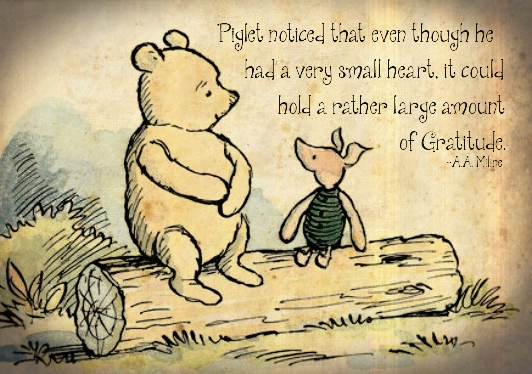
We entrepreneurs have much for which to be grateful. As I write this at the beginning of 2018, what better way to start a new year than to express gratitude? We have been blessed with so much and it’s helpful and healthy to reflect on these blessings.

I am grateful for my wife of more than 44 years and all of her love and support through the peaks and valleys of our lives. I am grateful for our daughters and how they have become great mothers to our three beautiful grandchildren. I am grateful to my son-in-law for the way he has become a terrific father. I am grateful to my parents who chose me through an adoption process and gave me an amazing childhood. I am grateful to my sister for so many things, but especially the way she cared for our mother before she died. I am grateful to our many friends who have joined us over the decades in countless moments of laughter and joy.

I am grateful that I learned to play the piano when I was young for it paved the way for me to type and be very efficient on the computer keyboard today. I am grateful that my parents helped me become a disciplined young man through many hours of piano and clarinet practice, as well as assigning me family responsibilities and holding me accountable accordingly. I am grateful that I was able to play basketball as a youngster and for the various summer jobs that taught me how to work hard and save money. I am grateful for having the opportunity to be a Boy Scout and all of the experiences that led to my Eagle award. I am grateful for having grown up in a small college town that was safe and offered a myriad of productive activities for a young person in the 1950s and 1960s.

I am grateful to my partner who gave me the opportunity nearly 43 years ago to become a part of a quality organization, and then let me spread my wings and soar. I am grateful to my other partner of nearly 22 years who has taught me empathy and understanding. I am grateful to the other senior leaders of our various companies who are helping to build a strong and sustainable culture. I am grateful to the hundreds of team members who advance our cause every hour of every day. I am grateful for the opportunity to use our platform to create and innovate. And I am grateful that our entrepreneurial endeavor has allowed me to live my “Why” which is to make sense of complexity.

I am also grateful for my physical health and the fact that I have few maladies for a person my age. I am especially grateful to each of my health care providers who have supported me in achieving great health. I am grateful that I have all of my mental faculties which enable me to read, write and think about the wonderful world in which we live.

I am grateful for having the honor of helping a number of mentees grow their businesses over the years. I am grateful for being invited to serve on different boards and various search committees. I am grateful for the young people who have participated in a university teacher’s scholarship program that my wife and I started in 1999. Many of them have now gone on to touch the lives of so many others as teachers.

I am grateful for having been able to earn an income that has provided a comfortable lifestyle. I am grateful to be able to travel throughout the country and abroad. I am grateful for my various hobbies including publishing this blog and recording a podcast – and of course I’m grateful to each of you who reads and listens.

I am grateful for my positive and optimistic outlook on life. I am grateful for my resilience and perseverance. I am grateful to be able to say that I have no real regrets, nor have I ever done anything to intentionally hurt someone else. I am grateful that I have a strong moral compass and that I can continue to explore my spirituality. I am grateful to all of the men and women who have sacrificed their lives for my freedom and for all of the first responders that stand ready to assist when needed.

My list could go on and on, so please don’t take offense if I didn’t make reference to you. It’s exhilarating to become immersed in gratitude and realize that our lives have been shaped by so many other people. I’m betting that you could also identify much for which you are grateful. To that end, let’s all be grateful for a Happy New Year!

You can also listen to a weekly audio podcast of my blog. What you hear will be different than what you read in this blog. Subscribe on iTunes or wherever you get your podcasts. You can also click on this link – Click here to listen to Audio Episode 78 – Oatmeal on the Floor.

This blog is being written in tandem with my book, “An Entrepreneur’s Words to Live By,” available on Amazon.com in paperback and Kindle (My Book), as well as being available in all of the other major eBook formats.