
A Dirty Word

What two words in the English language couldn’t be further apart in their meaning, but are often intertwined for entrepreneurs? The first word by itself is part of the everyday life of an entrepreneur – and every other person in the world as well. This word is relatively innocuous. But when connected with the second word it’s like adding the primer to dynamite. The resulting explosion can have all sorts of detrimental effects on our lives.

That first word is “failure.” Many entrepreneurs (and others) fear failure. But successful entrepreneurs have almost always experienced failure in different ways and multiple times. They use their failure to recalibrate or pivot, and find a new way to make something work. David H. McConnell was a door-to-door book salesman who offered a little gift of perfume to female customers. Selling the books didn’t work out so well, but there was great demand for the perfume. So McConnell ditched the books and turned the perfume concept into what is now known as Avon. Ever heard of Traf-O-Data? It was a partnership between Bill Gates and Paul Allen for the purpose of developing reports from traffic counters for traffic engineers. Needless to say the business was not a success. But Gates went on to launch another venture called . . . Microsoft. And then there’s the famous story about a man named Fred Smith who wrote a paper for his Yale University economics class involving overnight parcel deliveries. The professor wasn’t impressed and gave him what Smith recalls was a C. Undaunted, Smith pursued the idea which today is known as Federal Express.

This brings us to the second word. The word is toxic to entrepreneurs for it can easily become a mindset. The word . . . “defeat.” Failure is part of a process of experimentation and discovery. Defeat is the end. Once defeat is admitted, there’s nothing more to be done. I knew a man who worked for someone else for several decades. Then he decided to spread his entrepreneurial wings and bought a business. He labored mightily but eventually had to close his doors. But rather than lean into the experience and use it as a stepping stone to success, he withdrew. His confidence was shaken and he began making unhealthy choices. He tried working for someone else again but eventually ended up driving a taxi. Now there’s nothing wrong with driving a taxi if it’s for the right reason. But in this case it was his way of curling up in the fetal position and saying, “I can’t.”

I think that it boils down to whether or not we have a “die trying” mentality. It boils down to whether or not we have a positive image of ourselves. It boils down to moving as fast as we can to kill our own bad ideas so we can make room for the good ones! When we are afraid to fail, we are setting ourselves up for defeat. One of the most important things about failure is making certain that it’s not so monumental that we can’t right our ship. A mindset of defeat occurs when we are convinced we’ve lost it all – forever.

Here’s what I’ve learned. I don’t set out to fail at anything but accept the fact that I will and I must, if only to find the good ideas that work. I always make sure there’s enough of a margin of safety that my failures aren’t going to “kill” me. This leaves room for a pivot or a more significant shift. Regardless of my failures I will always remain positive and optimistic. Sometimes this can be very hard but it’s fundamental to avoiding defeat. When I do fail I look for what can be salvaged from the experience to bolt onto the next iteration of whatever I’m doing. And finally, I know that I’m a step closer to success by eliminating a step in the process that didn’t work.

Failure and defeat are not connected in any way, shape or form. Great opportunity and great success can rise from failure. Nothing good comes from defeat.

You can also listen to a weekly audio podcast of my blog. What you hear will be different than what you read in this blog. Subscribe on iTunes or wherever you get your podcasts. You can also click on this link – Click here to listen to Audio Episode 57 – Headwinds

This blog is being written in tandem with my book, “An Entrepreneur’s Words to Live By,” available on Amazon.com in paperback and Kindle (My Book), as well as being available in all of the other major eBook formats.

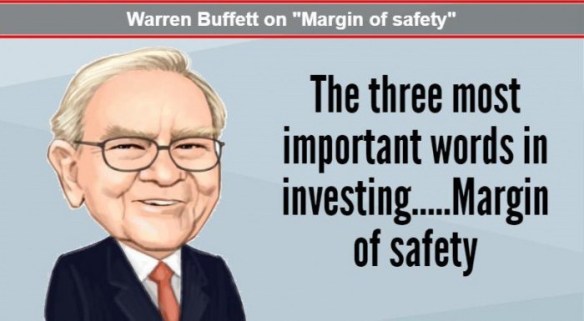
A Tip From Warren Buffet

We all know that life is full of risks. Some are more serious than others. I hold the view that I’d rather “manage” risk than “take” risk. I’ve said before that taking a risk seems a bit arbitrary. “Gee, I think I’ll try to run across this eight lane expressway right now!” Sounds silly, right? But in a way, that’s what taking a risk seems like to me. While it may not be as spontaneous as this overdramatized example, taking a risk feels like gambling. Meanwhile, managing a risk is calculated. It is studied and planned. Risk mitigation strategies are developed. If I’m to run across the eight lane expressway, I’m going to figure out every possible way to do so as safely as possible. That’s risk management.

One very important element of risk management is a concept that was espoused by one of the most revered investors of all time, Benjamin Graham (1894 – 1976). And this concept is practiced today by his acolyte, Warren Buffet. The concept is that of margin of safety. Entrepreneurs absolutely must understand margin of safety – but every member of society would benefit from practicing it as well. Graham and Buffet narrowly defined margin of safety as the difference between the intrinsic value of a stock and its market price. I look at margin of safety on a broader basis and define it as the difference between success and failure. In some cases this difference can be razor thin, and in others, it can be as wide as the Pacific Ocean. The key is to take the steps necessary to push the margin as wide as possible.

In our businesses, organizations and lives in general, we have an opportunity to become expert at creating margins of safety. One of our companies purchases apartment properties. Because we tend to hold these assets for five to seven years or longer, there can be a great deal of uncertainty about the future. What can we do to stack the deck in our favor and create a healthy margin of safety when we’re looking so far down the road? Obviously we make year-by-year financial projections that are based upon a set of assumptions. Those assumptions include rent levels, rent increases, operating expense levels, expense increases, occupancy percentages, rates of return on which a sale price can be calculated and various aspects surrounding debt financing. The Excel spreadsheet is quite comprehensive with all of these assumptions and projections – but how do we overlay a margin of safety on the process?

With one of our properties, we obtained a certified appraisal as a part of the due diligence process that indicated a value $3 million higher than we paid for the property. That’s a margin of safety right there. Perhaps we budgeted an initial increase in rents of $110 after making a number of physical improvements, but were actually able to achieve $200. Our assumptions might have anticipated a stabilized economic occupancy of 91%; but in actuality we were able to operate at 93%. Operating expenses may have been right on the money, but rent increases averaged 3.25% each year rather than the 3% that we had forecasted. And remember our baseline started $90 higher than the $110 initial increase that was projected. In summary, we pushed a number of levers to create several different margins of safety that when combined, produced a much better bottom line throughout the holding period than expected. In so doing, we are better protected from market factors that could degrade the future value of our asset.

The principal takeaway here is to find as many margins of safety as possible. If we make decisions based upon 100% optimal results, there’s no room for error. Then a blip in the market or a miss with operations could mean failure. I have learned the hard way that if there’s no way to create sufficient margins of safety, the risk I am contemplating may be too difficult to manage. So I move on to something else.

Developing the concept of margin of safety is an exercise in positive thinking. We are looking for ways to increase the probability for success – and that’s always a good thing.

You can also listen to a weekly audio podcast of my blog. What you hear will be different than what you read in this blog. Subscribe on iTunes or wherever you get your podcasts. You can also click on this link – Click here to listen to Audio Episode 56 – The Mystery of the Undercooked Steak.

This blog is being written in tandem with my book, “An Entrepreneur’s Words to Live By,” available on Amazon.com in paperback and Kindle (My Book), as well as being available in all of the other major eBook formats.

Wanna Change the World?

Here’s an obvious statement – entrepreneurs want to build successful businesses. But there’s something more that drives many of us. In some cases this objective is just as important as building the business itself. It’s a notion that invokes strong emotions and can be a driving force. Yes, many entrepreneurs want to make a difference in the world. They want to help change lives in a positive way. This is especially true of the millennial generation but also strikes a multi-generational chord for many.

While making a difference sounds great, how do we go about creating a company that does good work? A strong set of core values and a vision that embraces changing the world are critical factors. But to truly move forward to effectively and sustainably implement this concept we must start . . . with ourselves. Making a difference must become a mindset and a lifestyle. Think about it this way. If we want to lose weight permanently we don’t go on a diet, we change our lifestyle. It works the same way when we want to make a difference – we must change our lifestyle.

There is a simple yet powerful method that will help us move in the direction we desire. It revolves around a daily journal that we keep in which we record each attempt we make to do something that positively impacts one or more people. Here’s something else to think about. Making a difference doesn’t have to involve massive sweeping changes in the world. It starts with a lot of little steps that eventually have a cumulative effect. One of the mistakes that lead to frustration for entrepreneurs is believing that they can be the catalyst for major transformations overnight. Sure, every once in a while this can happen. But shooting for the stars without enough fuel is certainly going to end up in a fizzling disappointment.

What sort of baby steps should we be taking to develop a difference-making lifestyle and mindset? Look at all of the opportunities we have to make a positive impact on the lives of others every single day. In the restaurant where we are having breakfast or lunch, we can compliment our waitperson on providing excellent service. We can hold the door open so that another person can enter or exit. Perhaps we even anonymously pay for someone else’s meal in that restaurant from time-to-time. Maybe we handwrite a thank-you note to someone who has done something nice for us. Or we call a person with best wishes for their birthday. Do we always remember to acknowledge others with a smile and a warm greeting when we see them? Are our “please” and “thank you” manners always on display?

The little every day habits we develop to brighten the day of another individual are foundational toward taking bigger steps. Suppose one of our team members is apparently in distress. We can lend a sympathetic ear. Volunteering is a terrific way to make a positive difference in the lives we touch and can run the gamut of activities. Helping at a homeless shelter, mentoring other entrepreneurs, reading to sick kids in a children’s hospital and providing assistance to scouting organizations are examples of such bigger steps.

To keep ourselves on track, we utilize the Daily Difference Journal to record what we have done each day toward our lifestyle change. While it may seem trite to make an entry like, “told Olivia that her smile brightened the day,” the act of keeping such a tally reinforces the intentionality of our desire to do good things for our world. Repeating this process day-in and day-out helps set the pattern that we desire. Initially it pushes us to remember to look for opportunities to say and do things that create a positive experience for others. Eventually it becomes second nature and we don’t have to remember anything. We simply live each day looking for ways to make others happy and live better lives.

Making a difference in the world is a terrific benefit of being an entrepreneur. A Daily Difference Journal puts us on the path to accomplishing this with gusto!

You can also listen to a weekly audio podcast of my blog. What you hear will be different than what you read in this blog. Subscribe on iTunes or wherever you get your podcasts. You can also click on this link – Click here to listen to Audio Episode 55 – F-.

This blog is being written in tandem with my book, “An Entrepreneur’s Words to Live By,” available on Amazon.com in paperback and Kindle (My Book), as well as being available in all of the other major eBook formats.

Not Just Any Old Alarm Clock

Calvin Klein has a women’s fragrance called Obsession Perfume. It’s relatively inexpensive – around 20 bucks or so for a 3.4 ounce spray bottle. This blog is not about the perfume but it is about a particular type of “obsession;” one that is worth far more than 20 bucks.

What dominates our thoughts as entrepreneurs? Is it cash flow? How about the competition? Maybe it’s growth or perhaps it’s market share. Most of these aspects aren’t worth becoming obsessions. In fact, there is very little that rises to the level of importance to be worthy of obsession. Yet, there is one element that is so fundamental to the success of our businesses that it should be front and center as a focal point. You might say it’s the “Obsession on a Pedestal.” Everyone throughout the organization starting with the CEO should be obsessed about . . . the Customer.

Well of course, you say, it’s obvious that the Customer is important. No, I’m talking about something more intense than “important.” Customer Obsession takes many forms. There are certain business establishments – stores, restaurants, gas stations, etc., where I enter the restroom and am amazed at how sparkling clean they are. And they even smell good! That’s Customer Obsession. There are certain business establishments where I am called by name when I walk in the door. That’s Customer Obsession. Or take the case of a regular customer of a resort who developed a fondness for a particular type of clock radio. She looked high and low trying to purchase one but to no avail. She messaged the resort staff to see if they could point her in the right direction but was told that the clock was not commercially available. She was pleasantly surprised on her next visit to find a clock radio waiting for her as a gift upon her arrival. That’s Customer Obsession.

Wouldn’t it be incredible if we could create a culture where everyone is equally obsessive about the Customer? This utopia would have every member of the team smile and greet a Customer in a friendly manner when in his or her presence. This utopia would be a flurry of random thank-you notes, thank-you calls and other forms of true expressions of gratitude to our Customers. When a mistake occurs involving a Customer, our culture encourages a quick, heartfelt apology and a genuine attempt to make amends.

When I think about Customer Obsession, I want to know exactly what the Customer needs and wants. This requires a deep dive into data and other methods to understand what makes the Customer tick. And I want to go way beyond understanding what the Customer currently needs and wants. I must determine what his/her future needs and wants are going to be. I want my Customers to seek me out and tell me that they aren’t just satisfied. No, I want them to tell me that they are fulfilled beyond their wildest dreams.

I want to know when a Customer quits and why; and then I want to make a supreme effort to save that Customer and regain his or her trust. I want to talk directly to our Customers on a regular basis to understand as much as I can about the experience we have provided them. I realize that the cash flow, the competition, the growth and the market share are all secondary to Customer Obsession. Those aspects of our business will be fine if we have an ever expanding base of Customers for whom we are fanatical about making ecstatically happy. Finally, I want to constantly innovate with an eye on how to better serve the Customer. Running in place is not an option. We can and must always do better for the Customer’s sake.

Many obsessions aren’t necessarily healthy. However, obsessing about our Customers will help ensure that our business is healthy and prosperous for years to come.

You can also listen to a weekly audio podcast of my blog. What you hear will be different than what you read in this blog. Subscribe on iTunes or wherever you get your podcasts. You can also click on this link – Click here to listen to Audio Episode 54 – Blind Pigs.

This blog is being written in tandem with my book, “An Entrepreneur’s Words to Live By,” available on Amazon.com in paperback and Kindle (My Book), as well as being available in all of the other major eBook formats.

Congratulations – You Own a Gold Mine!

Have you ever watched the TV series Gold Rush: Alaska? It’s a lot of fun to see different miners interact with each other; spend a lot of money, and fight amazing odds to discover GOLD! They are grizzled guys and gals who brave the harsh Alaskan elements to find the elusive precious metal . . . and of course, smile (or snarl) at the TV camera.

If you watch very many episodes you will be led to believe that it is very, very difficult to succeed in finding gold. I disagree. In fact, I believe that each and every one of us already owns a gold mine. You may think this is a metaphorical reference and that’s partly true. But there is a literal aspect to this concept that I will explain in a moment. So what is this gold mine that each of us owns and where do we find it?

If you’ve read my blogs over the years and listened to my podcasts, you already know that I’m a dyed-in-the-wool advocate of maintaining a positive mindset. I believe that there’s a positive energy flow in the world into which we all can tap. When we worry; when we think negative thoughts, and when we act in ways that are hurtful to others, we block that positive energy flow. Then we wallow in our fears, our hurt, our frustrations and our misery – a process that feeds upon itself. And at the end of the day where are we?

Eliminating negativity is critical to discovering our gold mine. Being in a positive place all day, every day, allows us to harness the amazing power of passion and creativity. Do you ever feel stuck in place, spinning your wheels and not moving forward? You may be stuck right on top of your gold mine and you don’t even know it! So what to do? First, start with developing a meditative practice. Meditation is simply the act of dumping the wastebasket of stuff that collects in our minds. When we become quiet and discard the noise and negativity, we create a vacuum. But nature abhors a vacuum and what comes next is the exciting part. For me, a torrent of creative ideas begins to flow.

I want to support those creative ideas in every way possible. I do this with positive affirmations. If you want to become an expert at this, develop a positive affirmation that rings true for you. Then say it 100 times each day in blocks of ten. “Wonderful things are happening in my life right now!” is an example of a positive affirmation. Say it with gusto and different voice inflections. If you do this for a week, your conscious and subconscious mind will believe it.

When negative thoughts creep in, we recognize them and release them. One way to do this is to keep a journal in which we record our negative thoughts. We transfer them out of our minds and onto paper (electronically works too) – and we leave them there. At some point we might revisit them to determine what prompted the thoughts in the first place. But most importantly we get them out of our heads as fast as possible.

So where’s the gold? Here’s an example of how I found my gold mine. Recently I was speaking with a broker about listing for sale a property that we own. The property was purchased a few years ago and we knew it was going to have an excellent valuation – we just didn’t know how valuable it was going to be. In the process, I remembered that more than ten years ago, we sold an apartment property and completed a tax-deferred exchange for a couple of drug stores. Frankly, I figured that this was simply a process of protecting the tax positions for our investor limited partners. I never thought that we’d realize any value as general partners. While speaking with the broker, I mentioned that we owned the drug store properties as well. He responded by telling me that the market for this type of property has changed dramatically over the years. On a whim, I had him analyze the properties and he came back with an eye-popping valuation. We’ve listed those two properties as well and I’m looking forward to the day when we cash significant checks as a result of their sale.

I truly believe that by maintaining a positive mindset, a creative spark stimulated me to mention these properties to this broker. Up until that point I had completely written them off as having any value for my partner and me. By tapping into the flow of positive energy we discovered another vein of gold in our mine. I can tell you that this is not an isolated incident. It happens all the time.

The calculus is simple. An enduring positive mindset allows for the flow of creative ideas that in turn helps us find the gold mines that are ours to claim.

You can also listen to a weekly audio podcast of my blog. What you hear will be different than what you read in this blog. Subscribe on iTunes or wherever you get your podcasts. You can also click on this link – Click here to listen to Audio Episode 53 – Is the Lone Ranger Dead?

This blog is being written in tandem with my book, “An Entrepreneur’s Words to Live By,” available on Amazon.com in paperback and Kindle (My Book), as well as being available in all of the other major eBook formats.

Narrow Guardrails

Consider the following conversation that an entrepreneur named George is having with himself. “I really would like to accept the invitation to speak to the Downtown Civic Club. But I’m afraid I’ll be too nervous.” Here’s a similar conversation being held in the head of Megan, another budding entrepreneur. “I just don’t know. Maybe I should apply for that fellowship – but the odds aren’t in my favor to win.” And finally, Entrepreneur Don is thinking, “I’m reluctant to invest in a new product line because I’m not convinced it can succeed.”

But there’s more of a story behind each of these “conversations.” For George, he remembers the time several years ago when he made a presentation at a conference and was unprepared – he bombed. Megan recalls once applying for a highly coveted membership in a leadership organization. The process was very competitive and Megan’s application was rejected. Finally, Don previously invested in a product line that failed and he lost a chunk of change on the idea. I’m going to use a descriptive phrase for what is happening that will probably demonstrate a generation gap. What George, Megan and Don are doing is “playing old tapes.” Some younger members of the audience who may not know what “tapes” are. In the old days, some of us “old people” listened to music and dialogue on a thin magnetized strip of plastic film. There were reel-to-reel tapes, eight track tapes and cassette tapes to name a few “tape” formats.

To “play old tapes” is to recall negative experiences from the past and make decisions today based upon those experiences. Playing old tapes generally embraces the notion of lack and limitation. It’s based in fear – often an irrational fear – that shakes our confidence. Over time, these old tapes can have a paralyzing effect for an entrepreneur. Eventually we can fall into a rut with narrow guardrails that are reflective of our past failures. What we really want to do is to venture off this rutted road to nowhere and get back on the freeway that will take us to our dreams.

Getting rid of old tapes is harder than it sounds, but it can (and must) be done. First, we embrace who we are right now. We cannot change the past. There’s not a single person alive today who hasn’t made mistakes. And I think it’s safe to say that all of us have made many. We should use the past for its instructive elements while discarding the emotional aspects of how it felt to be embarrassed, hurt or even shamed. The instructive element for George is to always be sufficiently prepared for future presentations. It’s in his best interest to release the humiliation that he carries for it serves no purpose. In a sense, it’s time to get rid of the rearview mirror.

Once we have determined the instructive elements from our past mistakes and thrown out the emotional rearview mirror, we move on to the next step. What exactly does our success look like? For Megan, she holds an image in her mind’s eye. She sees herself attending a luncheon with hundreds of other people. And at the appointed time, she hears her name being called and watches as she walks to the stage to receive congratulations for winning the fellowship. This visualization is powerful and is a “tape” worth playing over and over. In so doing, we pattern our brain to be receptive to the success that awaits us.

Finally, we celebrate by making new “tapes.” This is accomplished by rejoicing in the small victories that we constantly encounter. We entrepreneurs think big. We set lofty goals and we are always pushing for the big wins. But we tend to overlook the small wins we experience every single day. Entrepreneur Don realizes that his sales are growing at a respectable pace. His team has been 100% intact for four years. His defective product returns are zero. All of these factors are wins and Don should take pride in their achievement. He now sees that he’s on the right track and is perfectly capable of making the right decisions.

We stop the process of playing old tapes by discerning the instructive elements from our past mistakes and eliminating the negative emotions that we remember. Then we repeatedly visualize our success and celebrate the wins we are experiencing on a daily basis. The end result is a completely new set of positive tapes that are free of lack and limitation.

You can also listen to a weekly audio podcast of my blog. What you hear will be different than what you read in this blog. Subscribe on iTunes or wherever you get your podcasts. You can also click on this link – Click here to listen to Audio Episode 52 – Ice and Eskimos.

This blog is being written in tandem with my book, “An Entrepreneur’s Words to Live By,” available on Amazon.com in paperback and Kindle (My Book), as well as being available in all of the other major eBook formats.

Another Form of Art

There’s something we all need to do from time-to-time, but many of us find it to be quite difficult. To become great leaders, entrepreneurs need to be able to perform this act in a genuine and authentic way. And yes, there’s definitely a right way and a wrong way. Before I give away the punchline, let me share an example that will illustrate the concept.

A company has a set of core values that includes Integrity. One of the individual actions prescribed in this core value is, “I speak directly with people to resolve issues as they arise.” This translates into the notion that rather than triangulate with other people about a problem we are having with someone, we go directly to that person to resolve the matter. Seems simple enough, right? Now, suppose a member of the team is in a meeting with senior leaders including the CEO and this team member makes a comment that makes other uncomfortable. Some might believe the comment to be slightly disrespectful to the CEO. After the meeting, the CEO and a couple of the senior leaders are debriefing and the CEO mentions that the comment that was made was probably inappropriate. The team member’s supervisor then goes to the team member and advises her that she should refrain from making similar comments in the future. The team member becomes upset that the CEO didn’t address this directly with her. What should the CEO do?

This situation actually occurred in our company and the CEO was me. It was brought to my attention by the supervisor that I may not have been keeping with our core value of Integrity because I triangulated with that supervisor rather than bringing the issue directly to the attention of the team member. What did I do? I picked up the phone and called the team member (who is based in another city). I told her that I had in fact mishandled the matter and should have come to her to discuss it. And I apologized for screwing up. In no way was this individual trying to deflect away any focus on her comment – she admitted that the remark was inappropriate and she apologized to me. But she was absolutely right in her observation that a fundamental core value had not been observed.

Earlier in my career I might have been defensive about the feedback I received. I might have been indignant that somehow I was wrong when it was another person who made the inappropriate comment to me in the first place. But I’ve learned a lot over the years and particularly how important it is to expunge false pride and an unhealthy ego to become a humble leader. Learning the Art of the Apology has been of great value to me.

Telling someone we’re sorry and admitting a mistake is important. But the way it’s done and what we say is equally critical. We’ve all heard this kind of an apology. “I want to apologize if what I did offended you.” This isn’t an admission that the perpetrator did anything wrong. He is simply apologizing if you are offended. The correct apology would have been, “I am sorry and want to apologize to you because what I did was wrong.” Another mistake is that of trying to rationalize the offense and then apologizing for it. In a way we’re still trying to defend what we did – although somewhat weakly. And it can come across in a condescending sort of way with the message that the aggrieved party is overly sensitive.

Smart entrepreneurs are able to admit their mistakes and move on. Not making the same mistakes over and over is also a factor here. When a team member sees the leader of the organization easily and genuinely apologizing for his or her toe stubs, it goes a long way toward making it easier for others to follow suit.

You can also listen to a weekly audio podcast of my blog. What you hear will be different than what you read in this blog. Subscribe on iTunes or wherever you get your podcasts. You can also click on this link – Click here to listen to Audio Episode 51 – Nice to Be With You.

This blog is being written in tandem with my book, “An Entrepreneur’s Words to Live By,” available on Amazon.com in paperback and Kindle (My Book), as well as being available in all of the other major eBook formats.

Ethan and Emma

Entrepreneur Ethan and Entrepreneur Emma are similar in a lot of ways. They have built successful businesses from the ground up; are creators of innovative products, and are considered by their peers as visionaries. But there is a major difference between them. Probably the best way to explain this difference is to observe them in action.

One morning, Ethan’s production manager enters his office at which point Ethan launches into an inquisition. Apparently there is an issue on the assembly line and Ethan wants to get to the bottom of it. The production manager begins to explain the problem, but Ethan interrupts and cuts him off. He raises his voice and his face turns red – it’s obvious that he’s agitated. Eventually he stands up, paces and gestures frequently.

Across town, Emma is meeting with her sales manager who is explaining issues involving a downturn in sales. Emma sits calmly and listens to the entire presentation. She doesn’t say anything for a few moments and then asks several very direct questions. Her expression never changes as her clear blue eyes focus like lasers on her associate. Emma is the picture of composure and finally offers her opinion in a steady and measured voice.

How would we characterize the behavior of Ethan? And how about that of Emma? The word that describes Ethan is “aggressive” and the word that describes Emma is “assertive.” There’s no question that Ethan was heavy handed in his approach with the production manager. It’s almost like he was trying to overpower the guy. By contrast Emma was able to demonstrate her leadership forcefully without showing anger.

Assertiveness or aggressiveness – which is the more effective leadership style? While it may depend upon the circumstances, assertiveness has a higher probability to successfully influence others. Think about it. Are we more receptive to someone who is positive or someone who is negative? An assertive leader may be straightforward and even direct, but never belittles or resorts to intimidation.

Why are some leaders too aggressive? I believe that one explanation could be a lack of confidence, some sort of insecurity, or a combination of both. People who are concerned about being “found out” may use aggressiveness as a smokescreen. Leaders who are overly aggressive may cause morale problems. When negative energy is created it is difficult to maintain a productive environment. Aggressive people may be prone to mercurial outbursts and unnerving stares which further contribute to the unhealthy atmosphere that has been created.

For entrepreneurs building a business (and anyone else for that matter), a gut check is in order to determine one’s position on the aggression meter. Aggressive tendencies can be tempered when we learn how to become more assertive. And the first step is to recognize when our aggressive behavior is about to go on display. It’s important to identify a trigger that alerts us that we need to shift gears. This will require some real introspection to make this discovery. Then we must emulate the behavior of an assertive person. We become impassive with our facial features. We project calm. We lower the volume of our voice and we show respect for those with whom we interact. Changing one’s reputation as an aggressive personality is a tall order. But with awareness and effort such a change can be accomplished.

Assertiveness is a positive quality that can enhance our leadership style. And through awareness and commitment it’s possible to eliminate aggressive tendencies and replace them with the assertive traits that are desirable.

You can also listen to a weekly audio podcast of my blog. What you hear will be different than what you read in this blog. Subscribe on iTunes or wherever you get your podcasts. You can also click on this link – Audio Episode 50 – The Last Word.

This blog is being written in tandem with my book, “An Entrepreneur’s Words to Live By,” available on Amazon.com in paperback and Kindle (My Book), as well as being available in all of the other major eBook formats.

Rabbit Trails

I’ve had a number of conversations lately with bright energetic entrepreneurs. In each instance, they had a burning desire to build their business. And in all cases, they were filled with ideas, but implementation was a challenge – after all, the day-to-day aspects of running their businesses needed constant attention. It’s easy to see what often happens next. I call it rabbit trails. We become enamored with one idea and rush to put it into action. Then another idea emerges and yet another. Meanwhile every time a “rabbit” pops up we are ready to chase it down its hole. Needless to say this is an exhausting process! And we never seem to get where we want to go.

There is a cure for rabbit trails. Very simply, we need to know what it looks like when we get there. In other words – what’s our vision? Think about it this way. The weather is miserable outside – we want to relax in the warm sunshine. We know that it’s sunny and warm in Florida, so that’s where we head. Our vision is relaxing in the warm sunshine. We plot a course via air or car to get there. Now, here’s the rabbit trail approach. The weather outside is miserable. We jump in the car and start driving to get away. An off ramp appears ahead and we take it thinking maybe the weather will be better where it leads. As we drive along the frontage road we see a sign directing us to yet another destination and we make the turn. Eventually after multiple detours . . . we run out of gas. The analogy is similar to what it’s like when we run our business without a vision.

My advice to my entrepreneur friends was the same in every case. Start with the end in sight. Spend the time necessary to truly understand what it looks like when you get there. Think big and even bigger. Decide upon a timeframe. Are you looking out three years, five years or even longer? Avoiding rabbit trails is critical. Having clarity about where we’re going is the solution.

Now it’s time to work backwards. By understanding where we’re going we can identify the course that we’ll need to take to get there in the prescribed timeframe. This course may appear to be fairly precise but we all know that there may be a need for corrections along the way. By “reverse engineering” our vision we can determine our strategy for achieving it as well as the individual tactics that will support the strategy. A big vision may require big resources and this process will help us identify the level of human and capital resources. All of this will help us assess how realistic our vision is and guide us to make the necessary adjustments.

There is another aspect to avoiding rabbit trails. I’ve written several times before about the notion of “why” we do what we do. Our organizations also need a “why.” In Corporate America today a CEO can tell us what his company does. He can tell us how it’s done. But when asked “why” his company does what it does, he may struggle with this question. Often the answer may be, “we do what we do to produce a return on investment for our shareholders.” But that’s not really a “why.” There are nine “whys” that include: 1) Doing things the right way; 2) Doing things a better way (innovation); 3) Making sense of complexity; 4) Making a difference; 5) Creating trust and building relationships; 6) Simplifying things; 7) Mastering things; 8) Challenging the status quo and thinking differently, and 9) Creating clarity. Often the “why” of an organization mirrors the “why” of its founder/leader.

Understanding our personal “why” and the “why” of our organization will enable us to develop a vision that is congruent with that “why.” Thus it is critical that the “why” and a vision be developed in concert. We will struggle to implement a vision that isn’t aligned with our “why.”

Rabbit trails can be all consuming. Determining our “why” and defining a clear picture of what it looks like when we get there will help keep us on the path to success.

You can also listen to a weekly audio podcast of my blog. What you hear will be different than what you read in this blog. Subscribe on iTunes or wherever you get your podcasts. You can also click on this link – Audio Episode 49 – Toe Stepping.

This blog is being written in tandem with my book, “An Entrepreneur’s Words to Live By,” available on Amazon.com in paperback and Kindle (My Book), as well as being available in all of the other major eBook formats.

A Rabbit and a Hat

Have you ever felt like your back was against the wall? And I’m not talking about a looming deadline to renew a driver’s license. No, I’m referring to a true-life Indiana Jones sort of experience. You’ve stepped into a room and activated some sort of an ancient counterweight that causes the floor, ceiling and walls to shift and begin to close in on you. There’s seemingly no way out and you can either await your doom or “MacGyver it” and improvise a solution. I apologize – sometimes my metaphors can really become convoluted. Indiana, meet MacGyver. Perhaps you’re running low on cash – in your business or personal life. Maybe your top three team members have just announced they are setting up shop across the street and will become your competitor. Or your top three customers have determined that they will be purchasing 75% to 90% less of your product.

Human nature might say that a panic attack is in order, followed by a bottle or two of something at least 100-proof. We’re at a loss in terms of how to react. Some might call this a state of shock. While all we may want to do is run and hide, that’s simply not an option. And we really aren’t receptive to the notion espoused by a parent (or a coach) at some point in the past – “what doesn’t kill us makes us stronger.” Instead we look at the wall that seemingly has no way over, under or around, and completely shut down. Except there’s one thing . . . we cannot shut down. Period. Ultimately we develop a special kind of spirit. I call it “undaunted spirit.” In our hearts we truly believe that nothing is insurmountable. This isn’t just a conscious state of mind – it’s a knowing at the very core of our being.

So exactly how do we achieve this undaunted spirit? We can’t just snap our fingers and manifest it. It requires daily preparation and practice every chance we get. Undaunted spirit isn’t something that flips on and off like a light switch. Once we have it we always want to maintain it.

Step one is to make a game out of solving problems creatively. Entrepreneurs are pretty quick to solve a problem and move on without giving much thought to all of the different solutions that might be available. We usually go for the most intuitive, expeditious and least costly. But doing this deprives us of the opportunity to look at a whole host of other ideas. The entire point in doing this is to help us realize that there are usually many different options from which we can choose. It may be obvious that if kids are tracking a path through our yard after school, we plant a couple of thorn bushes to dissuade this behavior. If we slow down and think about it, there may be other solutions that are equally workable or even better. Maybe we could have the lawn sprinkler system set to come on as school is dismissing. Using every day issues like this to practice creatively identifying multiple solutions prepares us for the Tuesday when we learn that there’s not enough money to make payroll on Friday.

Step two is to do whatever it takes to stay positive every minute of every day. I’ve said it before – negative thoughts and negative energy never solved anything. Worse, they block the flow of positive energy that delivers creative solutions. Practicing maintaining a positive mindset in our everyday life prepares us for the day when the “you-know-what” hits the fan.

Step three is simple – stay calm. I remember years ago I was flying my airplane and practicing approaches in unstable weather. I was instrument rated and wanted to get some real life experience in more difficult conditions. A storm was moving in and I was near the airport when all of a sudden I was caught in a strong downdraft. I was going straight down and I mean STRAIGHT DOWN. Charts and pencils were flying around the cabin – and just as quickly I was caught in an updraft and going straight up and I mean STRAIGHT UP! I will confess that there was a brief moment of “pucker factor,” but I had practiced staying calm and the practice took over. I knew I just had to fly the airplane and not worry about anything else, and by remaining calm I was able to make it through a scary situation unscathed.

Creatively identifying multiple options; fiercely maintaining a positive frame of mind and keeping calm helps us develop undaunted spirit. Then like a magician, we are able to pull the rabbit out of a hat whenever the need arises because we know that no challenge is insurmountable.

You can also listen to a weekly audio podcast of my blog. What you hear will be different than what you read in this blog. Subscribe on iTunes or wherever you get your podcasts. You can also click on this link – Audio Episode 48 – Pluses and Minuses.

This blog is being written in tandem with my book, “An Entrepreneur’s Words to Live By,” available on Amazon.com in paperback and Kindle (My Book), as well as being available in all of the other major eBook formats.