
The “My Word is My Bond” Entrepreneur

This blog is a bit of a lament. I grew up in my industry during the 1970s and 1980s when a handshake was still as meaningful as written documentation. The proverbial handshake was not necessarily a legal contract, but it might as well have been. Once we gave our word, nothing could change the follow-through on our intent. Legal documentation was merely a formality and there was not a lot of haggling over the verbiage. Sadly, this notion of “my word is my bond” has diminished in recent times.

Sometime ago we sold two large apartment communities that were part of our portfolio for several years. We went through a painstaking process of listing the properties for sale with a national brokerage firm. The properties were marketed extensively, and we issued a call for offers. Dozens of offers were received, and we opted to have further discussions with the top ten bidders. Then we made a call for “best and final” offers. Once those offers were received, we interviewed the top four bidders and determined a winner. We then told the winners verbally that we were accepting their best and final bid. In both instances, one of the unsuccessful bidders reached out within 24 hours and increased their offer. In one case, the increase was $250,000, and in the other case it was $750,000 higher. In our minds there was no decision to be made. We had already given our word to the initial winning bidders, and we had no problem staying with their offers, even though it cost us $1 million.

Contrast that with a situation that occurred with another of our business units. This business is involved in the syndication of historic tax credits. We offered term sheets to a developer who verbally accepted our offer and confirmed the acceptance in an e-mail. A couple of weeks passed, and we had not received a return of the term sheets signed by the developer. When we reached out to the developer he apologized and said that he had decided to accept an offer from another tax credit syndicator. Legally, he had every right to do this. But it certainly left a sour taste in our mouths. For sure, his word was not his bond, and he did not even have the courtesy to let us know without being prompted.

It all boils down to the simple yet powerful premise of Integrity. Our company embraces five Core Values, one of which is Integrity. We are proud of the fact that we can demonstrate in real time that we practice what we preach. Integrity used to be a foundational principle for entrepreneurship. I believe that it still is, but it has become devalued – especially where the almighty dollar is involved. The problem is compounded by the fact that too many businesses throw around terms such as “integrity” and “honesty” but fail to deliver on them. Hearing Honest Harry yap about how you can trust him to sell you a car at “$1 over invoice” has caused society to tune out.

So, what do we do about this sad fact of life? At this point, I do not really care about whether I can believe that the word of other entrepreneurs is their bond. Instead, we will just keep doing things the old-fashioned way. If I tell you something, you can believe it whether we have a legal document or not. Hopefully, you will treat me the same way. If I screw-up, I will step up and make it right whether I have a legal document compelling me to do so or not. I cannot count the number of times over the course of my career this has happened – at a cost of literally millions of dollars. This may not be the smartest business decision, but it is the right thing to do, and I can sleep at night.

At the end of the day, as entrepreneurs we should want to be judged by the character we display over the course of our careers rather than the amount of money we will have made.

This blog is being written in tandem with my book, “An Entrepreneur’s Words to Live By,” available on Amazon.com in paperback and Kindle (My Book), as well as being available in all of the other major eBook formats.

The Vengeful Entrepreneur

Something happened in the entrepreneurial world that is so strange that I literally did a double take. Here is what was reported in the New York Times on May 25, 2016.

“A billionaire Silicon Valley entrepreneur was outed as being gay by a media organization. His friends suffered at the hands of the same gossip site. Nearly a decade later, the entrepreneur secretly financed a lawsuit to try to put the media company out of business.”

“That is the back story to a legal case that had already grabbed headlines: The wrestler Hulk Hogan sued Gawker Media for invasion of privacy after it published a sex tape, and a Florida jury recently awarded the wrestler, whose real name is Terry Gene Bollea, $140 million.”

“What the jury — and the public — did not know was that Mr. Bollea had a secret benefactor paying about $10 million for the lawsuit: Peter Thiel, a co-founder of PayPal and one of the earliest investors in Facebook.”

We have all heard the phrase, “don’t get mad – get even.” I think this example takes the concept to a whole new level. Ultimately Gawker filed for bankruptcy, so I suppose that Thiel achieved his objective. Thiel claims that his financing of lawsuits against the company was about deterrence rather than revenge. But that is a bit hard to swallow. Several issues surface with this situation including whether it is right for wealthy people to use lawsuits to attack free speech. But that is a subject for others to discuss. The focal point for this blog is how we as entrepreneurs choose to react when we perceive that others have been unfair to us.

Undoubtedly, we have all experienced a time when the Golden Rule was taken out of the drawer and used to beat rather than measure us. And when this happens our first instinct may be to fight the injustice that we have experienced. Thoughts cross our minds like, “we’ll sue,” or “let’s steal one of their clients or employees.” This is perfectly natural . . . and totally unproductive. Of course, there are situations where it is perfectly valid to take legal action. But doing so out of revenge or spite may not be in our best interest.

I am making no judgment about Peter Thiel. But I know for myself that even a hint of vengeance in my persona is a very bad thing. Vengeance is nothing but negative energy which can lead to all sorts of undesirable consequences. Why take a chance to attract illness, loss of relationships, financial hardship, and other unfavorable outcomes because we dwell in the negativity of revenge? Instead, why not focus on the goals and objectives at hand and deny the temptation to wander down the payback path? Rather than looking for retribution, look to use the injustice as a powerful incentive to succeed.

The English philosopher Francis Bacon once said, “A man that studieth revenge, keeps his own wounds green, which otherwise would heal.” In other words, wallowing in revenge keeps reminding us of our negative experience. It crowds out other thoughts and feelings that might be the new idea we need or the solution to a problem we have been seeking. The pursuit of punishment and retaliation keeps us stuck in neutral and prevents us from moving forward. Competition is tough enough these days – why allow our competitors to lap us while we are stuck in the metaphorical pit stop of vengeance?

As entrepreneurs we fortunately make our own choices. Choosing not to accept the negative emotions that are associated with unfair or unjust treatment puts us that much closer to prize which we desire.

This blog is being written in tandem with my book, “An Entrepreneur’s Words to Live By,” available on Amazon.com in paperback and Kindle (My Book), as well as being available in all of the other major eBook formats.

The Entrepreneur and the Bus

“Tom’s personal preferences on his footballs are something that he can talk about in much better detail and information than I could possibly provide,” Belichick said, “I can tell you that in my entire coaching career, I have never talked to any player (or) staff member, about football air pressure.” This is a quote from a press conference held by New England Patriots coach Bill Belichick during which he spoke about Patriots quarterback Tom Brady and the infamous “Deflategate” case. What just happened here?

This was a classic case of someone being “thrown under the bus.” In this instance it was very public and left some massive tire marks. In an entrepreneurial environment this is pure poison. Throwing someone under the bus destroys team spirit and leads to major internal trust issues.

As children, we tend to point fingers at others rather than accept responsibility for ourselves. The blame game was in full swing and a normal aspect of childhood. We should have seen its destructive nature then and refrained from carrying it into adulthood. How often have you heard something like this? “Our revenues are down because the salespeople didn’t move enough of our product.” Or “The contract was late being delivered to the client because my administrative assistant was sick.” And how about, “I’m sorry we delivered poor customer service – I’m going to fire John Doe whom you spoke to on the phone.”

Wow! These are some heavy-duty statements and perfect examples of what it looks like to be thrown under the bus. They are also perfect examples of scapegoating, finger-pointing, excuse-making and general lack of accountability. At all costs, the speaker wants to distance himself from what went wrong. It is obvious that this is not enlightened leadership. How simple it would be to change a few words and ultimately the whole message. Consider these alternatives. “We’re pulling the whole team together to identify a new strategy to increase revenues.” No one is being blamed here, and a positive step has been identified. “I’m very sorry the contract was late. Please let us know if there is anything that needs to be changed.” The client does not really care why the contract was late. Thus, a heartfelt apology is all that needs to be said. “I’m sorry our customer service wasn’t satisfactory. What else can we do to make this right?” Again, a straightforward apology and no one is blamed.

Teams become strong when each member knows everyone has his or her back. What if clearly someone screwed up and made the whole team look bad? Shouldn’t that person be held accountable? This is a fair question, and the answer is yes to accountability. But as leaders, we should never publicly do so – to a customer or in front of the whole team. Individual issues should be dealt with individually. We accomplish nothing when we embarrass a member of a team in front of others. Not only does that team member resent such treatment, but the other members become afraid of making mistakes for fear of being called out in similar fashion. Rather than move forward with positive energy, the team then becomes tentative and apprehensive.

A respected leader will always take one for the team. He or she understands that an individual failure is a team failure. The failure could have happened because the team members did not have the training or the resources to succeed. It could have happened because systems and processes within the organization were broken. Perhaps there was a lack of communication or understanding. And it is possible that the organization failed because it placed a bet on a team member that really was not qualified for the job. Rarely is failure isolated to a specific individual. Recognizing this, the strong leader will resist the temptation to single out an individual and instead accept responsibility on behalf of the entire enterprise.

Being thrown under the bus is humiliating and painful. People want to work within companies that create a climate of trust and avoid blaming individuals for problems when they arise.

This blog is being written in tandem with my book, “An Entrepreneur’s Words to Live By,” available on Amazon.com in paperback and Kindle (My Book), as well as being available in all of the other major eBook formats.

Messy Entrepreneurship

Years ago, I remember watching with great interest when my then-2½ year-old grandson and his then-11-month-old sister explored their relatively new lives. Building an entrepreneurial business is a lot like raising a child. There is a tremendous amount of nurturing required. Let us look at the parallels.

My grandson was prone to tantrums which come with the territory during the terrible twos. Usually this happened because he was frustrated or did not get his way. In a growing business we can feel extreme frustration when things do not go our way. We may tend to take out our frustration on others in the form of an adult tantrum – possibly we say or do things that are less than kind. I also noticed what happened when baby sister picked up one of his toys. Now, this may have been a toy that he had not touched for weeks, but if she latched onto it, he suddenly wanted and needed it right then and there. He would push her, and she would push him back – and trust me, she was a strong little cuss! In our entrepreneurial endeavors we may regularly experience conflict with others who see things differently. As with children it sometimes seems like all we do is attempt to resolve such conflicts.

Do you want to talk about hyperactivity? I am an expert on this subject. When you look up the word in the dictionary, my grandson’s picture is there. He and his sister have both been afflicted with this tendency all their lives. They are all over the place all the time. When he was younger, he would put together a couple pieces of a puzzle, then zip over and ride his tricycle, then run upstairs and bang on his drum set (a hand-me-down from his older cousin who received it from yours truly – kind of a Karma thing). Baby sister was motoring around and climbing on everything during every single waking moment. Think about the entrepreneurial environment. It is hectic. The pace is frenetic, and we are constantly putting out fires and incubating new ideas – all at the same time. The downside of course, can be a lack of focus and a failure to complete tasks and projects.

Kids make ginormous messes. Several years later, when I visited at my daughter’s house, I am always struck by all the “stuff” that is strewn about even though they were no longer toddlers at this point. At our home I watched these kids drag things out of the toy box and leave them in their wake as they move on to the next “thing.” Fortunately, we have fewer “stuff” items at our home, but there is no question that the little munchkins could pull everything out and cover the floor in a matter of seconds. And when it comes to eating, that is a whole other story. There is no other way to put it – it looked like a daily occurrence of an Animal House food fight. There was oatmeal on the floor, eggs on the walls and cheese stuck to the ceiling! Our businesses may look the same way. Building an entrepreneurial organization is a messy proposition. Things break. The prototype product we created is not the sleek game-changer we had anticipated. Systems and processes are half-completed and sometimes customers are less than pleased.

For all the trials and tribulations of raising children, there are many rewarding moments. Watching my grandson take his first few steps and become more confident every day thereafter was pretty cool. Listening to a 2½ year-old sing the “ABC Song” perfectly was a proud moment. Seeing the smiles and hearing them lovingly call me “Poppa” still melts my heart to this day. I guess it is true what they say about grandkids being the reward we receive for not killing our children. Likewise, our hearts sing when things come together, and we take three steps forward as entrepreneurs. Oh sure, there will be two-step-backward days as well, but the net effect is positive. How do we make sure that the rewards are always there? Like parents, we remain committed to building our business just like we are committed to raising our kids. We learn how to be patient. We learn how to be positive. And we learn how to celebrate victories along the way.

When we grow an entrepreneurial business, we know there is going to be oatmeal on the floor. But if we are committed, patient, positive and celebrate success, eventually our baby will grow up and make us very proud.

This blog is being written in tandem with my book, “An Entrepreneur’s Words to Live By,” available on Amazon.com in paperback and Kindle (My Book), as well as being available in all of the other major eBook formats.

The Swivel Headed Entrepreneur

A good pilot has his head on a swivel. He is constantly scanning his instrument panel as well as the skies around him. There may be other airplanes in the immediate area to avoid. Maybe there are TV towers or smokestacks to miss. Engine performance gauges must be monitored, and navigational displays are critical to comprehend. All of this can be summarized in two words . . . situational awareness. Without situational awareness we are more vulnerable to physical dangers around us. A lack of it can result in an auto accident, stepping off a curb and breaking an ankle, or starting a fire when the grill is too close to the house.

In the entrepreneurial world, situational awareness is worth its weight in gold. Now, you may be wondering how this concept applies to business situations. It has less to do with physical proximity and more to do with possessing a sixth sense about a multitude of factors. As entrepreneurs we can attain a much higher degree of success as we develop our entrepreneurial awareness. For example, how well do we sense what is happening in our marketplace? There is more to this than just crunching numbers. The key is to look behind the empirical data and understand what is truly happening. Here is a simplistic illustration. A quick look at market share might show that our firm is way ahead of the competition. And yet, we know that a start-up company has won three of the last five contracts for which we have competed. Not enough to move the market share needle but could signal trouble down the road. Situational awareness would have us take immediate action to understand why they are winning, and we are losing, and then do something about it.

Situational awareness from an entrepreneurial perspective involves a deep understanding of our customers and what makes them tick. Customer satisfaction surveys help in this regard, but we may need more than data. In person meetings are the best for getting a good read on our customers. If not in person, the next best option is a phone conference. At the root, we are looking for little tells that might indicate whether our customers are 100% in our camp. We encountered a situation a few years ago where we thought our client was totally satisfied with our services. Our team was convinced that we had performed as well as or better than expected. And yet, I had a gnawing feeling that something was amiss. When we dug in deeper, we learned that the client was hiring a competitor. The reason had nothing to do with our performance and everything to do with the fact that a corporate decision had been made to consolidate its business to a national company. I have always wondered whether we might have saved the business by doing some things in a radically different manner had our situational awareness enabled us to act sooner.

Finally, we must keep our finger on the pulse of our team. Are we on the lookout for signs of tension, boredom, or anxiety? It is easy to get caught up in the day-to-day chaos that we all experience and miss the signals that are flashing relative to our team. Perhaps an outgoing team member who normally participates in company activities gradually pulls back and is less gregarious. Without situational awareness, we could easily overlook that this individual is headed for the exits until it is too late. Realizing this sooner might have given us a chance of resolving whatever issue is causing our teammate to look elsewhere.

Situational awareness at the entrepreneurial level requires a certain degree of intuition. But even more important is our being intentional about having a deeper understanding of what is happening around us. Then we are less likely to unwittingly step off the cliff and into the abyss.

This blog is being written in tandem with my book, “An Entrepreneur’s Words to Live By,” available on Amazon.com in paperback and Kindle (My Book), as well as being available in all of the other major eBook formats.

The Mind Control Entrepreneur

I am sure that it is no surprise to know that the most powerful machine on earth is the human mind. A quick check on the Internet reveals many fascinating facts about the brain. How accurate they are is up for debate, but interesting, nonetheless. For example, the brain can store an estimated 2,500,000 gigabytes and operates with 86 billion neurons that travel 150 miles per hour. The average attention span is 20 minutes (12 minutes shorter than 15 years ago), and we are finding that easy access to information is making it harder to remember.

Entrepreneurship is a mind game – maybe close to 100%. How we manage our thoughts has a direct impact on our probability of success. I know people who are brilliant at a genius-level but cannot function in society. Emotional and psychological issues are too much for them to overcome. For most of us, however, mind control is a learned behavior. We have the capability to fine tune the way we think in such a way that our mind-power is amplified.

Our thoughts and emotions are inextricably linked. I have found when my emotions overwhelm my thinking nature, that’s when trouble begins. We entrepreneurs are especially vulnerable to a wide range of emotions that can run rampant and wreak havoc. Think about it. We learn that a major customer is taking its business elsewhere, and immediately our mind may go to the darkest possible depths. We see our business collapsing; the bills cannot be paid; our key team members see the writing on the wall and bail on us; the bank calls our loan, and on and on and on. What is worse, we may begin making decisions based upon the fear that is manifesting from the loss of this customer. Panic ensues and our thinking is so clouded that our decision-making process becomes impaired.

Back in the late 1970s, I started flying every week. In 1981, we had our first child, and I allowed my mind to play tricks on me. I became obsessed with the notion that the odds were going to catch up with me and I was going to die in a plane crash leaving behind my wife and young daughter. It literally got to the point that I would become physically ill each week, forcing myself to get on the plane. Eventually I was able to understand and resolve the root of this fear and as a bonus, became a pilot and flew my own aircraft. One of the reasons I was inclined to do this was to put myself in a situation where I had to practice mind control, or the consequences would be dire. Panicking in an airplane at 10,000 feet can certainly accelerate the expiration date on a human being!

Here is what I learned from this experience. Most of the time, things are not nearly as bad as we imagine them to be. It is easy to blow negative (and positive) experiences out of proportion. I learned that before making decisions, I need to pause for a moment, step back, and assess the situation. This may sound obvious, but we often overlook the obvious. Now, decades later, I refrain from making important decisions if I am fearful . . . and if I am euphoric. I wait for the emotions to pass and then proceed accordingly. Finally, I learned to try and get to the bottom of why I feel the way I do. Why am I angry? Why am I thinking thoughts of lack and limitation? What is the source of my fear? Why am I so “over the moon” with joy about something that has happened? In some cases, I want to control my mind to eliminate the negative thoughts, and in other instances I want to allow my mind to replicate the positive thoughts that resulted in my good fortune. Deep breathing, saying positive affirmations, and meditation are very helpful in making this happen.

As entrepreneurs we will always experience a wide range of emotions. The test of our fortitude comes when we can control our minds in such a way that we do not allow our emotions to overwhelm our ability to maintain our equilibrium and make sound decisions.

The Get-Rich-Quick Entrepreneur

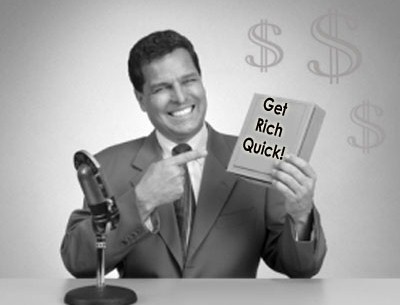
If I had a nickel for every book on how to get rich . . . I would get rich quick! I have spoken with countless entrepreneurs who wish they could find a sure-fire way to get rich quick – though none of them have ever succeeded. The notion of getting rich quick has been around for my entire adult life. Thankfully, I never paid much attention to it because I believe that it is unlikely to happen. When I was in high school, some of my classmates were all abuzz about a series of poker games in which they were participating. This was in the late 1960s and early 1970s and conversations went something like this, “Wow! Jack (names have been changed to protect the not-so innocent) won $340 and Sam lost $460!” Oh, and by the way, the guy who won $340 lost it all and more a couple of weeks later.

For some reason interest in getting rich quick seems to be snowballing. Take cryptocurrency for example. I recently heard an entrepreneur talking about “investing” in one of the major cryptocurrencies which has seen extraordinary highs (and periodically falls off the cliff) in the past few months. I shake my head because this is pure speculation, not investing. Generally, speculators are looking for a quick score. Lottery ticket sales are skyrocketing especially as the jackpots reach stratospheric levels. The online gambling industry grew from $37.5 billion in 2015 to a projected $121.29 billion in 2025 according to Grandview Research. 

Yes, there are anomalies – an entrepreneur here and there who invents something or develops a software application – and nearly overnight, this individual is filthy rich. But remember, for every example (the media only reports about these anomalies) of a get rich quick success, there are millions upon millions of us who do not get rich quick. The sensationalized nature of these stories becomes a siren song to entrepreneurs who have been laboring for a long time trying to get ahead. I am here to tell you . . . do not be swayed by the song you may be hearing. Often, those who try and play the get-rich-quick game end up in a worse position financially and have even developed unhealthy addictions that can ruin lives.

I know that the advice I am about to give is going to sound old-fashioned but trust me when I tell you that it is as sound today as it was in 1975 when I launched my career. There is no free lunch. You can dream about becoming rich all you want, but it will not make you rich. Skip the schemes and concentrate on your passion. You will have to make sacrifices along the way. Some may involve time while others may be financial. When we are younger, we tend to be very impatient. We want to take a helicopter to the mountain top rather than trudging through the thin air, slipping and sliding with every step. I have said it many times before, but when I chased the almighty dollar, it was always just beyond my outstretched fingertips. And it was frustrating beyond belief. After I began concentrating on living my passion for reasons other than making money, I began making real money. By then a couple of decades had passed in a flash and I was working a lot smarter and effectively. There were still setbacks along the way, but I rolled with the punches and persevered.

There is no silver bullet or magic wand. It is still all about hard work (and eventually “smart” work), resilience, maintaining a positive attitude, and keeping the passion front and center. You probably will not get rich quick. But you will have a fulfilling life and may eventually accumulate the wealth you seek.

This blog is being written in tandem with my book, “An Entrepreneur’s Words to Live By,” available on Amazon.com in paperback and Kindle (My Book), as well as being available in all of the other major eBook formats.
The Entrepreneur’s Three-Legged Stool

We entrepreneurs have no shortage of books and other resource materials at our disposal to understand how to win in today’s environment. We are barraged with a multitude of tips, tactics, strategies, and a host of other concepts. Everyone has an opinion, and everyone insists theirs is the right way. Ask any coach or consultant and undoubtedly each will have their own secret sauce. I have no issue with any of this and believe that this diversity of ideas is healthy for entrepreneurship as a whole. Fortunately, no one individual has it all figured out . . . so we continue to seek. As one of the “seekers” I might as well add my thoughts to the mix.

My approach involves a three-legged stool, and it is a very simple calculus. The first leg is that of Culture. For most of my career I was not very focused on Culture, and we certainly didn’t do much to promote it. Our Culture just kind of happened in a laissez-faire manner. Oh sure, we had a company picnic every now and then as well as a Christmas party; and from time-to-time we would undertake a community service project. But for the most part it was nose-to-the-grindstone – chew ‘em up and spit ‘em out. However, I have learned a lot over the past few years, and I am now drinking the Culture Kool-Aid – lots of it. Why? Because I have found that Core Values matter. Not just to the company but to each member of our team. And we really live our Core Values every single day. As a result, we now have a team of people who have a common alignment and purpose. We can connect with Millennials and Boomers alike and productivity has markedly increased. While Culture is more than just Core Values, they serve as the foundation for a Culture.

The second leg of the stool is Product. With the strengthening of our Culture, we have become more creative and innovative with respect to the products and services we provide. The positive environment that has emerged in our companies has enabled us to shine a spotlight on our Product set. We are constantly making tweaks every chance we get to differentiate from our competition that which we offer. “How is it different?” has become our mantra. We have become much more targeted with our marketing and sales effort in a manner that complements our Product refinement. A clear focus on Product has been the impetus for a much more strategic approach to decisions that we make as opposed to the small-ball tactics that we used to deploy.

Finally, the third leg of the stool is Customer. Many companies pay lip service to their customers. Everyone recognizes that without customers we do not stay in business very long. But to succeed entrepreneurs must go far beyond basic customer service. We must do the deep dive into understanding what makes the Customer tick. It is more than just needs and wants . . . it is also a more comprehensive understanding of buying patterns and lifestyles. It is about anticipating what the Customer will value. Thus, the value proposition becomes the Holy Grail. How does the customer experience attain complete and total fulfillment?

Maybe I have oversimplified this, but everything else seems incidental beyond Culture, Product and Customer. Without a strong Culture how can we possibly create a great Product and take care of the Customer? Without a great Product, our Culture begins to crack as team members become demoralized, and the Customer eventually suffers. And yes, without the Customer, there is no point in a Culture or a Product. 

Culture, Product and Customer. A three-legged stool that looks simple but is strong enough to support a long winning streak for us as entrepreneurs.

This blog is being written in tandem with my book, “An Entrepreneur’s Words to Live By,” available on Amazon.com in paperback and Kindle (My Book), as well as being available in all of the other major eBook formats.

The Warm Blanket Entrepreneur

Several years ago, I was waiting for a flight, and a lady came to the ticket counter from an adjoining gate and asked the attendant if an announcement could be made about the status of the flight from that gate. Apparently, it was past the departure time; the monitor revealed nothing, and there was no airline person at the gate. A few minutes later an announcement about the delay was made, but not after several moments of irritation on the part of the passengers waiting for that flight.

Why is it that so many companies communicate so poorly with their customers – especially when things are not going quite right? Common sense tells us that communications should be amplified in such instances. And yet it seems that there is a bit of a “run and hide” mentality when the train runs off the tracks. Airlines may be the worst where this is concerned – we all have more airline stories than we can remember. But this malady is shared across the business spectrum. While visiting a resort community in California, I walked past a grocery store that had a sign on the door at midday saying, “Closed – Computers Down.” Customers were trying to open the locked door and shook their heads after reading the sign. What a missed opportunity!

There are a couple of reasons why this happens, neither of which are good. The first is a cultural issue. If a company adopts the philosophy that the customer comes first, then its response to anything going awry impacting the customer will be immediate, complete, and ongoing communications. Anything less is contrary to a customer-first culture. We entrepreneurs must decide if we are going to embrace such a culture and if so, determine the steps that we are going to take to ensure that come hell or high water the customer will always be wrapped in a warm blanket. Which brings us to the second reason why many companies fail at communicating effectively when things go wrong.

A company may have every intention of effectively communicating with its customers through thick and thin. But unless there is a clearly defined strategy that translates into actionable steps for every member of the team, there is no way that successful implementation can happen. Take the airlines for instance. I have trouble believing that they do not have great customer service as an intention. However, there is no other explanation than there is a disconnect between their strategy and putting it into practice.

In our respective organizations, we can make certain that our strategy and implementation are seamless through simulation. This involves identifying every possible mishap that could occur, causing issues for our customers. Next, we can create a step-by-step process for dealing with these problems while maintaining a constant focus on how we smooth the way for our customers. It will require a combination of urgency, honesty, straightforwardness, empathy, clarity, and frequency. In other words, we are going to quickly tell our customers what has happened in clear and concise terms. We are not going to lie – if the airplane is broken, we will tell them that the airplane is broken and not make up some other excuse. We will apologize for any inconvenience and take the necessary steps to make things as painless for the customer as possible – even if it costs us some money. And we will continue to communicate early and often until the situation is resolved. Every member of our team will know exactly how they are supposed to make this happen and we will practice, practice, and practice some more.

If we truly care about our customers, our bottom line will be the best for it. Thus, we should do everything in our power to make sure that the customer has a positive experience even when we have trouble delivering our products or services.

This blog is being written in tandem with my book, “An Entrepreneur’s Words to Live By,” available on Amazon.com in paperback and Kindle (My Book), as well as being available in all of the other major eBook formats.

The Inspirational Entrepreneur

“. . . we shall fight in France, we shall fight on the seas and oceans, we shall fight with growing confidence and growing strength in the air, we shall defend our island, whatever the cost may be, we shall fight on the beaches, we shall fight on the landing grounds, we shall fight in the fields and in the streets, we shall fight in the hills; we shall never surrender.” “Let us therefore brace ourselves to our duties, and so bear ourselves, that if the British Empire and its Commonwealth last for a thousand years, men will still say, ‘This was their finest hour’.” Winston Churchill uttered these words during World War II and led Great Britain through one of its darkest periods in history.

“. . . I still have a dream. It is a dream deeply rooted in the American dream. I have a dream that one day this nation will rise up, live out the true meaning of its creed: We hold these truths to be self-evident, that all men are created equal.” On August 28, 1963, Dr. Martin Luther King made this proclamation at the Lincoln Memorial in Washington, DC, witnessed by 250,000 civil rights supporters.   

Have you ever heard of Patrick Henry Hughes? He is an amazing story. Born without eyes and a congenital birth defect that prevented him from straightening his arms and legs, Patrick became an accomplished vocalist as well as playing the piano and trumpet. He even became a member of the University of Louisville Marching and Pep Bands, and a UP Premiere movie, “I Am Potential,” is based upon his life and success.

What is the common theme for these three individuals? Inarguably each is an inspiration. Churchill inspired his countrymen to stand strong during the difficult days when Britain was under siege. King inspired millions seeking equality in their everyday lives. Patrick Henry Hughes as served as an inspiration for everyone who has encountered a challenge – and haven’t we all?

As entrepreneurs we want to be inspirational leaders. We want to lead inspirational organizations. We want our mission and vision to be inspirational. But sometimes the notion of inspiration can be confusing and even elusive. Exactly how do we inspire? I have looked high and low and there is no handbook. There are as many definitions as there are inspirational quotes – the quantities are massive. Here is an equation that I have developed over the years that I believe stimulates inspiration.

Passion + Authenticity + Conviction = Inspiration

This formula can be measured by the likes of Winston Churchill, Martin Luther King, Jr. and Patrick Henry Hughes. Is there any question that each had incredible passion for their cause? And is there any doubt as to their authenticity? Think about it. How could anyone play-act the power and impact that each had on society? Finally, they never wavered. They never quit. They stood by their beliefs no matter what. When we genuinely have a deep and lasting positive passion; demonstrate it in authentic ways, and are steadfast in maintaining this passion, we cannot help but inspire others. People are not inspired by wishy-washy. People are not inspired by fake. And people are not inspired by quitters.

Inspirational intelligence exists in great leaders. By emulating the inspirational formula, Passion + Authenticity + Conviction, we too can motivate others to join with us in doing great things.

This blog is being written in tandem with my book, “An Entrepreneur’s Words to Live By,” available on Amazon.com in paperback and Kindle (My Book), as well as being available in all of the other major eBook formats.